✧ Key Takeaways
- Tint that rejects solar heat may help the air con use less battery.
- We have not seen a measured Proton eMAS 5 test showing how much battery or range tint saves.
- A film's total solar energy rejection (TSER) shows how much heat it blocks, not how dark it looks, and TSER figures only compare fairly when tested on the same type of glass.
- For Malaysian private cars, the finished windscreen must let through at least 70% of visible light and the front side windows at least 50%, unless an approved exemption applies.
- Parking in shade and a sensible temperature setting can mean less work for the air con, and cooling the car while it is still charging may take some of the cooling energy from the charger instead of the battery.
Yes, window tint may help a Proton eMAS 5 use less battery. Window film that blocks the sun's heat gives the air con less work to do, and the cabin won't feel as hot in bright sun. We have not seen a measured test on this model showing how much battery tint saves or how many extra kilometres you would get.
The eMAS 5 Prime has a 30.12 kWh battery with an advertised WLTP range of 225 km. The Premium has a 40.16 kWh battery and a 325 km WLTP range. WLTP is a standard range test, not a prediction for every journey. Air con uses battery energy too, and how much it uses depends on the weather, cabin temperature, trip and your settings.
Why a hot cabin uses battery energy
After a car has been parked in the sun, its seats, dashboard and other interior surfaces hold heat. Air con has to cool those surfaces as well as the air, so bringing a hot cabin down to a comfortable temperature can use more energy than keeping it comfortable later.
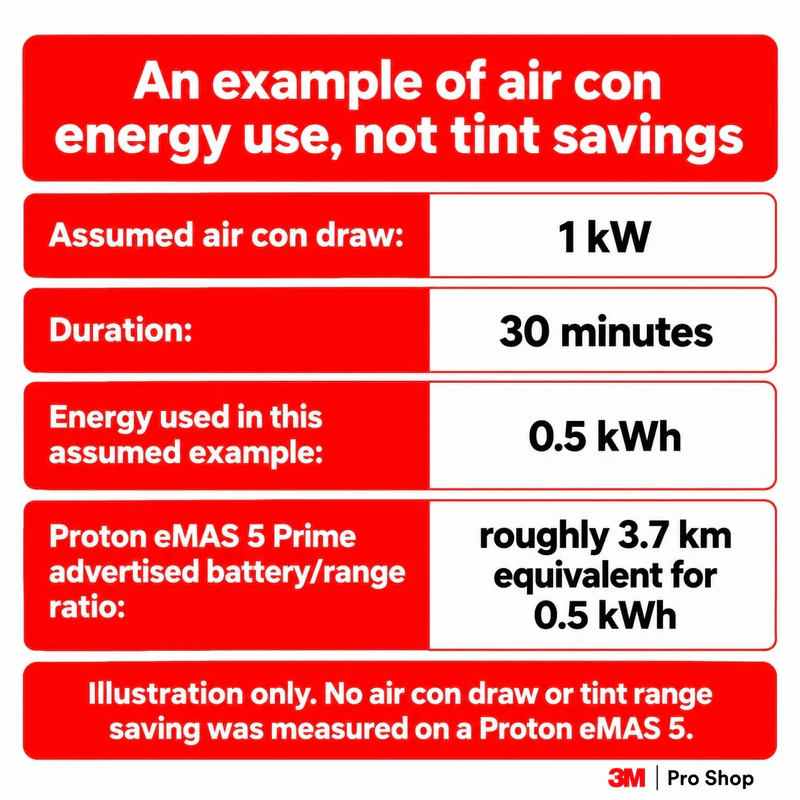
As a rough example, if the air con averaged 1 kW for 30 minutes, it would use 0.5 kWh. That 1 kW figure is our assumption, not a measurement on a Proton eMAS 5.
For the Prime, the advertised battery size divided by its WLTP range works out to about 134 Wh per kilometre, so 0.5 kWh is roughly the energy it needs to drive 3.7 km. For the Premium, the same calculation gives about 124 Wh per kilometre, or roughly 4 km.
These are rough figures from advertised specs, and they show what the air con uses, not what tint saves. In practice, the hotter the cabin is when you get in, the longer the air con has to work hard, so keeping heat out while the car is parked is where shade and tint can help.
Heat rejection (TSER) matters more than how dark the tint looks
A film's total solar energy rejection (TSER) figure tells you how much heat it blocks. How dark the film looks does not tell you that. Film that rejects more solar heat leaves the air con less heat to remove. A darker film can still reject less heat than a lighter one.
TSER is the percentage of the sun's energy that the glass and film reject together in a test. Clear glass and automotive green glass can give different results with the same film, so figures are only comparable when measured on the same type of glass under the same test conditions.
VLT stands for visible light transmission, which is how much visible light passes through the glass and film. Lower VLT means darker windows. If you see infrared (IR) rejection quoted instead, that covers only part of the sun's energy, so TSER gives a fuller picture of how much heat a film rejects.
A TSER figure is not the percentage by which your cabin gets cooler or your battery use falls. A tinted car can still feel hot after hours in the sun, because heat also comes in through the body and other surfaces. When you compare films, though, a higher TSER on the same test glass means the film keeps out more of the sun's energy.
JPJ tint limits: 70% on the windscreen, 50% on the front side windows
For Malaysian private cars without an approved exemption, JPJ requires at least 70% VLT on the windscreen and 50% on the front side windows. Rear glass has no minimum VLT under the JPJ private car tint rules, as long as the car has both side mirrors.
Your car's glass already blocks some light, so the reading on a finished window comes from the glass and film together. A film name such as CR BLK 70 doesn't tell you what that reading will be. You can ask the installer to measure your glass before choosing a film, and again after fitting, to confirm each window meets the limit.
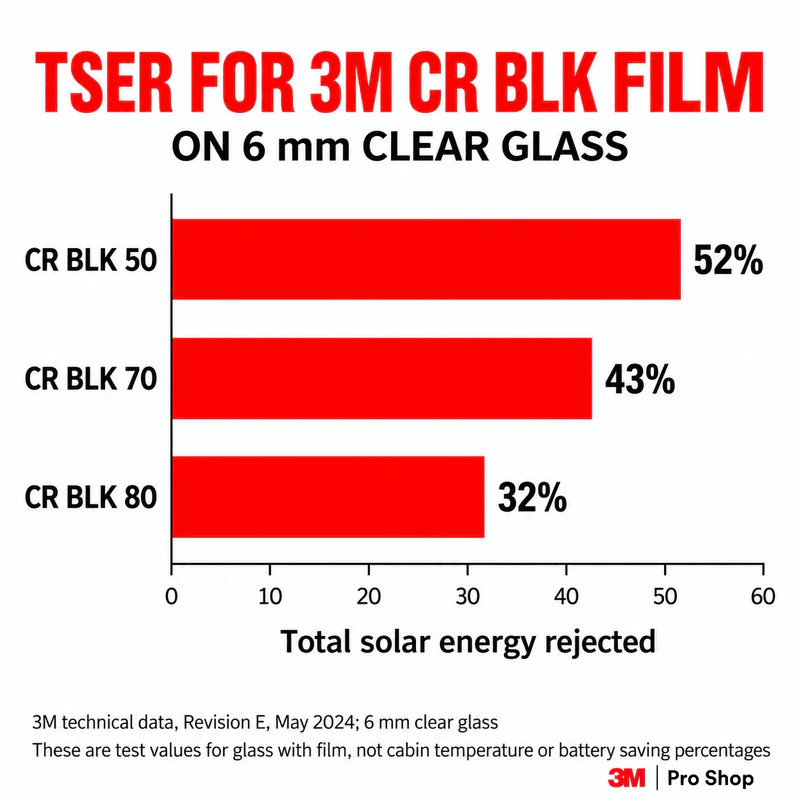
3M's technical data sheet for 3M Crystalline Black (CR BLK), Revision E, May 2024, gives these values on 6 mm clear glass:
| Film | Visible light transmitted (VLT) | Total solar energy rejected (TSER) | Where it may suit |
| CR BLK 80 | 88% | 32% | Windscreen (lighter option) |
| CR BLK 70 | 78% | 43% | Windscreen |
| CR BLK 50 | 59% | 52% | Front side windows |
| CR BLK 35 | 40% | 57% | Rear glass |
| CR BLK 30 | 35% | 59% | Rear glass |
These figures come from that test glass, not from a Proton eMAS 5. You can ask the installer for the latest spec sheet of the exact film going on your car. If you are weighing up 3M Crystalline against other tint brands, it helps to check that both sets of figures were measured on the same type of glass.
3M's data sheet also lists 99.9% ultraviolet (UV) rejection for CR BLK 30, 35 and 50, and 99.8% for CR BLK 70 and 80 on this glass. Crystalline contains no metal and is designed not to interfere with mobile or GPS signals.
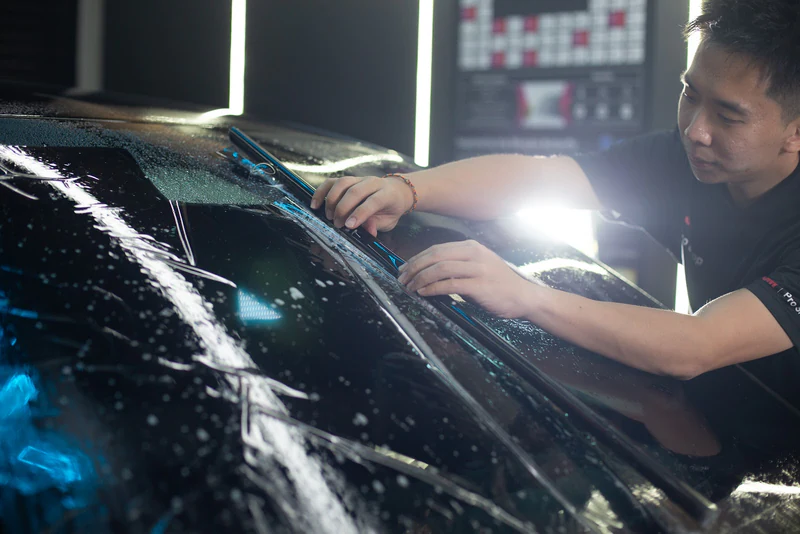
Parking in shade, recirculating air and cooling while charging may also save battery
Parking in shade, when you can find it, cuts the direct sun on the car, although the cabin can still get hot. If it is safe, opening the windows briefly before you set off lets the hottest air out, and a comfortable temperature setting avoids cooling the cabin more than you need.
The eMAS 5 owner's manual states that internal air circulation, which recirculates the cabin air, is more energy efficient when the air con is on. If the windows start to mist up, the manual's demisting instructions come first, even if that means switching back to fresh air, because clear glass matters more than saving a little energy.
If the car is still plugged in and charging, cooling it before you leave may take some of the cooling energy from the charger instead of the battery. How much depends on the charging settings, available power and how the car manages them, so being plugged in does not guarantee that all the cooling energy comes from the charger.
If you leave at the same time most days, you can look at the Scheduled Trip menu in the eMAS 5's Energy Centre, which has Cabin Comfort and Battery Temperature Maintenance settings. You can ask your dealer whether these can prepare the cabin while the car is still charging, and which remote controls your app offers.
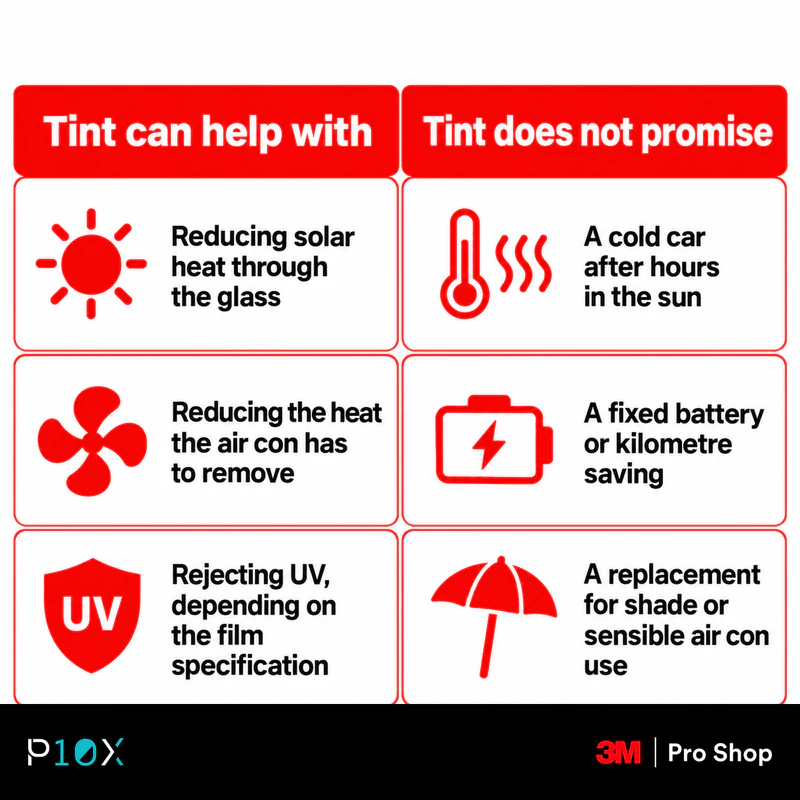
Should you choose tint for battery savings?
Not as the main reason. Tint is worth choosing because it cuts heat and glare through the glass and makes the cabin easier to cool. Any battery saving is a bonus rather than something to count on, since no measurement supports a promised number of extra kilometres.
At 3M Pro Shop by P10X, a 3M Authorized Dealer, our installers can show you the latest 3M spec sheet for each film, so you can compare figures measured on the same test glass. They can also check that each finished window meets the JPJ VLT limit. You can find the nearest outlet on our locations page.
Find out the best protection for your car
Visit a 3M Pro Shop and discover the cost-effective 3M Protective Film and Window Tint
Frequently asked questions
Can window tint improve EV range?
It may. Tint reduces heat coming through the windows, so the air con has less heat to remove, whether you drive a Proton eMAS 5 or the bigger Proton eMAS 7. Any range benefit depends on the film, glass, weather and how you use the car, and we have not seen a measured Proton eMAS 5 result showing a fixed gain.
How much range does the air con use?
We have not seen a measured figure for the Proton eMAS 5. As a rough example, 30 minutes of air con at an assumed 1 kW uses 0.5 kWh. Based on advertised battery sizes and WLTP ranges, that is about 3.7 km of range on the eMAS 5 Prime and about 4 km on the Premium. Tint may reduce that, depending on the film and how hot the cabin gets.
Does darker tint reject more heat?
Not always. Darkness, or VLT, only tells you how much visible light passes through. Total solar energy rejection (TSER) is the percentage of the sun's energy the glass and film reject together in a test, so it tells you more about heat. Film construction and the glass both affect it, and TSER figures are only a fair comparison when measured on the same glass under the same conditions.
What tint percentage is legal on the windscreen and front windows?
Unless an approved exemption applies, the windscreen needs at least 70% VLT and the front side windows at least 50%, measured with the film fitted. CR BLK 70 or 80 may suit the windscreen and CR BLK 50 the front side windows, but only the finished reading confirms compliance, not the product name.
Will tint affect cameras or wireless signals?
CR BLK contains no metal and is designed not to interfere with mobile or GPS signals. Cameras and sensors on the windscreen need a separate installation check. You can tell the installer what equipment your car has, so the film is fitted following the vehicle manufacturer's instructions, including keeping the specified viewing areas clear.
Is tint still useful if I usually park indoors?
Yes. Depending on the film, tint can still reduce solar heat and UV exposure while you drive. Parking out of direct sun leaves less heat for the air con to remove at the start of a trip. A cooler cabin while you drive and protection from UV are better reasons to choose tint than a battery saving that hasn't been measured.