✧ Key Takeaways
- VLT alone does not determine night driving quality. Film technology (ceramic, multi-layer, or dyed) affects how much clarity you keep after dark at any given VLT level.
- JPJ requires minimum 70% VLT on front windscreens and 50% VLT on front side windows. Using a high-TSER film within these limits gives the best balance of heat rejection and night visibility.
- At the same VLT, premium construction alone does not prove better night vision. Check haze, reflections and glass condition.
- The smartest tint setup varies VLT by window position: higher VLT on forward-facing glass for safety and compliance, darker on rear windows for privacy and comfort.
- TSER and IRR describe solar performance, not night-vision quality. Check fitted VLT and optical condition separately.
Window tint night driving in Malaysia is one of those decisions where most advice online misses the real point. The challenge is not just picking a dark shade for privacy. It is finding a film that keeps your cabin cool during the day without turning your windscreen into a wall of blur after sunset. If you drive regularly in KL or commute on Malaysian highways after dark, you already know that oncoming LED headlights, unlit motorcycles, and sudden rain make visibility a serious concern.
This guide walks through VLT ratings, glare behavior, JPJ limits, and film technology so you can make a tint decision that works for both halves of your driving day.
Why Night Visibility Changes When You Add Window Tint
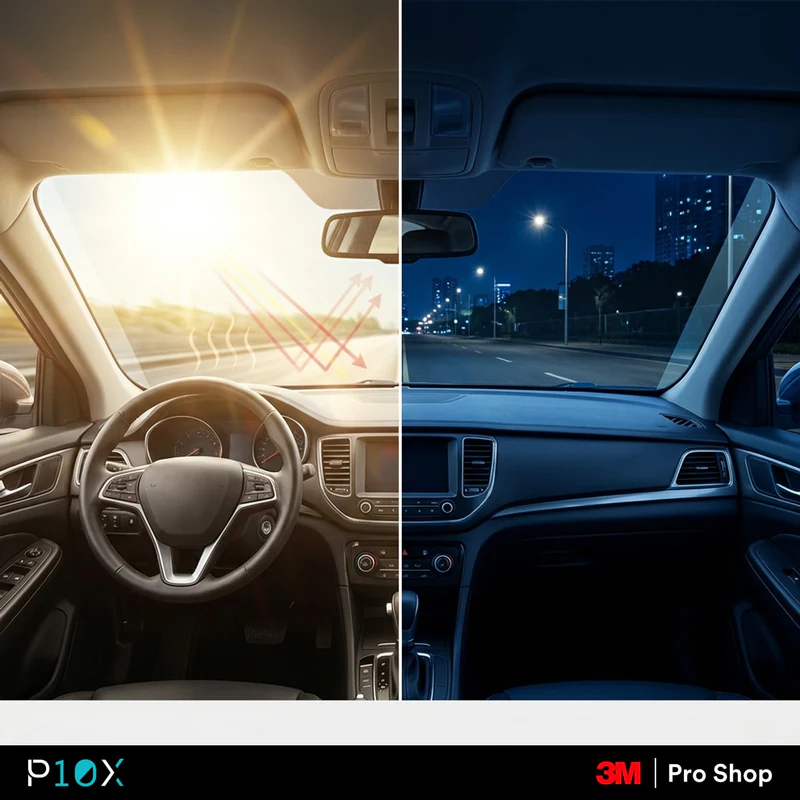
Tint works by reducing the amount of light that passes through your glass. During the day, that is exactly what you want. Less light means less heat, less glare from direct sun, and more comfort inside the cabin.
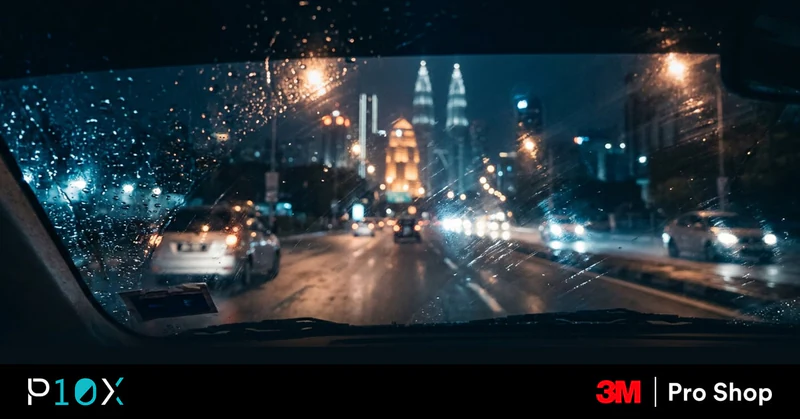
At night, the equation flips. There is already very little ambient light on the road. If your film absorbs or reflects too much of that remaining light, you lose the ability to see pedestrians, road markings, potholes, and unlit motorcycles. This is a real safety concern in Malaysia, where many secondary roads have minimal street lighting and motorcyclists sometimes ride without reflectors.
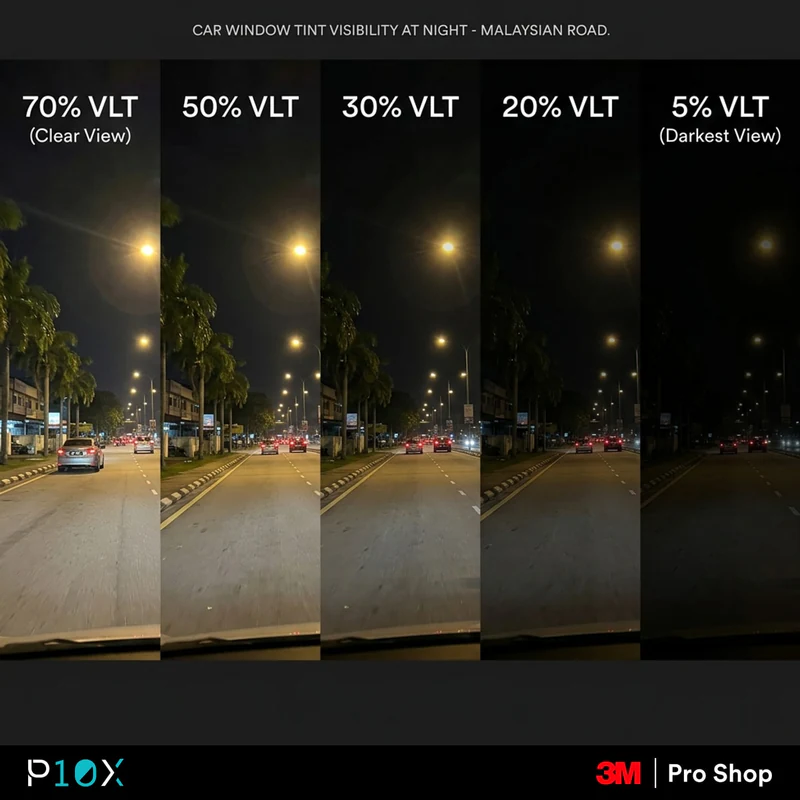
The key variable here is VLT (Visible Light Transmittance). It measures the percentage of visible light that passes through the glass and film together. A higher VLT means more light gets through. A lower VLT means a darker appearance and less visibility at night.
What VLT Numbers Actually Mean After Dark
VLT is usually the first number car owners look at when choosing tint. But most people only think of it as "how dark does it look." For night driving, the question is different: how much usable light does the film let in once the sun goes down?
Here is a practical breakdown:
- VLT 70% is very close to clear glass. Barely noticeable during the day. It still transmits only 70% of incident visible light, so do not promise no visibility loss. This is the JPJ-mandated minimum for front windscreens in Malaysia.
- VLT 50% is a light shade. You still get decent night visibility on well-lit KL roads, but you may notice some dimness on unlit rural stretches.
- VLT 30% is a noticeable tint. Comfortable during the day. At night, you will see reduced visibility, especially when checking side mirrors or reversing in dark car parks.
- VLT 20% is popular for side and rear windows. Gives strong privacy. Night driving requires more attention, and some drivers find it difficult in heavy rain after dark.
- VLT 5% is near-blackout. Only suitable for rear windows. Looking through this panel at night is like looking through a dark wall.
One detail that most guides overlook: factory glass VLT is not consistent across all cars. European-spec vehicles may have different factory glass tint levels than Asian-spec versions of the same model. Even two identical cars from the same production run can show slight VLT variance. This means a "70% VLT film" installed on two different cars will produce slightly different combined VLT readings. If you are optimising for night visibility at a specific VLT, ask your installer to measure your factory glass before selecting a shade.
The mistake many drivers make is choosing the same VLT for every window. A smarter approach is to use higher VLT on the front windscreen and front side windows for safety, and darker VLT on the rear and back windows for privacy and UV protection.
JPJ Tint Limits and How They Affect Your Night Driving Options
In Malaysia, JPJ (Jabatan Pengangkutan Jalan) sets legal limits on how dark your tint can be:
- Front windscreen: Minimum 70% VLT
- Front side windows: Minimum 50% VLT
- Rear side windows and rear windscreen: No restriction
These rules exist for safety. A front windscreen below 70% VLT becomes a real risk at night, especially during heavy rain or when driving through poorly lit areas. If you are caught with non-compliant tint during a roadblock, you face a fine and the hassle of removing or replacing the film.
For drivers who want maximum heat rejection on the front while staying legal, the answer is not a darker shade. It is better film technology. Premium ceramic and multi-layer films can reject far more heat at the same VLT than a basic dyed film. That means you can have a 70% VLT front windscreen that blocks a large percentage of infrared heat without any difference in how dark it looks.
If you want a deeper breakdown of how these limits work in practice and how to stay compliant during JPJ checks, the full guide on JPJ compliant window tint covers the specifics.
Worth noting: achieving exactly 70% combined VLT on the windscreen is extremely difficult in practice. Factory windscreen glass typically sits at 75% to 80% VLT. Adding even the lightest available film brings the combined reading close to or below 70%. This is a known industry-wide challenge, not a reflection of any specific film brand. For night driving, the takeaway is practical: choose the lightest windscreen film available (CR BLK 80 or equivalent) to maximise both legal safety margin and after-dark visibility.
Glare at Night: What Your Tint Can and Cannot Fix
Daytime glare and nighttime glare are two different problems. During the day, tint reduces glare by cutting the total light entering the cabin. Straightforward.
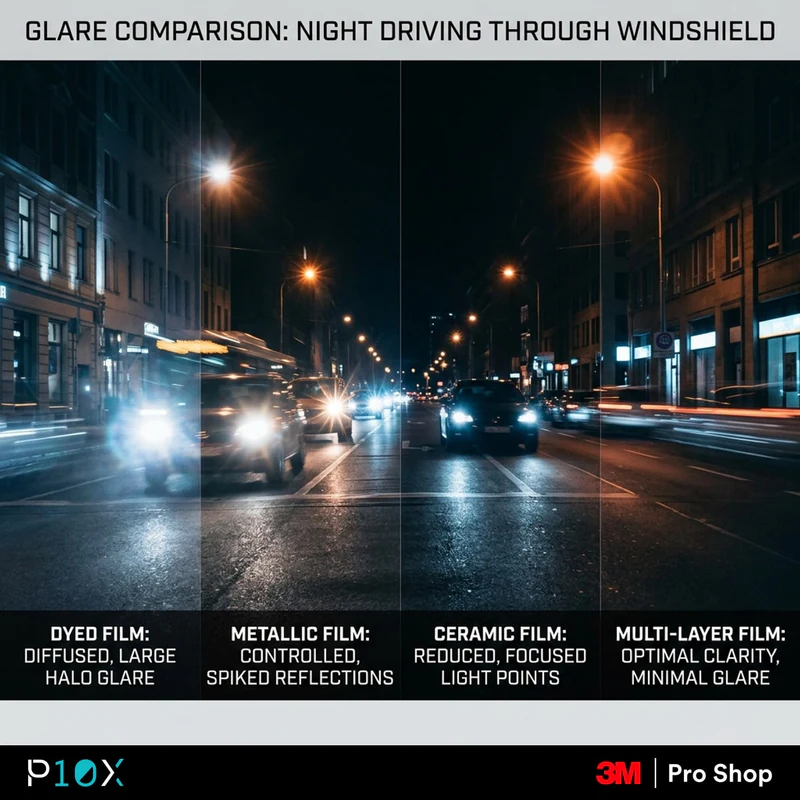
At night, glare comes from oncoming headlights, especially the LED and HID headlights that have become common on newer Malaysian cars. This glare is a localized burst of bright light against a dark background. Tint can reduce the intensity of that burst, but there is a tradeoff: it also dims everything else you need to see.
A high-quality film handles this better than a cheap one. Here is why.
Low-cost dyed films absorb light uniformly. They make everything darker, including the things you need to see. Over time, dyed films degrade and develop a purple or brown haze that further reduces clarity.
Higher infrared rejection does not prove better night vision at the same VLT. VLT describes visible-light transmission; haze, reflection, glass condition and the driver’s vision also matter. Compare optical properties, not TSER or IRR as a night-clarity score.
If you experience glare issues at night, also check your windscreen glass itself. Micro-scratches, old wiper marks, and internal haze can amplify glare regardless of your tint choice.
Film Technology That Matters for Night Clarity
Not all films at the same VLT perform equally at night. The difference comes down to how the film is made.
Dyed films use dye to reduce visible light. Inspect actual condition rather than assuming every low-cost film fails after two or three years.
Metallic films use thin metal layers to reflect heat. They perform well for heat rejection but can interfere with GPS, phone signals, and toll tag readers (Touch 'n Go RFID). At night, some metallic films create a slight mirror effect on the inside of your windows, reflecting dashboard lights back at you.
Ceramic films use ceramic technology for solar performance. That alone does not prove better night clarity at the same VLT or universal electronic-system compatibility.
Crystalline Black uses non-metallised multilayer optical and ceramic nano-technology, not metal sputtering. CR BLK TSER is 59–68% by shade: 15—64%, 30—66%, 35—67%, 40—67%, 50—68%, 60—67%, 70—65% and 80—59%. IRER is 59–68% on glass over 780–2,500 nm; IRR is 95–98% on film alone over 900–1,000 nm. Its infrared figures are solar-performance measurements, not night-vision ratings.
When comparing films, do not just look at VLT. Ask for the TSER (Total Solar Energy Rejected) and IRR (Infrared Rejection Rate) numbers. A film with 70% VLT and 60% TSER will keep your car cooler than a film with 70% VLT and 35% TSER, with no difference in how dark it looks. That is the advantage of better technology: you do not have to sacrifice night visibility to get heat protection.
For a data-driven side-by-side look at how different tint technologies stack up, the 3M crystalline tint comparison breaks it down with real performance numbers.
Choosing the Right Tint Setup for KL Day and Night Driving
KL drivers deal with a specific combination: intense tropical heat during the day and frequent night driving through a mix of well-lit highways, dim secondary roads, and pitch-dark parking structures.
Here is a practical approach to balancing both:
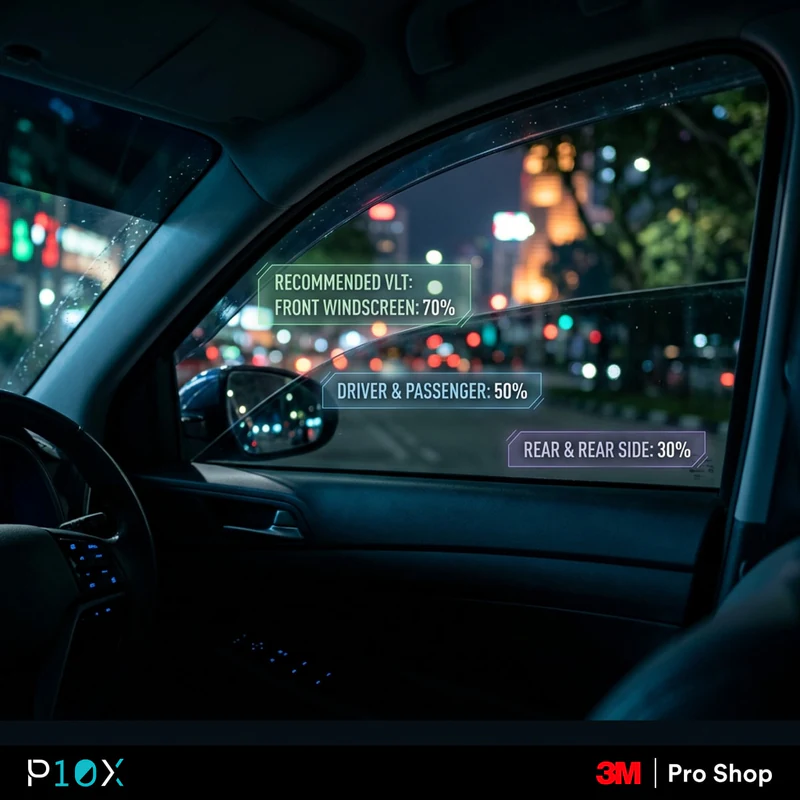
Front windscreen: Stay at 70% VLT to meet JPJ requirements. Choose a ceramic or multi-layer film with the highest TSER available at that VLT. This gives you maximum legal heat rejection with minimal night visibility impact.
Front side windows: Go with 50% VLT, again using a high-performance film. This keeps you JPJ-compliant while providing a slight privacy boost and solid heat rejection. At night, 50% VLT on the sides is manageable for mirror checks and lane changes on most KL roads.
Rear side windows: This is where you can go darker for privacy and rear passenger comfort. 20% or 30% VLT works well for most drivers.
Rear windscreen: Preserve rearward visibility in rain and darkness. A reverse camera is an aid, not justification for near-black glass or a substitute for mirrors and direct observation.
Drivers who frequently travel between KL and rural areas at night should lean toward higher VLT on all forward-facing glass and invest in the best film technology their budget allows. The 3M window tint price breakdown helps you understand what each tier of technology costs and what you get in return.
Common Mistakes That Hurt Night Driving
A few errors come up repeatedly:
- Going too dark on the front. Some drivers install 30% or 20% VLT on the front windscreen for looks, then struggle to see at night. This also puts you at risk of a JPJ fine.
- Choosing the cheapest film available. Budget dyed films lose clarity over time. After 12 to 18 months, night visibility through degraded film is noticeably worse than through fresh glass. When car tint bubbles or discolouration appear, optical distortions get even worse at night.
- Ignoring TSER and IRR numbers. Two films can both be 50% VLT, but one might reject 60% of total solar energy while the other rejects only 30%. The difference is technology, not darkness.
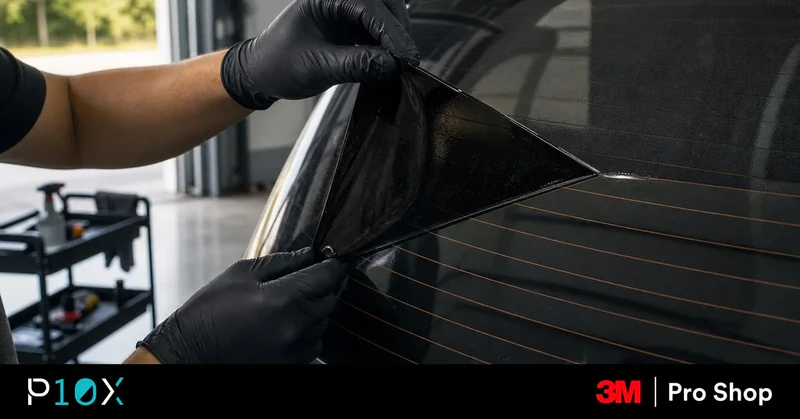
- Skipping proper installation. Bubbles, dust specks, and poor edge sealing create optical distortions that get worse at night when your eyes are more sensitive to imperfections. A professional car window tint installation makes a real difference to long-term clarity.
How 3M Films Handle the Day-Night Balance
Crystalline Black is the current Malaysian Crystalline range, replacing the legacy series from December 2025. CR BLK TSER is 59–68% by shade: 15—64%, 30—66%, 35—67%, 40—67%, 50—68%, 60—67%, 70—65% and 80—59%. IRER is 59–68% on glass over 780–2,500 nm; IRR is 95–98% on film alone over 900–1,000 nm. UV rejection is 99.9%. A film code is not fitted-window VLT. Measure the existing and finished glass-and-film combination for each window and confirm the current applicable JPJ requirements.
Ceramic IR offers up to 63% TSER and 95% IRR. CR BLK’s documented signal compatibility covers mobile, GPS and satellite radio; do not extend that to toll readers or ADAS.
The right combination depends on your vehicle, your typical driving pattern, and your budget. A certified 3M Pro Shop can measure your existing glass and recommend a VLT and technology pairing that covers your needs for both day and night. You can find the nearest 3M Pro Shop location to get a professional assessment based on your specific driving habits.
If you are still early in your research about car window tinting in Malaysia, that overview covers the broader decision from start to finish.
Your Next Step
Check your current tint. If you do not know the VLT, TSER, or film type on your car, that is the first gap to close. Pull out your warranty card or ask the shop that installed it. If the numbers are missing or the film is more than a few years old and you have noticed worsening night visibility, it may be time to upgrade to a modern ceramic or multi-layer film that handles solar performance and visibility needs, acknowledging the trade-offs.
For a spec-based recommendation matched to your car and driving pattern, visit a certified 3M Pro Shop and bring your questions. Comparing the TSER and VLT numbers side by side with a trained installer is the fastest way to find the right balance for your situation.
Find out the best protection for your car
Visit a 3M Pro Shop and discover the cost-effective 3M Protective Film and Window Tint
FAQs
Does darker tint always mean worse night driving?
Lower VLT means less visible light reaches your eyes. At equal VLT, ceramic construction or IR rejection alone does not prove better visibility. Check actual haze, reflection and glass condition.
Can I get a tint that blocks heat but keeps my windows nearly clear?
Yes. Ceramic and non-metallised multilayer optical films can achieve high TSER and IRR at VLT levels like 50% or 70%. The window looks almost clear but still blocks a large percentage of infrared heat and UV rays. This is where better technology makes the biggest difference for night driving comfort.
Will window tint affect my toll tag, GPS, or ADAS sensors?
Non-metallised construction does not prove camera, radar, HUD or ADAS compatibility. Follow the vehicle maker’s restrictions and sensor viewing-zone requirements. A qualified technician should assess any warning or calibration concern. CR BLK’s documented signal compatibility covers mobile, GPS and satellite radio, not every toll reader.
How long does window tint last before it starts affecting night visibility?
No fixed lifespan or degradation deadline is established for a price category. Crystalline Black, Ceramic IR and XP each have a five-year E-Warranty through a 3M Authorized Dealer or 3M Pro Shop. Covered defects are bubbling and cracking; confirm the written terms. A warranty is not a no-degradation or night-clarity guarantee.
Is it worth upgrading just the front windscreen tint?
If your front windscreen uses an old or low-quality film, upgrading just that one panel to a high-TSER ceramic or multi-layer film can make a noticeable difference in both daytime comfort and night driving clarity. It is one of the highest-impact single changes you can make for daily driving safety and comfort.