
Protecting Your Perodua QV-E: PPF and Window Tint for Malaysia's First Homegrown EV
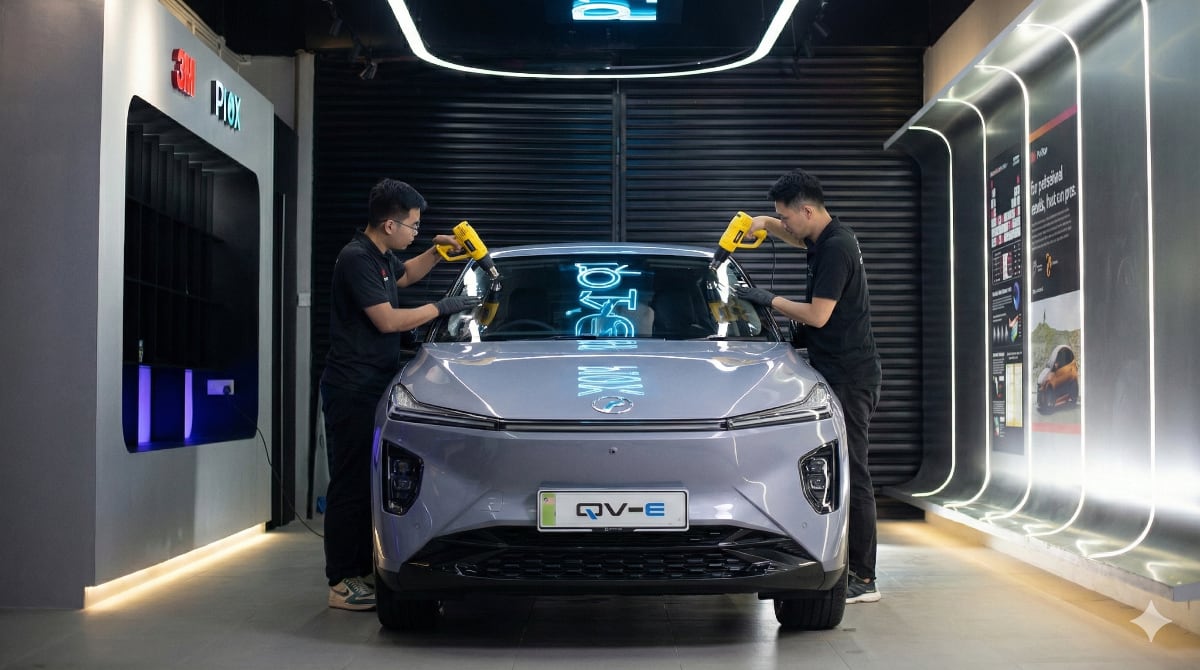
Perodua QV-E window tint is probably already on your mind if you just bought Malaysia's first homegrown EV. The Malaysian sun is brutal, your new electric car has a quoted 400 km range that you want to preserve, and sitting in a hot cabin is simply uncomfortable.
This guide focuses on what matters most to QV-E owners: keeping your cabin cool, protecting your range, and understanding what level of protection actually makes sense for an RM80,000 vehicle. We cover window tint in detail because that is where most buyers should start. We also address PPF (paint protection film) for those who want it, but with honest guidance on when it makes sense and when it does not.
By the end, you will know exactly what tint specifications to look for, how to avoid overpaying, and whether PPF belongs in your budget at all.
The Real Questions You Are Probably Asking Right Now
Will My EV Range Suffer in Malaysian Heat?
Yes, if you do not manage cabin temperature. The QV-E's quoted 400 to 410 km range assumes moderate air conditioning use. But when your car sits in open sun and the interior heats to 60 or 70 degrees Celsius, the AC has to work hard to cool it down. That energy comes directly from your battery.
Drivers who park outdoors daily and rely on maximum cooling can lose 10 to 15 percent of their effective range over time. Window tint that blocks solar heat reduces this problem at the source.
How Dark Can I Legally Go?
JPJ regulations set minimum Visible Light Transmission (VLT) levels:
- Front windshield: 70% VLT minimum
- Front side windows: 50% VLT minimum
- Rear windows: No restriction
The good news is that darkness and heat rejection are not the same thing. A film can be JPJ-legal on the front while still blocking significant heat. The key is choosing tint based on TSER (Total Solar Energy Rejected), not just how dark it looks.
Do I Need PPF for My QV-E?
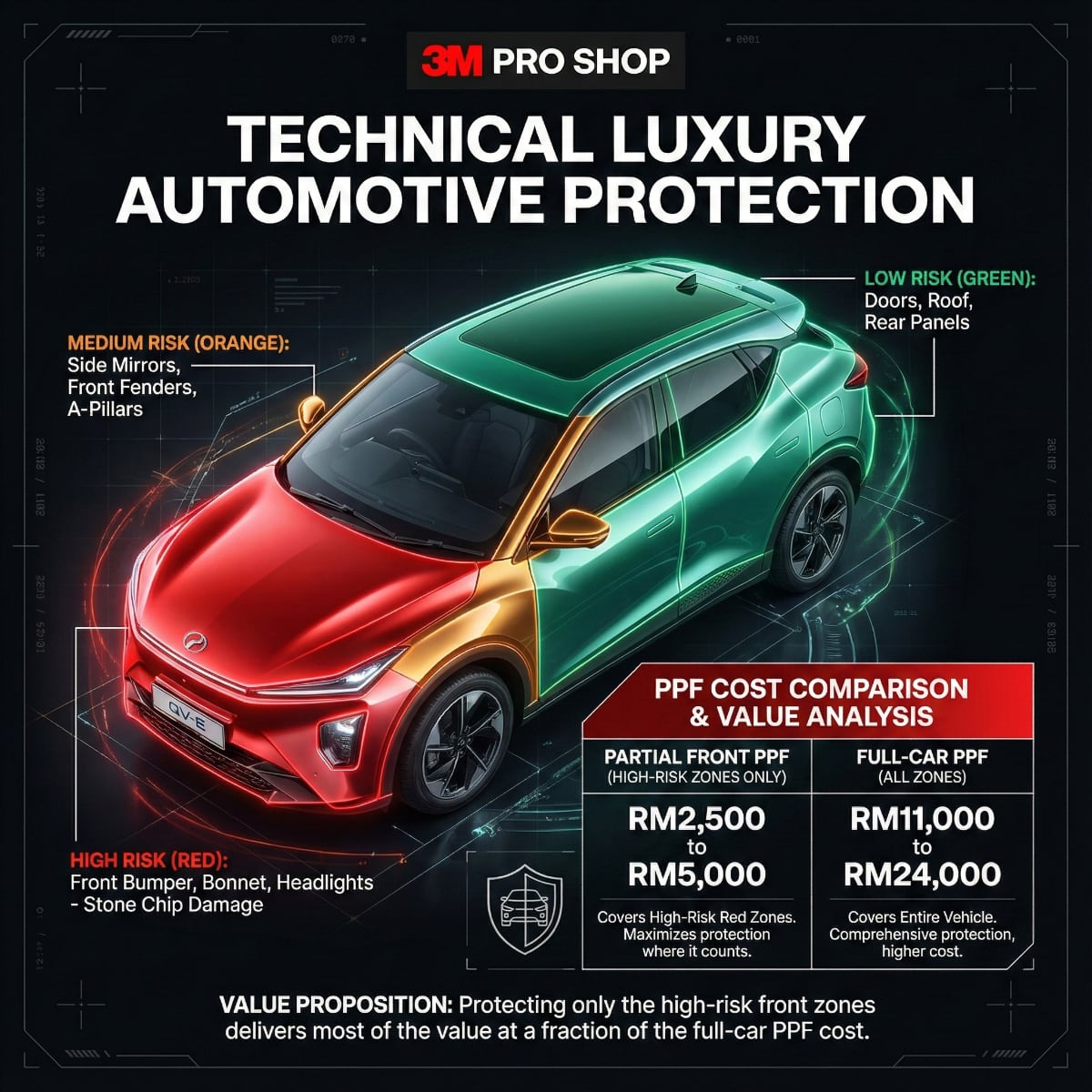
Maybe, but probably not as much as PPF shops will suggest. Full-car PPF costs RM11,000 to RM24,000. On an RM80,000 car, that is 14 to 30 percent of the vehicle's value.
Most stone chip damage happens on the bonnet, bumper, and headlights. If you commute on highways daily, protecting just those zones at RM2,500 to RM5,000 addresses the real risk. Urban drivers with minimal highway exposure may not need PPF at all.
Why Does Protection Cost So Much Compared to My Car?
The QV-E is priced for accessibility. You chose this car because it makes electric driving affordable without stretching your finances.
When you see full-car PPF quoted at RM15,000 to RM24,000, something feels off. That money could go toward a home charging setup, an extended warranty, or simply staying within budget. The uncomfortable truth is that full-car PPF rarely makes financial sense for an RM80k vehicle. Window tint, on the other hand, is almost always worth it.
Why Window Tint Matters More for EVs Than Petrol Cars
The Heat and Range Connection
In a petrol car, running the AC burns extra fuel, but the engine generates power regardless. In an EV like the QV-E, every watt spent cooling the cabin is a watt not spent moving the car.
Here is the math. If your AC draws 2 to 3 kW while running hard, and your QV-E has a 52.5 kWh battery, aggressive cooling can consume 4 to 6 percent of your battery per hour of driving. Over time, this adds up.
Window tint that blocks 60 to 65 percent of solar energy means your cabin starts cooler and stays cooler. Your AC runs at lower intensity. Your range improves.
This is why window tint delivers more value for EV owners than petrol car owners. It directly affects your daily driving experience.
Privacy and Security
The QV-E is a new model that attracts attention. Darker rear tint provides privacy for passengers and conceals valuables inside. In Malaysia's urban areas, this is a practical consideration.
Rear windows have no VLT restrictions under JPJ rules, so you can go as dark as you want. Many owners choose 15 to 20 percent VLT for rear windows, which provides strong privacy while still allowing some visibility from inside.
Glare Reduction and Eye Comfort
Malaysian sunlight is intense. Driving east in the morning or west in the evening means dealing with direct glare. Window tint reduces this strain on your eyes, making daily commutes more comfortable.
Quality films with high IRR (Infrared Rejection) specifically target the wavelengths that cause the burning sensation on your skin when sunlight hits you through glass. This is different from just blocking visible light.
Interior Protection
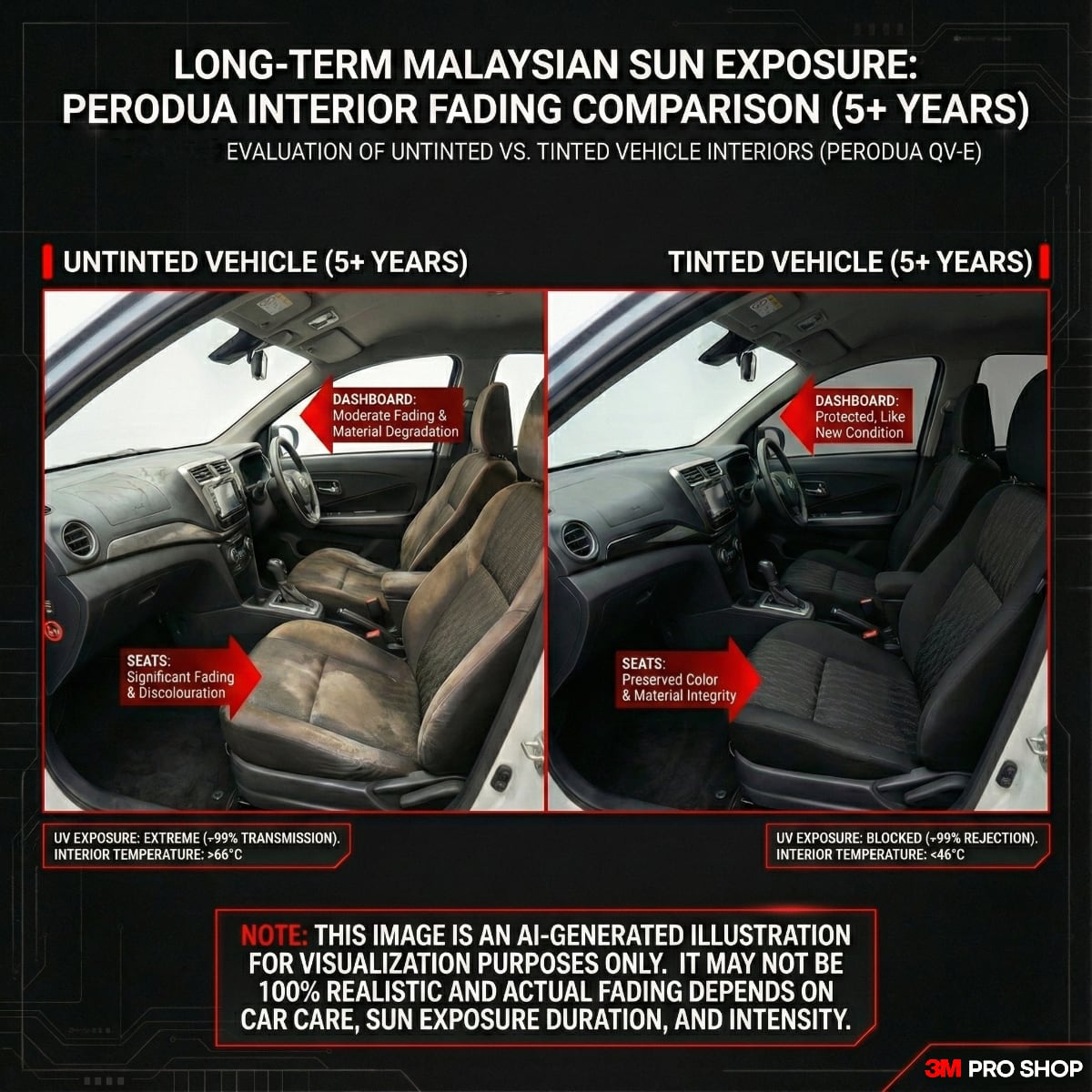
UV radiation fades and cracks interior materials over time. Dashboard plastics, leather or fabric seats, and trim pieces all degrade faster under constant UV exposure. Quality window tint blocks 99 percent or more of UV radiation, extending the life of your interior.
For a new car like the QV-E, this protection starts paying off immediately. The interior you protect now is the interior buyers will evaluate if you sell the car in five years.
Understanding Window Tint Specs: What Actually Matters
VLT (Visible Light Transmission)
VLT measures how much visible light passes through the film. Lower VLT means darker tint.
- 70% VLT: Nearly clear. JPJ minimum for windshields.
- 50% VLT: Light tint. JPJ minimum for front side windows.
- 35% VLT: Medium tint. Popular for rear windows.
- 20% VLT: Dark tint. Common for privacy.
- 5 to 15% VLT: Very dark. Maximum privacy but reduced night visibility.
Important: VLT only tells you how dark the film is. It does not tell you how well it blocks heat.
TSER (Total Solar Energy Rejected)
TSER is the percentage of total solar energy blocked by the film. This is the most important number for cooling performance.
- 50% TSER: Entry-level. Noticeable improvement over no tint.
- 55 to 60% TSER: Mid-range. Good balance of performance and cost.
- 60 to 65% TSER: High performance. Meaningful difference in cabin temperature.
- 65%+ TSER: Premium. Maximum heat rejection.
A film with 50% VLT (legal for front sides) and 65% TSER will keep your cabin cooler than a film with 20% VLT and 45% TSER. Darkness does not equal cooling.
IRR (Infrared Rejection)
IRR measures how much infrared radiation (heat you feel on your skin) is blocked. High IRR films reduce the burning sensation when sunlight hits you through the glass.
- 80%+ IRR: Good
- 90%+ IRR: Better
- 95%+ IRR: Best
For the QV-E, prioritising high IRR means you feel cooler even before the AC fully cools the cabin.
UV Rejection
Most quality films block 99% or more of UV radiation. This protects your skin and prevents interior fading. At this level, differences between brands are minimal.
Spec Benchmarks for QV-E Owners
Ask any installer for these numbers before committing. If they cannot provide TSER and IRR figures, they are probably selling low-quality film.
Choosing Window Tint for Your QV-E
Entry-Level Ceramic Films (RM1,500 to RM2,000)
TSER: Around 50 to 55%
Best for: Budget-conscious buyers who want basic heat rejection
These films use ceramic particles to block heat without metallisation (which can interfere with phone and toll signals). They perform better than old-style dyed films but lag behind premium options.
Honest assessment: Noticeable improvement over factory glass. Adequate for drivers who park in shade regularly or do not mind running the AC harder.
Mid-Range Ceramic Films (RM2,500 to RM3,500)
TSER: Around 55 to 63%
Best for: Most QV-E owners seeking good value
This category offers meaningful heat rejection at a reasonable price. The difference between 50% TSER and 60% TSER is perceptible in daily driving.
Honest assessment: The sweet spot for most buyers. Delivers real cooling benefit without premium pricing.
Premium Multilayer Films (RM3,500 to RM4,500)
TSER: Around 64 to 68%
Best for: Owners who prioritise maximum cooling and range preservation
Premium films use multiple nano-ceramic layers to achieve high heat rejection while maintaining clarity. They typically come with longer warranties (often lifetime) and more consistent quality.
Honest assessment: Measurably better than mid-range, but the incremental benefit costs RM1,000 to RM2,000 extra. Worth it if you park outdoors daily and want to maximise range. Harder to justify if you have covered parking.
Matching Tint to Your Driving Pattern
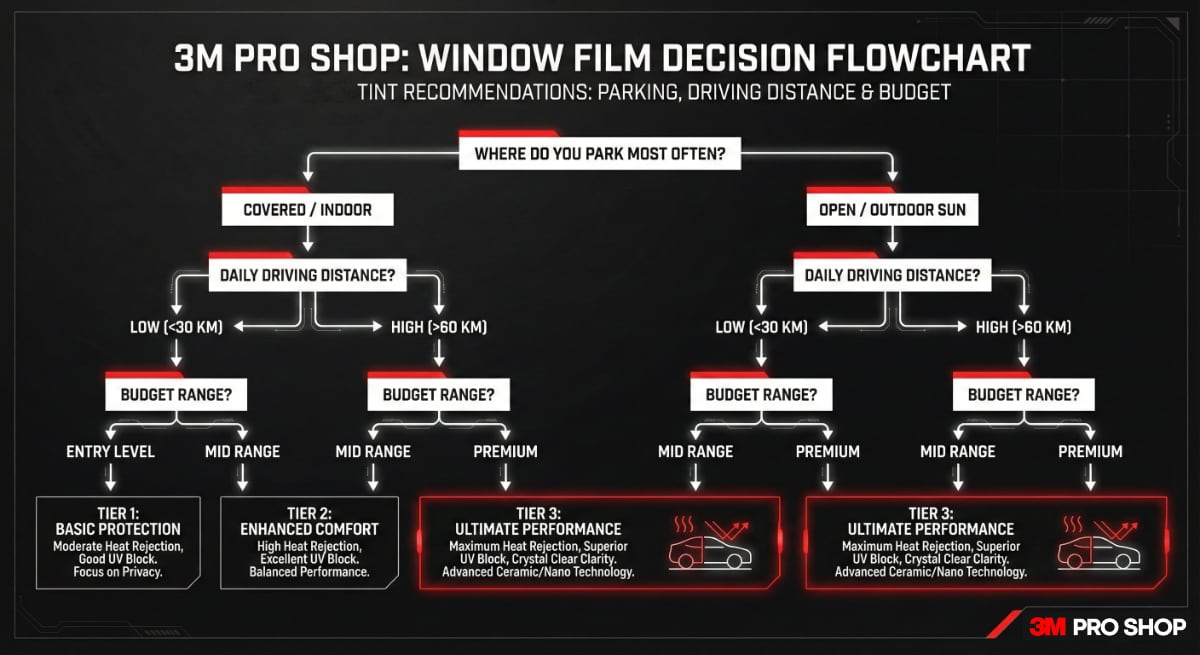
If you park in covered parking at home and work:
Mid-range ceramic is probably sufficient. Your cabin does not experience extreme heat buildup, so maximum TSER is less critical.
If you park outdoors daily:
Premium multilayer film pays off faster. Every degree of cabin temperature reduction means less AC load and better range.
If budget is tight:
Entry-level ceramic still beats factory glass. Start there and upgrade later if needed.
JPJ Tint Regulations: What You Need to Know
The Legal Limits
Malaysian law sets minimum VLT requirements:
- Front windshield: 70% VLT minimum (very light tint or clear film only)
- Front side windows: 50% VLT minimum (light to medium tint)
- Rear side windows: No restriction
- Rear windshield: No restriction
These limits apply to the combined VLT of your glass plus film. Most car windows already have some factory tint built in, so the actual film VLT needs to account for this.
Enforcement Reality
JPJ conducts random roadblocks where officers check VLT using handheld meters. If your front windows are below the legal limit, you face a summons and may need to remove the film.
Some drivers apply for medical exemptions citing skin conditions or light sensitivity. Enforcement of exemptions is inconsistent, but the exemption process exists.
Staying Legal While Maximising Cooling
The smart approach for QV-E owners:
- Front windshield: 70%+ VLT film with high TSER. Yes, these exist. They block heat while staying fully legal.
- Front side windows: 50% VLT film with the highest TSER available in that VLT range.
- Rear windows: Go as dark as you want. Most owners choose 15 to 35% VLT for privacy and heat control.
This combination keeps you legal while maximising cooling where it matters.
What About PPF? A Realistic Assessment
When PPF Genuinely Helps
PPF (Paint Protection Film) is a clear urethane layer that protects your paint from stone chips, scratches, and UV damage. It makes sense in specific situations:
- Highway commuters: Daily drives on PLUS, KESAS, LDP, or similar highways expose your bonnet and bumper to debris. PPF on these areas prevents chips that accumulate over years.
- Long-term ownership (7+ years): If you plan to keep the QV-E beyond its warranty period, protecting the paint now prevents correction costs later.
- Dark colours: Black, dark grey, and dark blue show chips and swirl marks more visibly. If you chose a dark QV-E, damage is more noticeable.
- Resale priority: A chip-free bonnet signals a well-maintained car to used buyers.
When PPF Is Overkill
Full-car PPF rarely makes financial sense for the QV-E:
- Cost versus car value: Full coverage runs RM11,000 to RM24,000. That is 14 to 30 percent of an RM80k car.
- Risk profile: Most damage happens on the front third. Protecting the roof, doors, and rear protects areas that rarely get hit.
- Depreciation math: Even perfect paint does not stop a five-year-old EV from depreciating. The resale premium from PPF may not recover your investment.
The Smarter Approach for QV-E Owners
If you decide PPF makes sense for your situation:
- Partial front coverage (bonnet, bumper, headlights): RM2,500 to RM5,000
- Extended front (add mirrors, fenders, door edges): RM5,000 to RM8,000
Skip full-car coverage unless you have specific reasons to protect every panel.
Or skip PPF entirely. Many QV-E owners can maintain their paint with good washing habits and touch-up paint for occasional chips. PPF is not mandatory.
How to Choose a Quality Installer
What Good Tint Shops Do
- Controlled environment: Installation happens in an enclosed, climate-controlled space. Dust particles trapped under film cause permanent defects.
- Computer-cut patterns: Quality shops use pre-cut film patterns for your specific vehicle, not hand-trimmed pieces that risk scratching your glass.
- Door panel removal: For a cleaner edge finish, good installers remove door panels to tuck the film deeper into the window channel. Shops that skip this step leave visible edges.
- Written warranty: Get warranty terms in writing. Quality ceramic films typically carry 5-year to lifetime warranties.
- Transparent specs: They provide TSER, IRR, and VLT numbers for the film they install, not just vague "ceramic tint" descriptions.
Red Flags to Avoid
- Outdoor installation: Dust contamination is inevitable without a controlled environment.
- No spec sheets: If they cannot tell you the TSER, they are probably using cheap film.
- "Same day, no appointment": Quality installation takes time. Rushed work shows.
- Price too good to be true: Quality ceramic film costs money. Shops quoting significantly below market rates are cutting corners somewhere.
Questions to Ask Before Committing
- What brand and series of film do you use?
- What is the TSER and IRR rating for the film?
- Do you remove door panels for installation?
- Can I see your installation area?
- What does your warranty cover, and for how long?
Free and Low-Cost Ways to Stay Cool
Not everyone needs to spend thousands immediately. These habits help while you decide on tint:
Parking Strategy
- Seek shade: Parking under cover or trees reduces cabin temperature significantly.
- Use a windshield sunshade: A RM30 reflective sunshade keeps your dashboard cooler and reduces initial AC load.
- Crack windows when safe: In secure locations, leaving windows slightly open prevents the worst heat buildup.
Pre-Cooling
- Remote AC activation: If your QV-E supports pre-conditioning, turn on the AC a few minutes before you start driving. The car cools while still plugged in, preserving battery for actual driving.
Paint Maintenance Habits
- Wash regularly: Bird droppings, tree sap, and insect residue damage paint. Weekly washing during heavy contamination periods prevents etching.
- Two-bucket method: One bucket for soapy water, one for rinsing your mitt. Prevents swirl marks.
- Address chips promptly: A RM30 touch-up pen seals chips before rust starts.
- Quarterly sealant: A RM50 spray sealant adds a sacrificial UV-blocking layer.
Professional Options: What to Expect
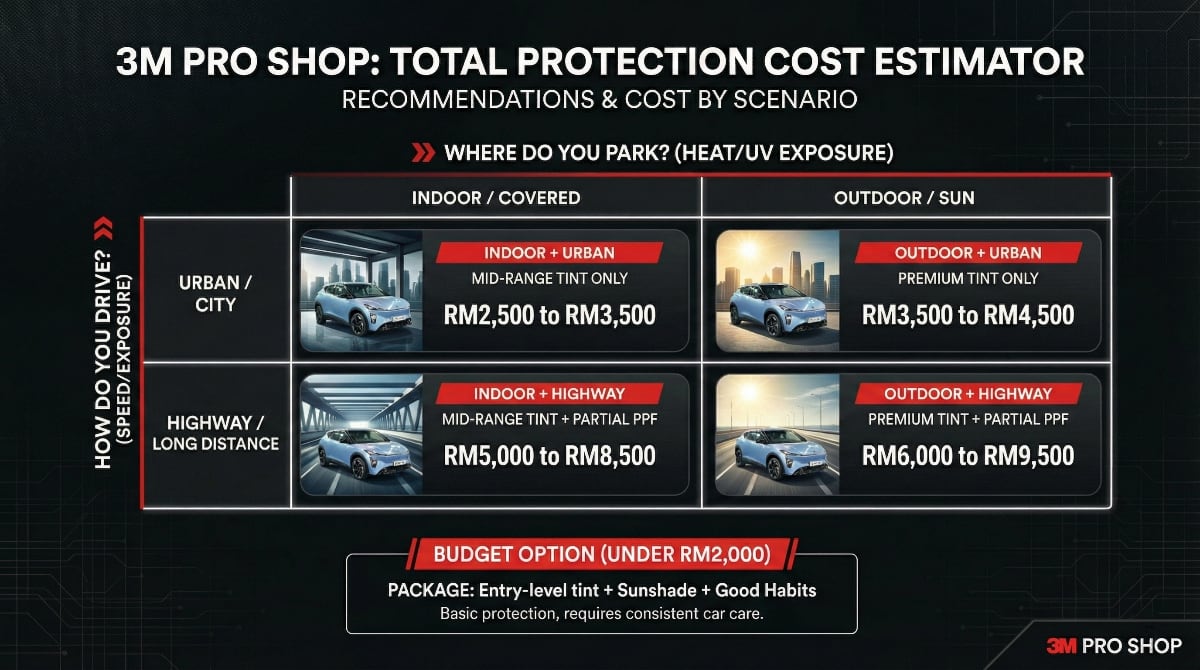
If you have decided professional protection fits your situation, here is what to expect from pricing and performance.
Window Tint Pricing
PPF Pricing (If Needed)
Making the Right Decision for Your Perodua QV-E
If You Park Indoors and Drive Urban Routes
Start with: Mid-range ceramic tint
Consider later: Nothing else needed for most drivers. Good habits protect paint.
Skip: Full-car PPF
If You Park Outdoors Daily
Start with: Premium multilayer tint to maximise TSER for range preservation
Consider later: Partial PPF if you drive highways regularly
Skip: Full-car PPF
If You Commute on Highways Daily
Start with: Quality tint in the mid-range or premium tier
Add: Partial PPF on bonnet, bumper, and headlights
Skip: Full-car PPF
If Budget Is Tight
Start with: Entry-level ceramic tint and a windshield sunshade
Focus on: Good washing habits
Reassess: After six months based on actual paint condition
If you are unsure which film fits your driving pattern, compare the TSER and VLT specifications from at least two installers, then speak to a certified 3M Pro Shop for a recommendation based on your specific situation.
Getting a Professional Assessment at 3M Pro Shop by P10X
If you want expert guidance tailored to your QV-E, a certified 3M Pro Shop can assess your vehicle and recommend coverage based on your driving pattern and budget. 3M Pro Shop by P10X offers consultations where you can discuss options, see the installation facility, and get written quotes without pressure.
3M's window film range includes Crystalline Black for maximum heat rejection, Ceramic IR for balanced performance, and XP Series for value-conscious buyers. For PPF, the Series 150 offers the highest protection, with Series 100 and Series 50 providing coverage at different price points. A good installer will recommend what fits your needs, not the most expensive package.
Find out the best protection for your EV
Visit a 3M Pro Shop and discover the cost-effective 3M Protective Film and Window Tint
FAQs
Will window tint really improve my EV range?
Yes. High TSER tint reduces cabin heat, which means your AC works less to cool the interior. For QV-E owners who park outdoors daily, this can preserve 5 to 10 percent of effective range over time. The effect is more noticeable on hot days and during longer drives.
What is more important for cooling: darker tint or higher TSER?
TSER matters more. A 50% VLT film with 65% TSER will keep your cabin cooler than a 20% VLT film with 45% TSER. Darkness affects privacy and visible light, but TSER determines actual heat rejection.
Is PPF worth it for an RM80,000 car?
Full-car PPF is hard to justify at RM11,000 to RM24,000 on an RM80k vehicle. Partial coverage on high-impact zones at RM2,500 to RM5,000 makes more sense if you drive highways daily. Many QV-E owners can skip PPF entirely and maintain paint with good washing habits.
How do I check if my tint is JPJ legal?
Ask your installer for the VLT specification of the film applied to each window. Some tint shops have VLT meters you can use to verify. Legal limits are 70% VLT minimum for windshield and 50% VLT minimum for front side windows.
Will window tint interfere with my QV-E's electronics or sensors?
Quality ceramic and multilayer films do not contain metal, so they will not interfere with phone signals, GPS, toll readers, or dashboard electronics. Avoid metallised films if signal interference is a concern.
Author
Fabian
He is passionate about revolutionizing the car protection services industry by bringing innovation and transparency to a traditionally opaque and often misunderstood field. His mission is to educate end users on the true benefits and importance of car protection, aiming to replace outdated practices with honest, customer-focused solutions. With a fresh approach to car tinting, paint protection film (PPF), and detailing services, he is committed to delivering a superior customer experience that sets a new standard in the market. He welcomes discussions about the future of the automotive industry and is eager to connect with like-minded professionals who share his vision for innovation, integrity, and excellence.
Experience the future of window tinting
Visit a 3M Pro Shop and discover the revolutionary Crystalline CR BLK film