
3M Crystalline Black vs Other Car Tint Brands: A Transparent Comparison for Malaysian Weather

Choosing the right 3M Crystalline tint option in Malaysia means understanding how it compares to other brands available in the market. With dozens of window film brands claiming superior heat rejection and UV protection, separating marketing claims from actual performance data helps you make a decision based on facts rather than sales pitches. For a comprehensive overview of why 3M leads in car window tinting Malaysia, including science, comfort, and legal compliance factors, refer to our complete guide. This comparison examines how 3M Crystalline Black stacks up against competing tint brands in the context of Malaysian driving conditions.
Understanding Window Tint Performance Metrics
Before comparing brands, you need to understand what the numbers actually mean.
Total Solar Energy Rejected (TSER)
TSER measures the percentage of total solar energy blocked by the film and glass combination. This includes visible light, infrared radiation and ultraviolet rays. A film with 65% TSER blocks 65% of all incoming solar energy.
Why it matters in Malaysia: Higher TSER means less heat enters your cabin. In a country where midday temperatures regularly exceed 35 degrees Celsius and parked cars can reach interior temperatures above 60 degrees, TSER is the single most important performance metric.
Infrared Energy Rejection (IRER)
Infrared radiation creates the "heat on skin" sensation you feel through windows. IRER (Infrared Energy Rejection) measures how comprehensively the film blocks this heat across the infrared spectrum.
Understanding IRER versus IRR:
- IRR (Infrared Rejection): Measures heat blockage in a narrow wavelength band (typically 900-1000nm). This provides a partial heat measure focused on a specific range.
- IRER (Infrared Energy Rejection): Covers a broader spectrum (780-2500nm) and accounts for both directly transmitted infrared and heat that gets absorbed by the glass then re-radiated into the cabin.
Why IRER matters more:
IRER gives you a more accurate indicator of overall cooling performance because it factors in the full infrared spectrum plus the re-radiated heat effect. A film might show impressive IRR numbers in a narrow band but still allow substantial heat transfer through other wavelengths. IRER captures the complete picture of infrared heat rejection.
For the most comprehensive assessment of window film performance, look at TSER (Total Solar Energy Rejection), which combines IRER with UV rejection and visible light management for a complete solar heat performance number.
Visible Light Transmission (VLT)
VLT indicates how much visible light passes through the film. Lower VLT means darker appearance. JPJ regulations restrict front windscreen and front side windows to specific VLT minimums.
UV Rejection
UV rays cause skin damage and fade interior materials. Quality films block 99% or more of UV radiation regardless of darkness level.

Technology Platform
3M Crystalline Black uses multilayer optical film technology with approximately 200 nano-layers. This non-metallised construction achieves high heat rejection without the signal interference issues that plague metallic films.
Performance Specifications by Shade
Data shown is the estimated performance of film applied to ¼" (6mm) thick, 73% VLT automotive green glass. Data is for reference only.
*IRER — Percent of solar infrared energy that is rejected over the wavelength range from 780–2,500 nm. IRER takes into account the transmitted and absorbed IR energy that will be reradiated into a car. Data shown is for the performance of film applied to glass.
**IRR — Percent of solar infrared energy in the 900–1,000 nm wavelength range that is rejected by the film. Measurement is made of film with liner alone (i.e. no glass).
Key observations:
- TSER peaks at 62% for CR BLK 15, the darkest shade
- Even the lightest shade (CR BLK 80) achieves 32% TSER
- All shades block 99.9% of UV rays
- IRER performance is measured across the 780-2500nm spectrum
Unique Advantages
Signal transparency: Non-metallised construction means your GPS, Touch 'n Go RFID, mobile phone and satellite radio work without interference.
Colour stability: The film maintains a neutral appearance without the purple or brown colour shift that affects cheaper dyed films over time.
Factory-like appearance: The deep black and grey tones blend naturally with factory glass, avoiding the "aftermarket" look of some tint brands.
For detailed information about the CR BLK series launch and features, refer to our article on 3M Crystalline CR BLK Malaysia.
Series Use-Case Labels
Each 3M tint series is designed for a specific set of priorities. When comparing against competitors, it helps to know which label fits each product:
This labeling makes it easier to compare against competitors who may lead in one category but fall short in others. Few competing brands match 3M's combination of top-tier heat rejection, signal transparency, and manufacturer-backed warranty.
How Competing Brands Compare
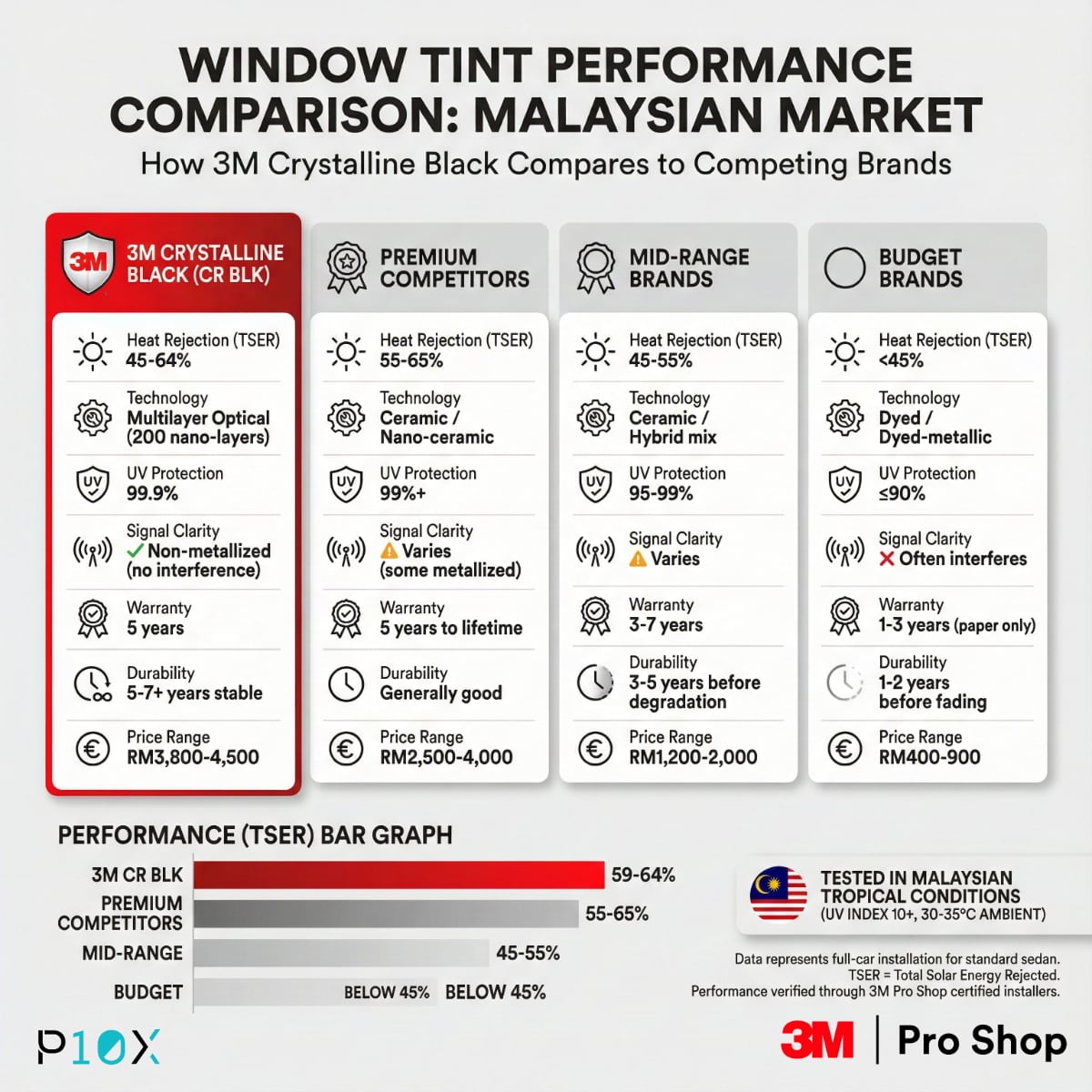
The Malaysian market includes numerous window film brands. Here is how they generally compare to 3M Crystalline Black.
Premium Competing Brands
Several international brands compete in the premium segment:
Common characteristics:
- TSER typically ranges from 55% to 65%
- Most use ceramic or nano-ceramic technology
- UV rejection generally at 99%+
- Warranties vary from 5 years to lifetime
Where they often fall short:
- Lower TSER per VLT level compared to 3M's multilayer optical technology
- Some use metallised layers that interfere with electronics
- Colour consistency and long-term stability vary
- Warranty enforcement depends on distributor presence in Malaysia
- Metallic-layer films can interfere with GPS navigation if applied to all windows. Drivers using metallic tints may need to leave front door windows uncoated or accept reduced GPS accuracy. This is not an issue with non-metallic ceramic or sputtered technologies
Mid-Range Brands
The middle market includes both international and regional brands:
Common characteristics:
- TSER typically 45% to 55%
- Mix of ceramic and hybrid technologies
- UV rejection at 95% to 99%
- Warranties from 3 to 7 years
Typical limitations:
- Noticeable performance gap versus premium films
- Colour shift more common after 2 to 3 years
- Less consistent quality control
- Limited installer training and support
Budget Brands
Entry-level films dominate the low-price segment:
Common characteristics:
- TSER often below 45%
- Primarily dyed or dyed-metallic construction
- UV rejection may be 90% or lower
- Warranties from 1 to 3 years if offered
Significant drawbacks:
- Rapid heat rejection degradation
- Colour fading and purple shift within 1 to 2 years
- Bubbling and peeling more common
- No meaningful warranty support
Real-World Performance in Malaysian Conditions
Laboratory specifications tell part of the story. Real-world performance in Malaysian conditions reveals the rest.
Heat Rejection Under Tropical Sun
Malaysia's equatorial location means intense solar radiation year-round. During peak hours (10am to 3pm), unprotected vehicles can reach cabin temperatures exceeding 60 degrees Celsius within 30 minutes of parking.
3M Crystalline Black performance:
- Drivers consistently report noticeably cooler cabins compared to mid-range films
- Air conditioning reaches comfortable temperature faster
- Dashboard and steering wheel surface temperatures remain lower
- The difference is most apparent on longer drives and during traffic congestion
Budget film reality:
- Initial heat rejection may feel adequate
- Performance degrades significantly within 12 to 24 months
- Drivers often retint within 2 to 3 years, negating cost savings
Durability in High UV Environment
Malaysian UV index regularly exceeds 10, which accelerates film degradation:
3M Crystalline Black longevity:
- Colour stability maintained over 5+ years
- No significant TSER degradation documented
- 5-year warranty provides confidence
Competitor durability varies:
- Premium brands generally perform well
- Mid-range films show visible degradation at 3 to 5 years
- Budget films often fail within 2 years
Signal Interference Considerations
Modern vehicles rely heavily on wireless signals:
3M's non-metallised advantage:
- Touch 'n Go RFID functions normally (non-metallic film does not block radio frequency signals)
- GPS navigation unaffected
- Mobile signal strength maintained
- Satellite radio reception clear
Metallised film problems:
- Signal degradation common
- Some drivers report complete Touch 'n Go RFID failure.
- RFID placement tip: If you or your customers use metallic tint for specific aesthetic reasons, RFID tags can be relocated to the headlamp area or other non-tinted surfaces to bypass signal interference entirely. Your installer can advise on the best location for your vehicle.
- GPS accuracy issues in covered parking
- Mobile calls drop more frequently
Cost Analysis: Price vs Value
Comparing window tint purely on price ignores the total cost of ownership.
Initial Investment Comparison
Five-Year Cost of Ownership
3M Crystalline Black scenario:
- Initial cost: RM4,000
- Retinting needed: None (warranty coverage)
- Total 5-year cost: RM4,000
Budget brand scenario:
- Initial cost: RM600
- First retint at year 2: RM700
- Second retint at year 4: RM800
- Total 5-year cost: RM2,100
The calculation shifts when you factor:
- Time spent on multiple installations
- Potential damage to window mechanisms from removal
- Inconsistent performance during degradation periods
- Aesthetic deterioration affecting vehicle appearance
Resale Value Impact
Documented quality tint installation adds value when selling your vehicle:
- Buyers recognise brand names like 3M
- Warranty transferability is a selling point
- Well-maintained appearance suggests overall vehicle care
Making the Right Choice for Your Situation
Different drivers have different priorities. Here is how to match your needs to the right solution.
Choose 3M Crystalline Black If:
- Heat rejection is your primary concern
- You want to maintain electronic signal clarity
- Long-term ownership (5+ years) is planned
- Vehicle appearance and resale value matter
- You prefer warranty-backed peace of mind
Consider Premium Competitors If:
- Budget is slightly constrained but quality still matters
- Specific aesthetic preferences align with another brand
- You have positive experience with a particular brand
- Local installer relationships favour another product
Mid-Range May Suffice If:
- Vehicle ownership is short-term (2 to 3 years)
- Budget constraints are significant
- The car is primarily a utility vehicle
- You accept performance degradation over time
Avoid Budget Brands If:
- You expect consistent performance
- Appearance matters to you
- Long-term cost matters more than upfront savings
- Warranty protection is important
Warranty and Support Comparison
Warranty backing varies significantly across brands.
3M Warranty Structure
- 5-year warranty on Crystalline Black series
- E-warranty registration through authorized dealers
- Coverage includes yellowing, bubbling, cracking and adhesive failure
- 3M's Malaysian presence ensures warranty enforcement
Competitor Warranty Realities
Premium brands:
- Warranties range from 5 years to lifetime
- Enforcement depends on distributor stability
- Some require specific installer networks
Mid-range and budget brands:
- Warranties often exist on paper only
- Distributor changes can void coverage
- Claims process may be difficult or impossible
What Warranty Does Not Cover
Across all brands, warranties typically exclude:
- Damage from accidents or improper care
- Normal wear from stone chips
- Issues from non-authorized installation
- Cosmetic preferences (you chose the shade)
Installation Quality: The Hidden Variable
Even the best film performs poorly with bad installation. This affects brand comparisons.
3M Pro Shop Advantage
3M maintains a network of certified Pro Shop installers who:
- Receive direct training from 3M
- Use approved installation techniques
- Work in controlled environments
- Provide proper warranty documentation
Generic Installer Risks
When competitors' films are installed by general workshops:
- Training quality varies dramatically
- Installation environments may not be controlled
- Warranty documentation may be incomplete
- Accountability for issues becomes unclear
Why This Matters for Comparison
A premium competitor film installed poorly may perform worse than a mid-range film installed professionally. When comparing brands, consider the installation ecosystem, not just the film specifications.
Choosing Your Configuration
If you decide on 3M Crystalline Black, selecting the right shades matters.
JPJ-Compliant Front Configuration
Malaysian regulations require:
- Front windscreen: 70% VLT minimum
- Front side windows: 50% VLT minimum
Recommended CR BLK configuration:
- Windscreen: CR BLK 70 or CR BLK 80
- Front doors: CR BLK 50 or CR BLK 60
Maximum Heat Rejection Rear Configuration
Rear windows have no VLT restrictions:
- Rear doors and rear windscreen: CR BLK 15 or CR BLK 30
Balanced Approach
For drivers who want visibility and heat rejection:
- Consider CR BLK 35 or CR BLK 40 throughout for consistency
- Darker front may require JPJ permit for medical reasons
For professional guidance on selecting the right configuration for your vehicle and needs, you can visit our 3M Pro Shop for window tinting services to consult with certified installers.
Find out the best protection for your EV
Visit a 3M Pro Shop and discover the cost-effective 3M Protective Film and Window Tint
Frequently Asked Questions
Is 3M Crystalline Black the same as the original 3M Crystalline?
No. Crystalline Black (CR BLK) is a newer series that replaced the original Crystalline range in Malaysia from December 2025. CR BLK offers similar heat rejection performance with a deeper black and grey appearance that provides a more factory-like look. The multilayer optical film technology is similar, but the aesthetic profile differs.
Does darker CR BLK always have higher TSER?
For TSER specifically, yes. TSER is highest at the darkest shade. CR BLK 15 peaks at 62% TSER, and TSER decreases as the shade gets lighter, all the way down to 32% at CR BLK 80. What is genuinely non-linear is IRER (Infrared Energy Rejection) across the 780–2500nm spectrum: it peaks in the mid shades. CR BLK 30 (70%), CR BLK 35 (69%), CR BLK 40 (68%), CR BLK 50 (69%) —> because the multilayer optical film is tuned to reflect a specific slice of the infrared spectrum regardless of darkness. So if your priority is the strongest "heat-on-skin" infrared rejection at a JPJ-legal VLT for the front side windows, the mid-range CR BLK shades are the sweet spot, but if total solar energy rejected is your only metric, the darkest legally available shade wins. (Note: an earlier version of this FAQ incorrectly cited CR BLK 50 at 68% TSER. The correct value is 53% TSER for CR BLK 50; 68% refers to IRER, not TSER.)
Will 3M Crystalline Black interfere with my car's sensors and cameras?
No. The non-metallised construction means no interference with parking sensors, lane departure cameras, rain sensors or other electronic systems. This is a significant advantage over metallised films that can disrupt these functions.
How do I verify if a shop is using genuine 3M film?
Request to see the original 3M film roll with batch markings. Certified 3M Pro Shops can provide e-warranty registration through 3M's system. If an installer cannot provide proper documentation or registration, the film may not be genuine.
Can I install 3M Crystalline Black myself to save money?
Window film installation requires specific skills, tools and controlled environments. DIY installation typically results in bubbles, debris contamination and poor edge finishing. The cost of film wasted on failed attempts often exceeds professional installation costs, and self-installed film has no warranty coverage.
Author

Fabian
He is passionate about revolutionizing the car protection services industry by bringing innovation and transparency to a traditionally opaque and often misunderstood field. His mission is to educate end users on the true benefits and importance of car protection, aiming to replace outdated practices with honest, customer-focused solutions. With a fresh approach to car tinting, paint protection film (PPF), and detailing services, he is committed to delivering a superior customer experience that sets a new standard in the market. He welcomes discussions about the future of the automotive industry and is eager to connect with like-minded professionals who share his vision for innovation, integrity, and excellence.
Experience the future of window tinting
Visit a 3M Pro Shop and discover the revolutionary Crystalline CR BLK film