
Why 3M Window Tinting is the Best Choice for Malaysian Drivers: Science, Comfort, and JPJ Compliance

Choosing car window tinting options in Malaysia involves comparing dozens of brands and performance claims. Malaysian drivers face specific challenges that generic tint solutions often fail to address properly. Intense tropical heat, year-round UV exposure, legal compliance requirements, and the need for reliable electronic signal transmission create a unique set of requirements. This guide explains why 3M window tinting delivers superior performance for Malaysian driving conditions, backed by measurable science, proven comfort improvements, and guaranteed legal compliance.
The Science Behind 3M Window Film Technology
3M's window film technology stems from decades of materials science research, creating measurable advantages over conventional tinting options.
Multilayer Optical Film Construction
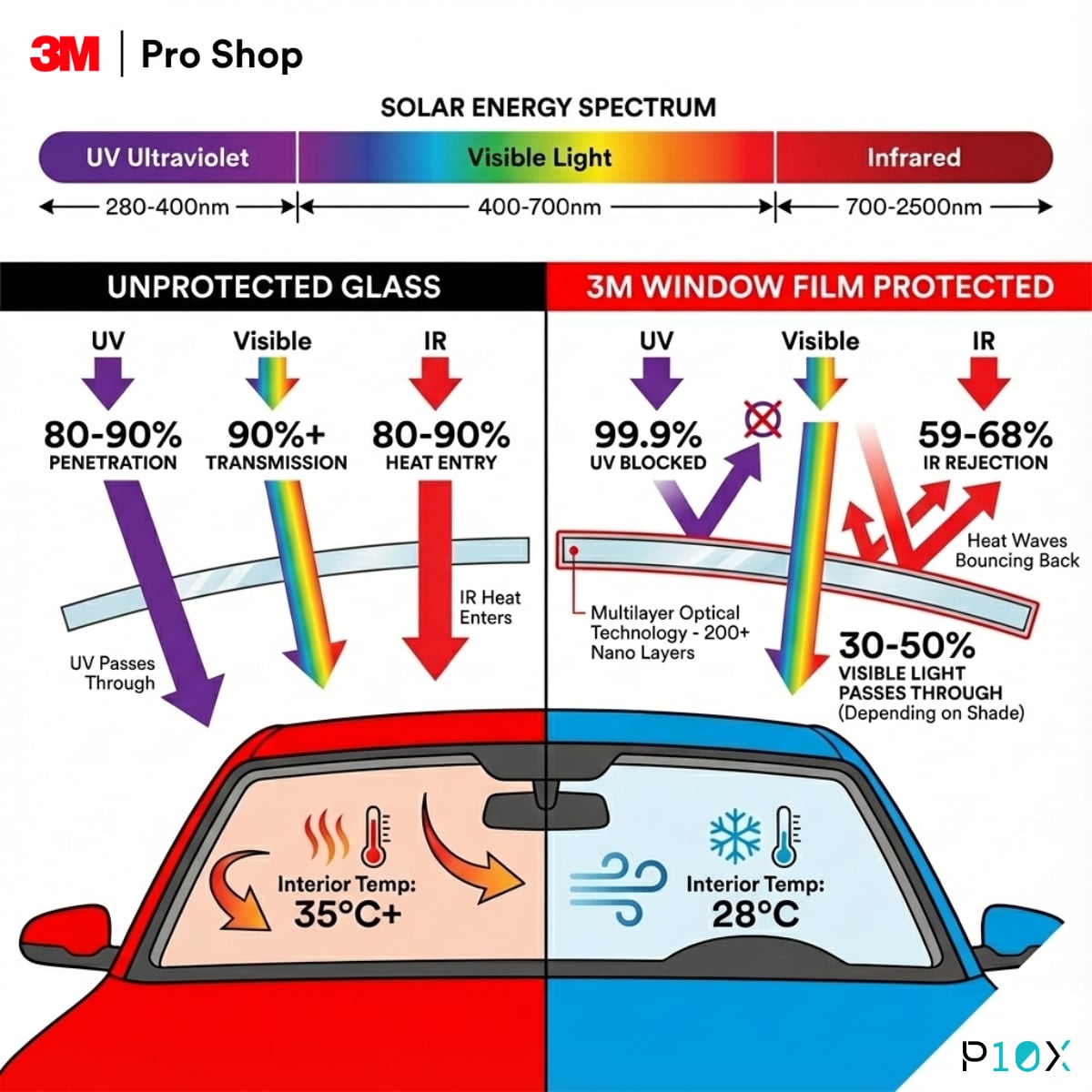
3M's premium Crystalline Black (CR BLK) series uses approximately 200 nano-layers of optical film. For complete details on this breakthrough technology and the CR BLK launch, refer to our 3M Crystalline CR BLK Malaysia announcement. This non-metallized construction works through precise light wave interference rather than simple absorption or reflection.
Each nano-layer is engineered to target specific wavelengths of solar energy. Infrared radiation (heat you feel) gets blocked while visible light passes through. This separation allows lighter-looking films to reject more heat than darker conventional films.
The manufacturing precision required for this technology explains why 3M films maintain consistent performance. Each layer must align within nanometer tolerances. Lower-cost dyed films cannot replicate this because they rely on chemical absorption that degrades under UV exposure.
Heat Rejection Performance Specifications
Total Solar Energy Rejected (TSER) measures the percentage of all incoming solar energy that the film and glass combination blocks. This metric captures the real-world heat reduction you experience.
3M Crystalline Black series achieves TSER ranging from 32% (CR BLK 80, lightest) up to 62% (CR BLK 15, darkest) depending on shade. TSER peaks at the darkest shade because more visible light is blocked alongside infrared. What is non-linear in the CR BLK lineup is IRER (Infrared Energy Rejection across the full 780–2500nm spectrum), which peaks at 70% on CR BLK 30 and stays in the high 60s through CR BLK 50, because the multilayer optical film is tuned to reflect specific infrared wavelengths regardless of darkness.
For comparison, conventional dyed films typically achieve 35-45% TSER even at darker shades. The performance gap becomes obvious when you park under midday sun. CR BLK-equipped vehicles show dashboard surface temperatures 10-15°C cooler than vehicles with budget tint.
There are two infrared metrics to know. IRER (Infrared Energy Rejection) covers the full 780–2500nm spectrum: 3M CR BLK ranges from 48% (CR BLK 80) up to 70% (CR BLK 30) measured on glass. IRR (Infrared Rejection) is a narrower 900–1000nm film-only measurement: 3M CR BLK sits at 95–98% across the range. The narrow IRR figure is what most brands quote in marketing, but IRER is the more honest indicator of overall heat felt in the cabin. Always verify which measurement standard a manufacturer is citing.
UV Protection and Skin Safety
All 3M automotive window films block 99.9% of UV radiation regardless of darkness level. This protection applies to both UVA rays (aging and skin damage) and UVB rays (burning).
Malaysian drivers spend significant time in vehicles. A typical Klang Valley commuter may spend 10-15 hours weekly driving, often with sun exposure through windows. Unprotected glass blocks UVB but allows UVA penetration, contributing to skin aging and potential skin cancer risk.
3M's UV blocking remains stable over time. The protection comes from absorbers integrated throughout the film, not just a surface coating. Budget films may claim UV protection initially, but chemical degradation reduces effectiveness within 18-24 months.
Non-Metallized Signal Transparency
Modern vehicles rely on wireless signals for essential functions. GPS navigation, mobile phone connectivity, Touch 'n Go RFID, and satellite radio all depend on electromagnetic signal transmission through glass.
Metallized films create a Faraday cage effect, blocking or severely attenuating these signals. Many Malaysian drivers with budget metallized tint experience frustrating Touch 'n Go RFID failures at toll plazas, GPS signal loss in covered parking, and dropped mobile calls.
3M's multilayer optical films and ceramic-based films contain no metal layers. All electronic signals pass through cleanly. This becomes increasingly important as vehicles add more connected features like emergency calling systems and real-time traffic updates.
3M's multilayer optical films and ceramic-based films contain no metal layers, so RF-based signals (GPS, RFID, mobile, radio) pass through cleanly. For Smart Tag, CR BLK's IRR (the narrow 900–1000nm film-only measurement) sits at 95–98% across shades — above the ~90% threshold that can weaken Smart Tag's infrared signal. Lowering the window slightly at Smart Tag lanes is the common workaround. The wider-spectrum IRER, which is what affects cabin heat, ranges from 48–70% depending on shade.
Comfort Improvements Malaysian Drivers Experience
Scientific specifications translate into daily driving comfort in specific ways relevant to Malaysian conditions.
Cabin Temperature Management
Malaysia's equatorial location means consistent year-round heat. Outdoor parking exposes vehicles to intense solar radiation that can raise cabin temperatures above 60°C within 30 minutes.
3M window tint reduces this heat buildup significantly. Drivers consistently report entering parked vehicles to find dashboards warm rather than burning hot, steering wheels touchable immediately, and leather seats comfortable enough to sit on without waiting.
The cooling effect continues while driving. During traffic congestion, where vehicles move slowly with maximum sun exposure, 3M tint keeps cabin temperatures manageable even with moderate air conditioning. This becomes especially noticeable during midday drives on highways like NKVE, LDP, or PLUS where there's limited shade.
Air conditioning systems work less intensely to achieve comfortable temperatures. The compressor cycles less frequently, reducing strain on the system and potentially extending its service life. For vehicles with marginal air conditioning performance, quality tint can make the difference between adequate and inadequate cooling.
Fuel Efficiency Benefits
Lower cabin temperatures mean reduced air conditioning load, which directly impacts fuel consumption. Air conditioning compressors draw power from the engine, reducing fuel efficiency.
While exact savings vary by vehicle, driving pattern, and ambient conditions, drivers commonly report 5-8% fuel consumption improvements after installing high-TSER window film. For a driver spending RM500 monthly on fuel, this represents potential savings of RM25-40 monthly, or RM300-480 annually.
These savings compound over years of vehicle ownership. The fuel cost reduction helps offset the initial tint investment, especially for high-mileage drivers covering 20,000km or more annually.
Glare Reduction and Eye Comfort
Glare from direct sunlight or reflections off wet roads causes eye strain and reduces visibility. This becomes dangerous during rush hour commutes when sun angle hits directly through windscreens or side windows.
3M Crystalline Black films reduce glare by 1–81% depending on shade. CR BLK 15, the darkest shade, blocks 81% of glare while still maintaining adequate visibility for safe driving. Lighter shades like CR BLK 70 reduce glare by 12%, making a noticeable difference during drives.
Reduced glare means less squinting, fewer headaches from eye strain, and better ability to see dashboard instruments and road conditions. Long-distance drivers particularly notice this benefit during multi-hour trips to Penang, Malacca, or Johor Bahru.
Interior Preservation
UV radiation and heat cause interior materials to fade, crack, and degrade. Leather seats dry out and crack, plastic dashboard surfaces become brittle, and fabric upholstery fades.
By blocking 99.9% of UV rays and significantly reducing heat buildup, 3M window tint extends interior component life. This protection maintains the vehicle's appearance and resale value. A five-year-old car with protected interiors looks noticeably better than one with sun-damaged materials.
Premium and luxury vehicle owners particularly benefit from this protection. Replacing faded leather seats or cracked dashboard components costs thousands of ringgit. Quality window tint provides insurance against these degradation costs.
JPJ Compliance and Legal Requirements
Malaysia enforces specific regulations on window tint darkness. Understanding and following these rules prevents summons and vehicle inspection failures.
Current JPJ Tint Regulations
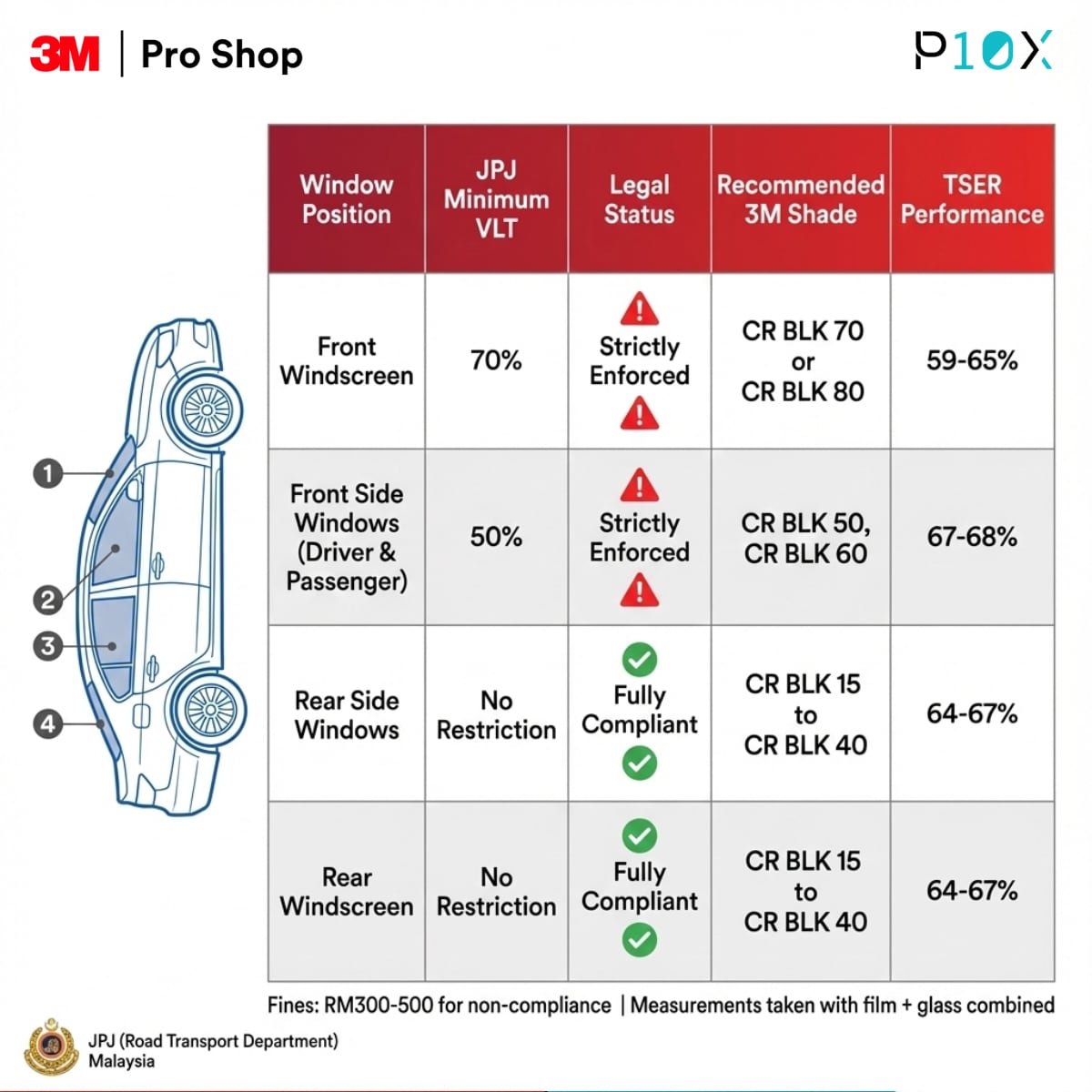
The Road Transport Department (JPJ) specifies minimum Visible Light Transmission (VLT) levels for vehicle windows:
Front windscreen: Must allow at least 70% of visible light to pass through. This means only very light tints are legal. Most drivers use either no tint or the lightest available shades like CR BLK 70 or CR BLK 80.
Front side windows (driver and front passenger): Must allow at least 50% of visible light transmission. This permits moderate tinting for comfort while maintaining adequate visibility for safe driving.
Rear windows: No VLT restrictions apply. Drivers can choose any darkness level based on privacy and comfort preferences.
These regulations aim to ensure drivers maintain adequate visibility in all conditions, particularly at night and during rain. Enforcement occurs through roadside checks and during vehicle registration renewals.
VLT Measurement and Verification
VLT measures the percentage of visible light passing through the combined glass and film. Higher VLT numbers mean more light passes through (lighter appearance). Lower VLT numbers mean less light passes through (darker appearance).
Certified 3M Pro Shop installers measure VLT for each window after installation. They provide documented readings showing compliance with JPJ regulations. This documentation serves as evidence if questioned by enforcement officers.
Budget installers rarely provide VLT measurements. Many apply illegal darkness levels without informing customers, leaving drivers at risk of summons. JPJ enforcement officers use handheld VLT meters at roadside checks. If measured VLT falls below legal minimums, drivers face fines of RM300-500 and potential requirements to remove tint immediately.
3M's JPJ-Compliant Configurations
All 3M film series offer shades that meet JPJ requirements. Certified installers recommend compliant configurations based on your priorities:
Maximum heat rejection with full compliance:
- Windscreen: CR BLK 70 (43% TSER, ~78% VLT)
- Front doors: CR BLK 50 (53% TSER, ~59% VLT)
- Rear windows: CR BLK 30 (59% TSER, ~35% VLT)
Balanced visibility and comfort:
- Windscreen: CR BLK 80 (32% TSER, ~88% VLT)
- Front doors: CR BLK 60 (49% TSER, ~69% VLT)
- Rear windows: CR BLK 40 (54% TSER, ~50% VLT)
Both configurations maintain legal compliance while delivering strong heat rejection and UV protection.
For complete details on CR BLK specifications and shade options, refer to our article on 3M Crystalline CR BLK Malaysia. Understanding JPJ compliant window tint regulations helps you avoid fines while maximizing heat rejection within legal limits.
Medical Exemption Permits
Drivers with medical conditions requiring extra UV protection (such as lupus, xeroderma pigmentosum, or photosensitivity disorders) can apply to JPJ for exemption permits allowing darker front window tint.
The application requires medical documentation from registered physicians. Approved permits allow darker tint while maintaining some minimum visibility requirements for safety. This provides necessary health protection without compromising legal compliance.
Why 3M Outperforms Budget Alternatives
Understanding the specific advantages 3M brings helps explain the price premium and long-term value proposition.
Proven Durability in Tropical Climate
Malaysia's climate stresses window films severely. Constant UV exposure, high humidity, and temperature fluctuations cause rapid degradation in lower-quality products.
Budget dyed films typically show visible color shift within 18-24 months. The purple or brown discoloration comes from dye molecule breakdown under UV radiation. Once color shifts start, heat rejection performance also declines as the dye structure that blocked infrared energy deteriorates.
3M films use stable technologies that resist this degradation. The multilayer optical construction in Crystalline Black series doesn't rely on dyes that can break down. Ceramic particles in Ceramic IR series remain stable under UV exposure. Drivers report consistent appearance and performance even after five to seven years of use.
Warranty Protection and Enforcement
3M backs its premium films with limited lifetime warranty coverage when installed by authorized dealers. This warranty protects against bubbling, cracking, delamination, and adhesive failure.
The warranty includes proper enforcement mechanisms. 3M maintains presence in Malaysia through authorized dealer networks. If warranty issues develop, dealers coordinate with 3M to assess and resolve the problem, including replacement if necessary.
Budget film warranties often exist only on paper. When issues develop, small installers may have closed or refuse to honor coverage. Even if they honor the warranty, they often lack direct manufacturer support for claims resolution.
Installation Quality Standards
3M requires authorized dealers to meet specific facility and training standards. Installers attend certification programs covering proper techniques, surface preparation, and quality control.
Certified 3M Pro Shops work in controlled indoor environments with proper lighting and air filtration. This prevents dust contamination that causes visible defects under film. They use computer-aided design patterns for precise cutting, minimizing waste and ensuring complete coverage.
Budget installers often work in roadside shops or outdoor environments. Dust, wind, and temperature variations make achieving clean installations nearly impossible. The resulting bubbles, debris, and poor edge finishing become permanent defects.
Comprehensive Product Range
3M offers three distinct film series addressing different priorities and budgets:
Crystalline Black (CR BLK) delivers maximum heat rejection with factory-like appearance. Eight shade options from CR BLK 15 to CR BLK 80 provide flexibility for different window positions and compliance requirements.
Ceramic IR provides strong performance at mid-range pricing. Non-metallized ceramic construction offers good heat rejection and signal transparency without premium pricing.
XP series delivers solid UV protection and glare reduction at accessible pricing for budget-conscious drivers who still want legitimate quality and warranty backing.
This range lets drivers match film performance to actual needs rather than choosing between inadequate budget options and one-size-fits-all premium pricing. For detailed 3M crystalline tint comparison against other brands, refer to our comprehensive analysis.
Long-Term Value and Total Cost of Ownership
Upfront cost comparisons miss the complete picture. Total cost over typical vehicle ownership periods reveals different economics.
Five-Year Ownership Analysis
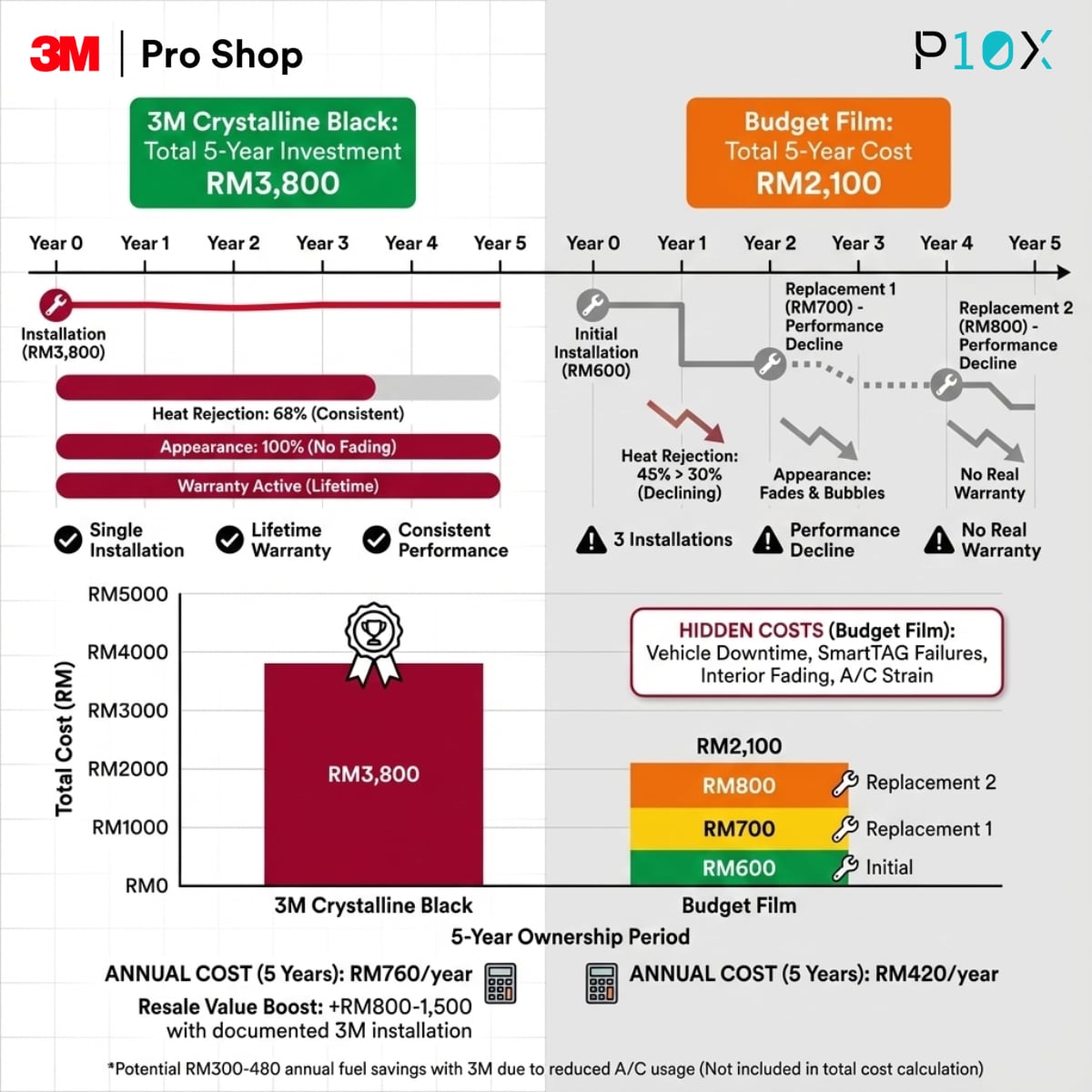
3M Crystalline Black installation: RM3,800 initially, no retinting needed, consistent performance throughout. Total five-year cost: RM3,800.
Budget film installation: RM600-800 initially, first retint at year 2 (RM700), second retint at year 4 (RM800). Total five-year cost: RM2,100-2,300, but with two periods of degraded appearance and performance.
The annual cost difference narrows to RM300-340. For daily drivers, potential fuel savings from superior heat rejection can partially or fully offset this difference.
Hidden budget film costs not captured in direct pricing:
- Vehicle downtime for multiple installation appointments
- Potential window mechanism damage from repeated film removal
- Toll plaza delays and Touch 'n Go RFID replacement attempts due to signal interference
- Increased air conditioning strain and potential earlier system failure
- Interior fading during periods between tint failures
Resale Value Impact
Quality documented window tint installation adds value when selling vehicles. Buyers recognize 3M brand reputation and appreciate transferable warranty coverage. Well-maintained appearance signals overall vehicle care, supporting higher asking prices.
Verified 3M installations add estimated RM800-1,500 to resale value depending on vehicle class. This recovers 20-40% of initial tint investment, further improving total cost of ownership economics.
Vehicles with degraded budget tint often face negotiated price reductions. Buyers plan to retint after purchase, deducting their estimated cost from offers. This can reduce sale price by RM500-800.
Performance Consistency Value
Beyond pure cost analysis, consistent performance throughout ownership provides value that's difficult to quantify. Not worrying about tint appearance, not dealing with warranty claims or retinting appointments, and maintaining reliable signal transmission all contribute to peace of mind and reduced hassle.
For drivers who keep vehicles for five to ten years, paying once for quality that lasts beats the repeated cycle of budget film failure, frustration, and replacement.
Choosing the Right 3M Film Series for Your Needs
Different driving patterns and priorities call for different film selections. Understanding how to match film to usage helps optimize value.
Daily Commuter in Heavy Traffic
- Profile: 30-50km daily drive through Klang Valley congestion, frequent stop-and-go traffic, extended sun exposure during rush hours.
- Recommendation: CR BLK series for maximum heat rejection. The 62% TSER peak (at CR BLK 15) reduces air conditioning load during prolonged traffic exposure. Fuel savings from reduced A/C strain help justify premium pricing over time.
- Configuration suggestion: CR BLK 70 windscreen, CR BLK 50 front doors, CR BLK 30 rear windows. This maximizes heat rejection while maintaining full JPJ compliance.
Family Vehicle with Children
- Profile: School runs, weekend errands, occasional long trips, priority on rear passenger comfort and UV protection for children.
- Recommendation: Ceramic IR series offers strong performance with moderate pricing. Focus darker shades on rear windows where children sit.
- Configuration suggestion: Ceramic IR 70 windscreen, Ceramic IR 50 front doors, Ceramic IR 15 rear doors and rear windscreen. Maximum UV protection and heat rejection for rear passengers while meeting legal requirements.
Weekend Driver with Limited Use
- Profile: Under 10,000km annually, mostly short trips, limited traffic exposure, budget-conscious approach.
- Recommendation: XP series provides legitimate UV protection and moderate heat rejection at accessible pricing. Lower annual mileage reduces fuel savings importance, making premium heat rejection less economically justified.
- Configuration suggestion: XP 70 windscreen, XP 50 front doors, XP 35 rear windows. Full JPJ compliance with solid protection at lowest 3M price point.
Business or Executive Vehicle
- Profile: Client transportation, professional image priority, passenger comfort important, resale value considerations.
- Recommendation: CR BLK series delivers premium appearance and maximum comfort. The deep black and gray tones look factory-installed. Strong performance supports professional image.
- Configuration suggestion: CR BLK 70 windscreen, CR BLK 60 front doors (extra privacy while compliant), CR BLK 15 rear windows (maximum privacy and heat rejection). Professional appearance with optimal passenger comfort.
Installation Process and What to Expect
Understanding the professional installation process helps you evaluate installer quality and know what proper execution involves.
Pre-Installation Consultation
Certified 3M Pro Shop installers begin with vehicle assessment. They examine existing glass condition, checking for chips or cracks that might affect film adhesion. They discuss your driving patterns, parking situations, comfort priorities, and budget.
Installers explain JPJ regulations and show physical shade samples so you understand appearance before committing. They provide TSER, VLT, and IRR specifications for recommended films. This consultation ensures you select the configuration that genuinely matches your needs.
Installation Environment and Technique
Quality installation requires controlled indoor environments. Proper facilities maintain consistent temperature, minimize airborne dust, and provide adequate lighting to spot potential defects during application.
The process involves thorough window cleaning, precise film cutting using computer-aided patterns, careful application with professional tools to eliminate bubbles, and edge sealing to prevent future lifting. Standard sedans require three to four hours. Larger vehicles with complex curves need five to six hours.
Budget installers who rush the process or work in uncontrolled environments cannot achieve the same quality. The time investment in proper installation directly affects long-term performance and appearance. Learn more about professional car window tint installation processes and what to expect during your appointment.
Post-Installation Care and Curing
Newly installed film requires a curing period before full exposure to moisture or stress. Installers provide specific guidance, but typical recommendations include:
- First 72 hours: Avoid washing the vehicle. Do not roll down windows. Keep windows closed and avoid touching the film. This allows adhesive to fully bond with glass.
- First week: Clean only with soft, damp cloth and mild soap. Avoid ammonia-based cleaners that can damage film.
- Ongoing care: Use recommended cleaning products. Avoid abrasive tools or rough materials. Regular maintenance extends film life and maintains warranty coverage.
Documentation and Warranty Activation
Professional installations include complete documentation package:
- E-warranty certificate: Electronic registration through 3M's system with unique registration number, ensuring verifiable warranty coverage.
- VLT measurements: Documented readings for each window proving JPJ compliance, serving as evidence if questioned by enforcement.
- Care instructions: Written guidance for cleaning and maintenance specific to your film series.
- Installer certification: Proof that work was performed by authorized dealer, required for warranty validity.
Keep these documents in vehicle records. If you sell the vehicle, transfer the warranty to the buyer as added value.
For professional installation at certified facilities, explore 3M window tint products and find your nearest 3M Pro Shop location to consult with authorized installers who can assess your vehicle and recommend appropriate film configurations.
4 Common Myths About Window Tinting
Several misconceptions about window tint performance and requirements persist. Clarifying these helps drivers make better decisions.
Myth 1: Darker Tint Always Means Better Heat Rejection
VLT (darkness) and TSER (heat rejection) are not directly correlated. The relationship depends on film technology.
For TSER (Total Solar Energy Rejection), darker CR BLK does mean higher TSER — peak TSER of 62% occurs at CR BLK 15 (the darkest shade), declining steadily to 32% at CR BLK 80 (the lightest). However, the non-linear pattern shows up on a different metric: IRER (Infrared Energy Rejection) peaks at 70% on the mid-range CR BLK 30 shade, then stays in the high 60s through CR BLK 50, before dropping at the lightest shades. So if "heat on skin" from infrared is what bothers you most, the mid shades have the edge but on raw total solar energy rejected, darker is still higher.
This non-linear IRER behaviour happens because multilayer optical technology targets specific infrared wavelengths regardless of visible light transmission. Conventional dyed films do show correlation between darkness and heat blocking, but their maximum TSER remains far below what 3M achieves at lighter shades.
Myth 2: UV Protection Requires Dark Tint
All 3M automotive films block 99.9% of UV radiation regardless of shade. CR BLK 80, the lightest shade at 80% VLT, provides identical UV protection to CR BLK 15 at 15% VLT.
UV blocking comes from absorbers throughout the film, not from darkness. This means drivers can choose shades based on visibility preferences and legal compliance without sacrificing UV protection.
Myth 3: Tint Visibility Is Poor at Night
Quality window tint at JPJ-compliant VLT levels does not significantly impair night visibility. Films meeting 70% and 50% VLT requirements for windscreens and front windows allow adequate light transmission for safe night driving.
The misconception comes from experience with illegal over-dark tint. When drivers install 20% or 30% VLT on front windows (below 50% legal minimum), night visibility does suffer. This is why regulations exist and why certified installers ensure compliant configurations.
Proper film selection actually improves night driving by reducing headlight glare from oncoming traffic while maintaining clear forward visibility.
Myth 4: Any Installer Can Apply 3M Film
3M film availability is restricted to authorized dealers who meet facility and training requirements. Installers claiming to use 3M film without proper certification likely sell counterfeit products.
Genuine 3M film comes with verifiable batch markings, proper packaging, and e-warranty registration capability. If an installer cannot provide these, the film is not authentic regardless of claims.
Installation technique also matters. Even genuine 3M film performs poorly if applied incorrectly. Certified dealer training ensures proper surface preparation, application methods, and quality control that affect long-term performance.
Making Your Decision
Choosing window tint involves balancing multiple factors. This framework helps organize your decision process.
Assess Your Priorities
Rank these factors by importance to your situation:
Heat rejection: Critical if you park outdoors, drive daily in traffic, or experience significant discomfort from cabin heat.
UV protection: Important for health-conscious drivers, those with sun-sensitive conditions, or anyone concerned about interior preservation.
Legal compliance: Essential for all drivers to avoid summons and inspection failures.
Signal transparency: Critical if you rely on Touch 'n Go RFID, GPS navigation, or mobile connectivity for work or convenience.
Budget: Realistic assessment of what you can afford initially versus total cost over ownership period.
Durability: More important for drivers keeping vehicles five-plus years, less critical for short-term ownership.
Match Film Series to Priorities
If heat rejection ranks highest: CR BLK series delivers maximum TSER and IRR performance. The premium pricing justifies itself through superior comfort and potential fuel savings for high-mileage drivers. For complete 3M window tint price breakdown including cost analysis, refer to our pricing guide.
If budget constraints dominate: XP series provides legitimate quality with warranty backing at accessible pricing. Performance trails premium options but represents significant upgrade over unbranded budget films.
If you want balanced approach: Ceramic IR series offers strong heat rejection at moderate pricing, closing most of the performance gap at 76% of flagship cost.
Verify Installer Credentials
Before committing, confirm:
Authorized dealer status: Ask to see 3M Pro Shop certification. Check the 3M Malaysia website for authorized dealer listings.
Facility quality: Visit the installation location. Proper shops work indoors in clean, well-lit environments.
Documentation commitment: Confirm they provide e-warranty registration, VLT measurements, and care instructions.
References or reviews: Look for customer feedback on installation quality and after-service support.
Consider Long-Term Value
Focus on total cost of ownership rather than only upfront price. Factor in:
- Expected vehicle ownership period
- Likelihood of retinting need with budget options
- Fuel savings potential from better heat rejection
- Resale value impact of documented quality installation
- Peace of mind from warranty backing and consistent performance
For most drivers keeping vehicles three-plus years, quality 3M tint delivers better total value than cycling through budget alternatives.
Find out the best protection for your EV
Visit a 3M Pro Shop and discover the cost-effective 3M Protective Film and Window Tint
Frequently Asked Questions
What makes 3M window tint better than cheaper alternatives available in Malaysia?
3M Crystalline Black window films use multilayer optical technology and stable ceramic materials that maintain up to 62% TSER (at the darkest shade) for five-plus years. Budget dyed films typically achieve only 35-45% TSER initially and degrade to 30-40% effectiveness within 18-24 months due to UV breakdown. 3M's non-metallized construction prevents the RF signal interference common with cheap metallized films, ensuring GPS, Touch 'n Go RFID, and mobile systems function properly. Smart Tag (infrared-based) compatibility depends on IRR levels rather than metallic content; CR BLK's IRR sits at 95–98% across shades, which is above the ~90% threshold that can weaken Smart Tag's infrared signal. Limited lifetime warranty on premium series provides protection budget brands cannot match.
Can I install darker 3M tint than JPJ allows if I am willing to accept the summons risk?
Certified 3M Pro Shop installers will not install illegal configurations. JPJ regulations exist for safety reasons, particularly night visibility and adverse weather driving. Summons for illegal tint range from RM300-500 per offense, with potential requirement for immediate removal. Repeat violations result in escalating penalties. Additionally, insurance claims may be complicated if illegal modifications contribute to accidents. 3M's JPJ-compliant shade options provide strong heat rejection and UV protection within legal limits.
How long does 3M window tint actually last in Malaysian weather conditions?
Crystalline Black series with limited lifetime warranty shows consistent performance beyond five to seven years in Malaysian tropical conditions based on customer reports. Ceramic IR and XP series typically carry three to five year warranties. The key difference from budget alternatives is performance maintenance. Budget films may physically remain on glass for three to four years but show visible color shift and declining heat rejection within 18-24 months. 3M films maintain original appearance and specifications throughout their warranty period.
Does 3M tint really reduce fuel consumption or is that just marketing?
Reduced cabin temperatures from high-TSER window film measurably decrease air conditioning load, which directly affects fuel consumption since A/C compressors draw engine power. Drivers commonly report 5-8% fuel consumption improvements after installing quality tint with 50-plus percent TSER (the upper half of the CR BLK range). Actual savings vary by vehicle, driving pattern, and climate conditions. For a driver spending RM500 monthly on fuel, this represents potential annual savings of RM300-480. The effect is most noticeable for high-mileage drivers with significant daytime driving and traffic exposure.
What should I look for to verify I am getting genuine 3M film and not counterfeit products?
Genuine 3M installations include verifiable batch markings on film rolls, proper 3M packaging, and e-warranty registration through 3M's official system with unique registration numbers. Request to see the original film roll before installation. Certified 3M Pro Shop dealers can show authorization certificates and are listed on 3M Malaysia's official dealer network. If pricing seems unusually low (for example, "Crystalline" quoted under RM3,000 for a sedan versus standard RM3,800), the film is likely counterfeit. Always verify dealer authorization before committing to installation.
Author

Fabian
He is passionate about revolutionizing the car protection services industry by bringing innovation and transparency to a traditionally opaque and often misunderstood field. His mission is to educate end users on the true benefits and importance of car protection, aiming to replace outdated practices with honest, customer-focused solutions. With a fresh approach to car tinting, paint protection film (PPF), and detailing services, he is committed to delivering a superior customer experience that sets a new standard in the market. He welcomes discussions about the future of the automotive industry and is eager to connect with like-minded professionals who share his vision for innovation, integrity, and excellence.
Experience the future of window tinting
Visit a 3M Pro Shop and discover the revolutionary Crystalline CR BLK film