
How to Maintain Your PPF Warranty Malaysia and Extend Film Life
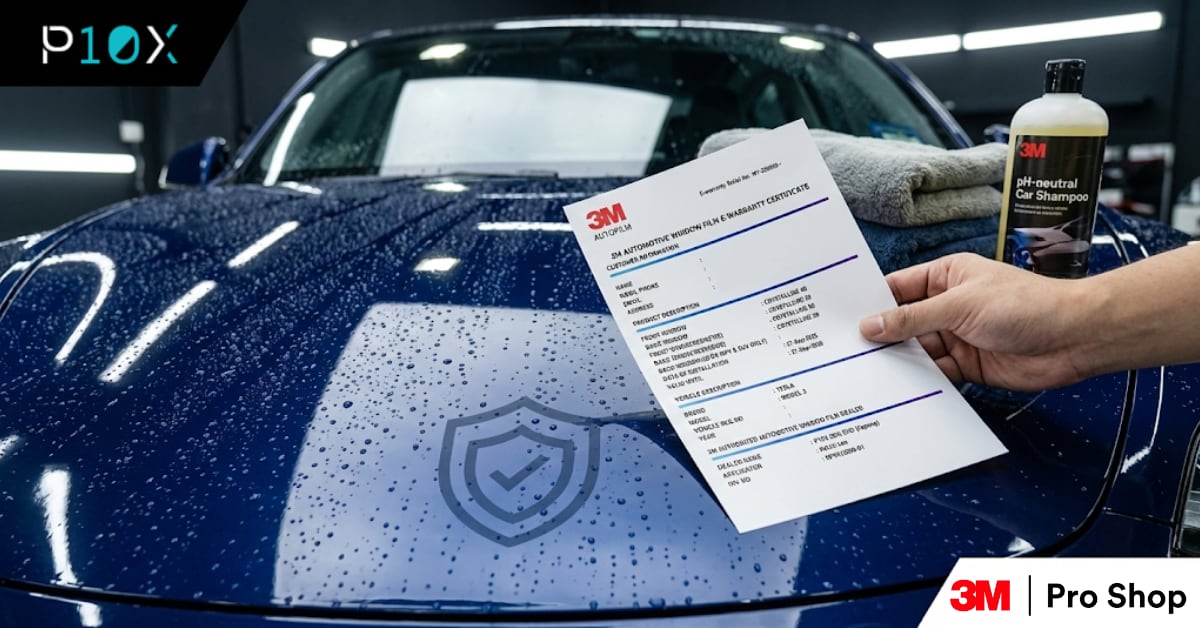
Understanding the ppf warranty malaysia requirements helps you protect both your film investment and your car's paint. 3M Paint Protection Film comes with warranty coverage that guards against defects, yellowing, and film failure. However, that warranty is not unconditional. Regular maintenance is the bridge between purchasing PPF and actually receiving the full protection the warranty promises.
Many car owners assume the warranty automatically covers any problem with the film. In reality, warranty terms require you to maintain the PPF according to 3M's care guidelines. If you neglect basic maintenance, you risk voiding the warranty and shortening the film's effective lifespan. This guide explains exactly how maintenance connects to warranty protection and what you need to do to maximize both.
Understanding 3M PPF Warranty Coverage in Malaysia
What the warranty covers
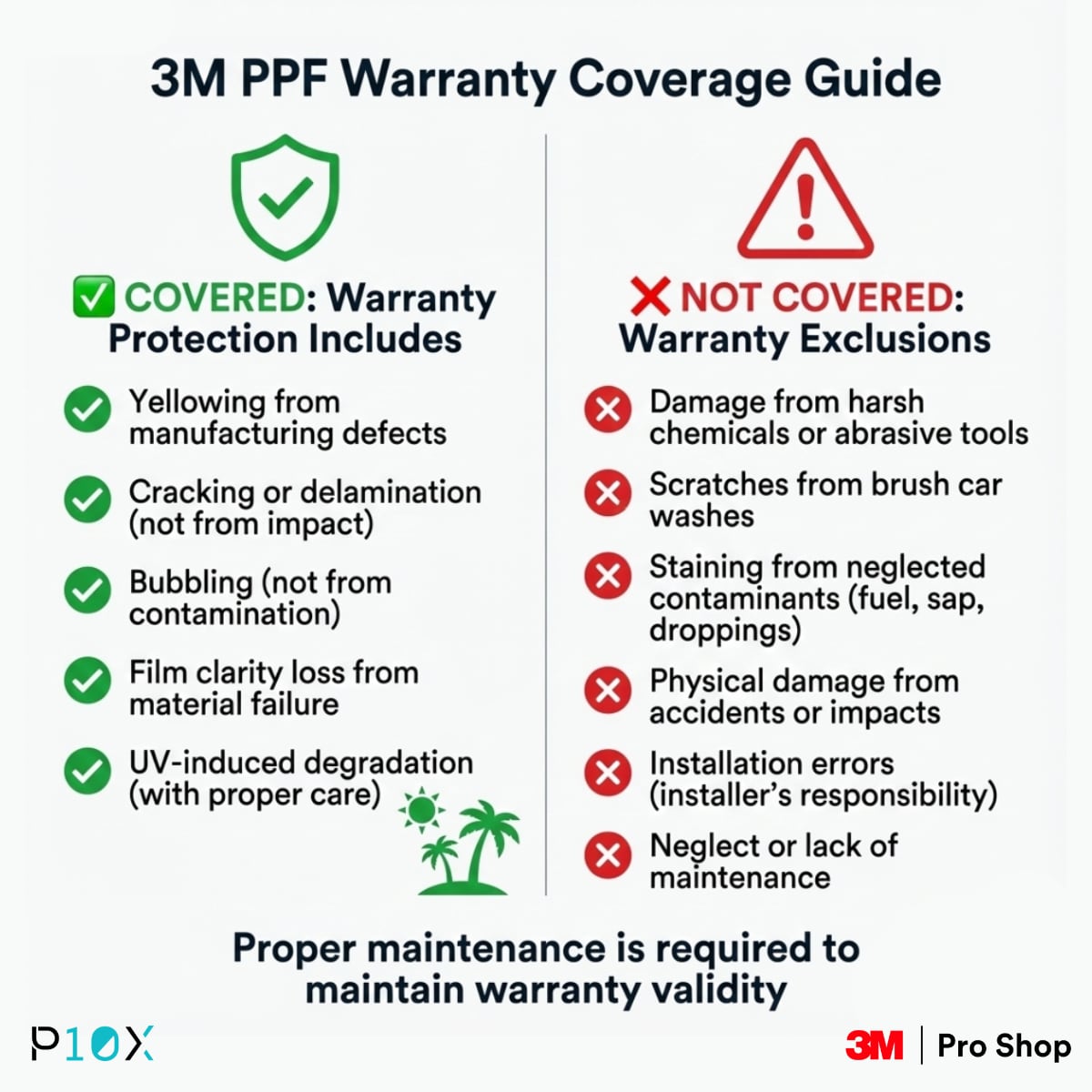
3M Paint Protection Film warranties protect against specific types of failure. For Series 150, Series 100, and Series 50, the warranty typically covers yellowing, cracking, bubbling, and delamination caused by manufacturing defects or material failure. If the film loses clarity, starts to peel from the paint, or develops a yellow tint without external cause, the warranty should cover replacement.
The warranty period varies by series. Series 150 generally offers longer coverage, reflecting its premium formulation and durability. Series 100 and Series 50 have shorter warranty periods but still provide solid protection against defects during the coverage window. Exact warranty lengths can differ based on the installer and regional terms, so confirm specifics with your 3M authorized dealer Malaysia at the time of installation.
UV damage is a key part of warranty coverage. Malaysia's intense tropical sun subjects PPF to constant UV exposure. 3M PPF is formulated with UV inhibitors to resist yellowing and degradation. If the film yellows prematurely despite proper care, that falls under warranty protection.
What the warranty does not cover
Damage from improper care is excluded. If you use abrasive cleaning tools, harsh chemicals, or automated brush car washes that scratch or lift the film, the warranty will not cover the resulting damage. Similarly, if you ignore fuel spills, tree sap, or bird droppings that stain or etch the film, those issues are considered maintenance failures, not defects.
Physical damage from accidents, collisions, or intentional misuse is also excluded. If a stone chip damages the PPF during normal driving, the film has done its job by protecting the paint underneath. However, that type of impact damage is not covered by warranty. The warranty addresses film failure, not the wear and tear the film is designed to absorb.
Installation errors fall under the installer's responsibility, not the film warranty. If the installer leaves contamination under the film, applies it incorrectly, or causes lifting due to poor technique, you should address that with the installer directly. This is why choosing a certified 3M Pro Shop matters. Certified installers stand behind their work and can resolve installation issues separately from the film warranty.
How Maintenance Directly Affects Warranty Validity
The maintenance clause in warranty terms
Every 3M PPF warranty includes a maintenance requirement. The exact wording varies, but the principle is consistent. You must clean and care for the film according to 3M's guidelines. If you fail to do so, the warranty can be voided.
This means hand washing with pH-neutral products, avoiding abrasive tools, removing contaminants promptly, and following the 72-hour curing period after installation. These are not optional suggestions. They are conditions of the warranty. If you take your PPF-protected car through a brush car wash weekly and the film starts showing scratches and lifting edges, the warranty will not cover replacement because the damage resulted from improper care.
Installers document your understanding of these care requirements at the time of installation. Some provide a written care guide or include maintenance instructions on the warranty card. Keep that documentation. If you ever need to make a warranty claim, the installer or 3M may ask whether you followed the care guidelines.
Proving maintenance compliance
If you need to file a warranty claim, you may need to demonstrate that you maintained the film properly. This is where documentation helps. Keep records of when you washed the car, any professional detailing or inspections, and receipts from visits to certified installers for maintenance or repairs.
Take photos of your PPF regularly. Monthly or quarterly photos showing the film's condition create a visual history. If an issue develops, you can show that the film was in good condition previously and that the problem appeared despite proper care. This evidence strengthens your warranty claim.
Some car owners keep a simple log noting wash dates and any significant events, such as fuel spills or professional inspections. This does not need to be elaborate. A dated note in your phone or a simple spreadsheet is enough. The goal is to show a pattern of responsible ownership if you ever need to prove you met the maintenance requirements.
For detailed guidance on what proper care looks like, refer to our article on paint protection film care tips Malaysia.
The Maintenance Routine That Protects Your Warranty
Weekly and bi-weekly care
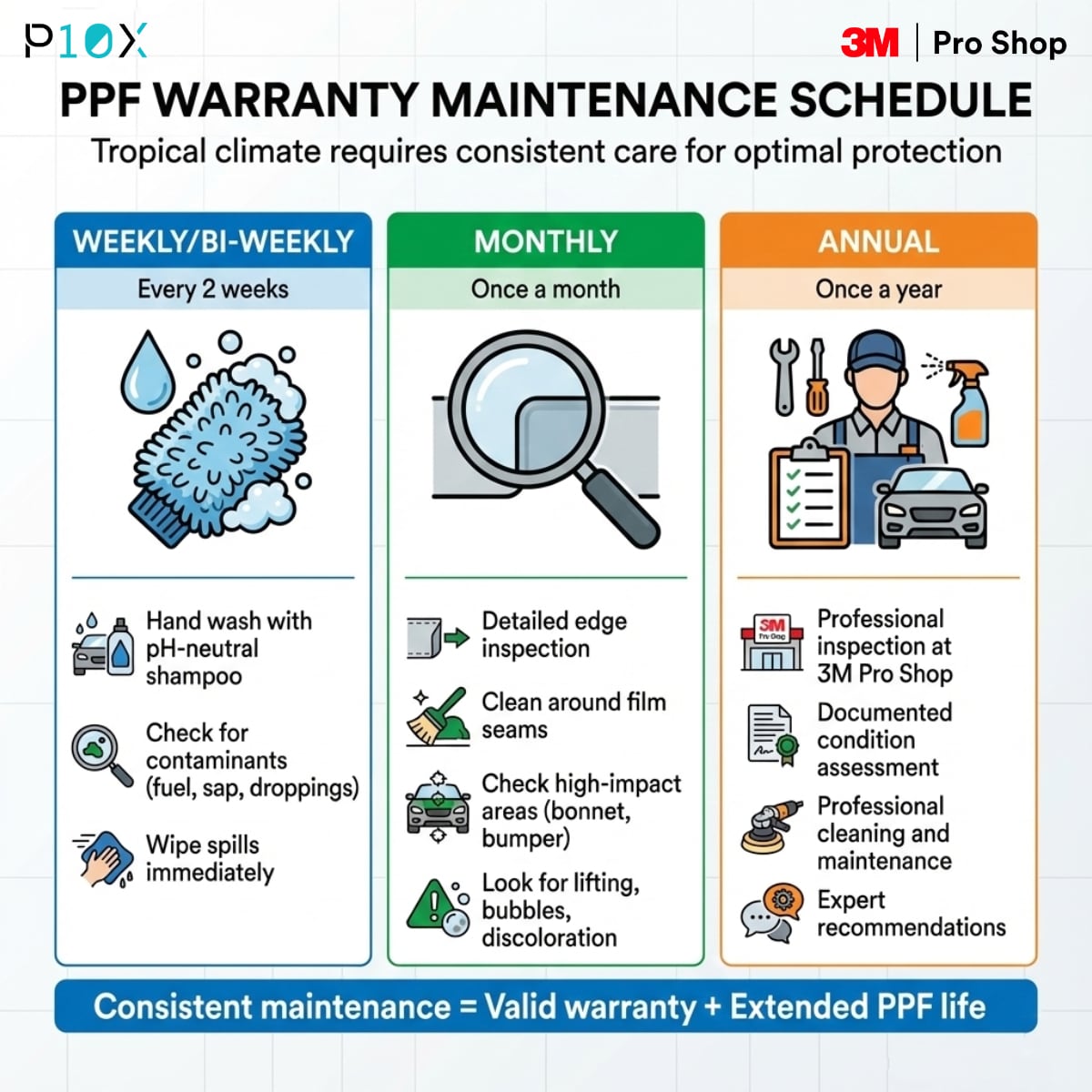
Hand washing every two weeks is the foundation. Use a pH-neutral car shampoo, two buckets (one for wash solution, one for rinsing your mitt), and a soft microfiber wash mitt. Rinse the car first to remove loose dirt. Wash from top to bottom in straight motions, not circles. Dry with a clean, plush microfiber towel.
This simple routine removes pollutants, dust, and light contaminants before they bond to the film. In Malaysia's urban areas, where traffic pollution and airborne grit are constant, regular washing prevents buildup that can dull the film or cause staining.
Check for new contamination after each wash. Look for bird droppings, tree sap, or insect remains. Remove these immediately with hot soapy water and a soft towel. Do not let them sit for days, especially in direct sun, as they can etch the film surface.
Monthly inspections
Once a month, inspect the PPF closely. Focus on edges, high-impact areas like the front bumper and bonnet, and any sections exposed to heavy sun or rain. Look for lifting edges, discoloration, bubbles, or changes in clarity.
Use a soft detailing brush and soapy water to clean around the film edges. Dirt and wax can accumulate at the seams where the film terminates. Keeping these areas clean prevents edge lifting and maintains the seamless appearance of the installation.
If you notice any issues, address them immediately. A small lifted edge can be re-sealed by a professional before it spreads. A minor discoloration might be removable with proper cleaning. Catching problems early keeps them from becoming warranty-threatening failures.
For guidance on when to seek professional help, see our article on when to schedule a professional PPF check-up.
Annual professional inspections
Schedule a professional inspection at a 3M Pro Shop once a year. Trained technicians know what to look for. They can spot early signs of adhesive weakening, UV damage, or contamination that you might miss. They can also perform a detailed cleaning and recommend any necessary touch-ups or repairs.
Annual inspections provide documentation. The installer will typically keep a record of the inspection, noting the film's condition and any work performed. This record supports your warranty claim if you ever need one. It shows you took proactive steps to maintain the film and sought professional oversight.
Professional inspections also offer an opportunity to ask questions. If you are unsure about a cleaning product, a new contaminant, or a change in the film's appearance, the technician can provide expert advice. This ongoing relationship with your installer is part of maintaining the warranty and the film's long-term performance.
How Proper Maintenance Extends PPF Lifespan Beyond Warranty
Why well-maintained PPF outlasts warranties
Warranty periods define the minimum expected lifespan of the film under proper care. However, PPF that receives consistent maintenance often performs well beyond the warranty period. Series 150 installed correctly and maintained diligently can remain clear and protective for seven to ten years or more. Series 100 and Series 50 can also exceed their warranty periods with proper attention.
The reason is simple. Warranty periods are conservative estimates. They account for average care conditions, including some degree of neglect or suboptimal maintenance. When you go beyond average and follow a disciplined care routine, you slow down the natural aging process. UV degradation, contamination, and wear accumulate more slowly, extending the film's useful life.
This extended lifespan means better return on investment. If you paid for Series 150 with an expected lifespan of five to seven years but the film remains effective for ten years, you have doubled the value of your initial investment. The cost per year of protection drops significantly when the film lasts longer.
Economic value of extended protection
Consider the cost of repainting a front bumper, bonnet, and fenders after years of stone chips and scratches. In Malaysia, professional paint correction and refinishing can cost several thousand ringgit. PPF prevents that expense entirely if maintained properly.
When you extend the PPF's life by two or three years through good maintenance, you delay or avoid the need for replacement. Each additional year of protection is another year you do not have to worry about paint damage, repaint costs, or reduced resale value. The return on your maintenance effort far exceeds the small investment of time and products required for regular care.
Resale value also benefits. Buyers pay premium prices for cars with flawless paint. If your PPF is still in excellent condition after several years because you maintained it well, the next owner sees a car that has been cared for meticulously. This perception increases buyer confidence and supports a higher asking price.
For more insight into maintaining your PPF for long-term value, refer to our ultimate 3M PPF aftercare guide for Malaysian car owners.
Common Maintenance Mistakes That Void Warranties
Using incorrect cleaning products
Many warranty claims are denied because car owners used cleaning products that damaged the PPF. Solvent-based cleaners, degreasers with strong alkaline formulas, and household cleaners with bleach or ammonia can break down the PPF's protective top coat. This causes yellowing, reduced hydrophobic properties, and accelerated UV degradation.
The warranty explicitly excludes damage from harsh chemicals. If you use a strong degreaser to remove a stubborn stain and the film turns yellow or loses its gloss, the warranty will not cover replacement. The damage is considered your responsibility because you used a product that violated the care guidelines.
Stick to automotive-specific, pH-neutral products. Read labels carefully. If a product warns against use on clear coats or films, do not use it on your PPF. When in doubt, ask your installer for product recommendations or use only products they sell or endorse.
Delaying contaminant removal
Fuel spills, tree sap, bird droppings, and insect remains damage PPF when left on the surface. In Malaysia's heat, these contaminants can etch into the film within hours. If you ignore a bird dropping for a week, it can leave a permanent stain or mark. That type of damage is not covered by warranty because it resulted from neglect.
The care guidelines specify prompt removal of contaminants. "Prompt" generally means within 24 hours, and ideally as soon as you notice them. Carry microfiber towels in your car so you can wipe spills immediately. This simple habit prevents almost all contamination-related damage and keeps your warranty intact.
If a stain does set because you were unable to address it quickly, visit a professional immediately. Some stains can be polished out if treated early. Waiting weeks or months reduces the chance of successful removal and increases the likelihood that the damage becomes permanent and non-warrantable.
Skipping post-installation curing period
The 72-hour curing period after installation is critical. Washing the car too early can introduce water under the film edges or prevent the adhesive from bonding correctly. This can cause bubbling, lifting, or delamination. If those issues appear and the installer determines you washed the car during the curing period, the warranty may not cover the repair.
Installers provide clear instructions about the curing period. Follow them exactly. If you must drive during the first 72 hours, avoid heavy rain and muddy conditions. Park in a covered area. After 72 hours, you can resume normal washing and care routines.
Respecting the curing period is part of the installation process. Think of it as an extension of the installation itself. The film is not fully installed until the adhesive has cured. Treating the car as if the film is fully set before it actually is can void the warranty before you even begin regular maintenance.
To avoid these and other common errors, review our guide on common mistakes to avoid when caring for your PPF.
Warranty Transfer and Resale Considerations
Does the warranty transfer to new owners?
Some 3M PPF warranties are transferable, while others are not. Transferability depends on the specific warranty terms provided by the installer and the film series. If your warranty is transferable, it can add value to your car at resale. Buyers appreciate knowing the PPF is still under warranty and that they will have protection if a defect appears.
To transfer a warranty, you typically need to provide documentation to the new owner. This includes the original warranty certificate, proof of installation, and any maintenance records. The new owner may need to register the transfer with the installer or 3M. Check the warranty terms at the time of installation to understand the transfer process.
Even if the warranty is not formally transferable, documented maintenance and a well-maintained film still add value. Buyers can see that the PPF is in excellent condition and has been cared for properly. This gives them confidence in the car's overall condition and reduces the perceived risk of future paint damage.
Documenting care for resale value
When you sell your car, provide the new owner with a complete maintenance history for the PPF. Include the original installation receipt, warranty certificate, maintenance logs, and photos showing the film's condition over time. This documentation demonstrates that the car has been well cared for and that the PPF has been maintained according to 3M's guidelines.
Buyers often pay more for cars with documented service histories. PPF maintenance records are part of that history. They show that you invested not just in protection but also in maintaining that protection. This level of care signals to buyers that the entire car has likely been treated with the same attention to detail.
If you have had annual inspections at a 3M Pro Shop, include those records as well. Professional inspection reports carry weight with buyers. They provide an independent assessment of the film's condition and confirm that the car received professional oversight throughout your ownership.
Why Professional Installers Matter for Warranty Protection
Certified vs. uncertified installers
3M PPF warranties typically require installation by a certified installer. If you purchase 3M film but have it installed by an uncertified shop, you may not receive the full warranty coverage. Certification ensures the installer has been trained by 3M, understands proper installation techniques, and uses the correct tools and environment.
Certified 3M certified installers Malaysia follow strict standards. They work in controlled environments, use clean tools, and apply the film according to 3M's specifications. This reduces the risk of installation defects that could compromise the warranty. It also means you have a knowledgeable partner for maintenance and warranty support throughout the film's life.
Uncertified installers may offer lower prices, but the risk is higher. If the installation fails due to poor technique or contamination, you may have no recourse. The film warranty may be void, and the installer may not stand behind the work. The initial savings are not worth the risk of losing warranty protection and having to pay for reinstallation or paint repair.
Installer support for warranty claims
When you need to file a warranty claim, your installer is your first point of contact. Certified installers understand the warranty process and can help you gather the necessary documentation, assess the issue, and submit the claim to 3M if needed.
Good installers also handle minor issues proactively. If you bring your car in for an annual inspection and the technician notices early signs of edge lifting or contamination, they can address it on the spot. This prevents the issue from becoming a warranty claim and keeps your film in top condition.
Building a relationship with your installer pays off over the life of the PPF. They get to know your car, your driving conditions, and your maintenance habits. They can offer tailored advice and catch issues early. This ongoing support is part of the value of choosing a certified 3M Pro Shop for installation and maintenance.
For more on what to look for when choosing an installer, see our article on what to look for in a 3M authorized dealer.

Maintaining Different PPF Series for Maximum Warranty Benefit
Series-specific care considerations
While the basic maintenance routine applies to all 3M PPF series, there are nuances. Series 150 has a more advanced top coat with stronger hydrophobic properties. This means contaminants bead off more easily, but you should still wipe spills promptly. The higher performance does not mean you can neglect care.
Series 100 offers a balanced formula. It requires the same hand washing, contaminant removal, and edge inspection as Series 150. The warranty period may be shorter, but the care requirements are identical. Do not assume a shorter warranty means lower maintenance standards. Proper care is required regardless of series.
Series 50 is the entry-level option. It still delivers excellent protection, but the top coat may be less durable than higher series. This means you should be extra cautious with cleaning tools and chemicals. Use only the softest microfiber mitts and the gentlest pH-neutral shampoos. Avoid any product that could stress the film's surface.
Warranty period differences
Series 150 typically carries the longest warranty, reflecting its premium construction and durability. If you have Series 150, you can expect warranty coverage for several years, provided you maintain the film properly. This longer coverage period gives you more time to benefit from warranty protection and more incentive to maintain the film diligently.
Series 100 and Series 50 have shorter warranty periods, but the coverage is still valuable. Even a three-year warranty provides significant peace of mind. If a defect appears within that window and you have maintained the film correctly, you are protected. The shorter warranty does not reduce the importance of maintenance. It actually makes consistent care more critical, since you have a narrower window to address any issues under warranty.
Regardless of series, the goal is the same. Maintain the film properly so it lasts beyond the warranty period. The warranty is a safety net, not a target. Aim for the film to perform flawlessly for years after the warranty expires, with the warranty serving as backup protection in case of unexpected defects.
For more details on the differences between 3M PPF series, refer to our article on comparing 3M PPF series in Malaysia.
The Long-Term Value of Warranty-Backed PPF Maintenance
Calculating total cost of ownership
When you factor in maintenance costs, the total cost of owning PPF is still far lower than the cost of repairing paint damage. A few bottles of pH-neutral shampoo, microfiber towels, and an annual professional inspection cost a few hundred ringgit per year at most. Compare that to the cost of repainting a bonnet or front bumper after years of stone chips, which can run into several thousand ringgit.
If your PPF lasts eight years because you maintained it well, the cost per year of protection drops significantly. Divide the initial installation cost plus maintenance expenses by eight years, and the annual cost is modest. The value is even greater when you consider the preserved resale value and the peace of mind of driving without worrying about paint damage.
Maintenance also prevents small problems from becoming expensive repairs. A lifted edge that is re-sealed early costs a fraction of what full film replacement would cost. Regular inspections catch these issues when they are minor and inexpensive to fix. This preventive approach keeps your total cost of ownership low.
Peace of mind and confidence
Knowing your PPF is under warranty and properly maintained gives you confidence. You can park under trees without worrying about sap. You can drive on highways without stressing over stone chips. You can refuel without panicking if a drop of petrol hits the bonnet. The film is doing its job, and your maintenance routine ensures it keeps doing that job for years.
This peace of mind has real value. You enjoy your car more. You drive with less stress. You do not have to avoid certain roads or parking spots because you are worried about paint damage. The combination of quality film, proper installation, diligent maintenance, and warranty protection creates a complete shield for your car's appearance.
When you eventually sell the car, you can present it with pride. The paint is flawless. The PPF is clear and intact. The maintenance records show you cared for the car meticulously. Buyers recognize this care and reward it with higher offers. The return on your maintenance investment is realized not just in protection but also in resale value.
Proper maintenance of your 3M PPF is not optional. It is the key to keeping your warranty valid, extending the film's lifespan, and maximizing the value of your investment. Simple, consistent care routines protect your film and your peace of mind. When you maintain your PPF according to 3M's guidelines, you unlock the full potential of the warranty and ensure your car's paint stays pristine for years. If you want expert support, partner with a 3M Pro Shop for professional maintenance and warranty-backed care.
Find out the best protection for your car
Visit a 3M Pro Shop and discover the cost-effective 3M Protective Film and Window Tint
Frequently Asked Questions
What happens if I miss a few washes or forget monthly inspections?
Occasional lapses are not likely to void your warranty if the film remains in good condition. The issue arises when neglect causes visible damage, such as staining, edge lifting, or contamination buildup. If you miss a wash or inspection, catch up as soon as possible and ensure you stay consistent going forward.
Can I use a wax or sealant on top of my PPF?
Yes, you can apply wax or sealant designed for clear coats and films. Use a soft applicator and avoid products with abrasive compounds. However, well-maintained 3M PPF already has a hydrophobic top coat, so additional wax is often unnecessary. If you do apply wax, choose a high-quality product and follow the manufacturer's instructions.
Will my warranty cover damage from a stone chip?
No. Stone chips are expected wear and tear. The PPF absorbs the impact and protects the paint underneath. The film has done its job. Warranty covers defects in the film material, not damage from external impacts. If the film tears or chips from a stone strike, that is not a warranty issue.
How do I know if my installer is certified by 3M?
Ask the installer directly. Certified installers can show their 3M accreditation certificate or you can verify them through 3M's official dealer locator. Working with a certified installer ensures you receive full warranty coverage and professional support throughout the film's life.
What should I do if I notice yellowing within the warranty period?
Contact your installer immediately. Yellowing within the warranty period may be covered if you have maintained the film properly. The installer will assess the issue, review your maintenance records, and determine if the yellowing is due to a defect or external factors. If covered, they will process the warranty claim with 3M.

Fabian
He is passionate about revolutionizing the car protection services industry by bringing innovation and transparency to a traditionally opaque and often misunderstood field. His mission is to educate end users on the true benefits and importance of car protection, aiming to replace outdated practices with honest, customer-focused solutions. With a fresh approach to car tinting, paint protection film (PPF), and detailing services, he is committed to delivering a superior customer experience that sets a new standard in the market. He welcomes discussions about the future of the automotive industry and is eager to connect with like-minded professionals who share his vision for innovation, integrity, and excellence.
Experience the future of window tinting
Visit a 3M Pro Shop and discover the revolutionary Crystalline CR BLK film