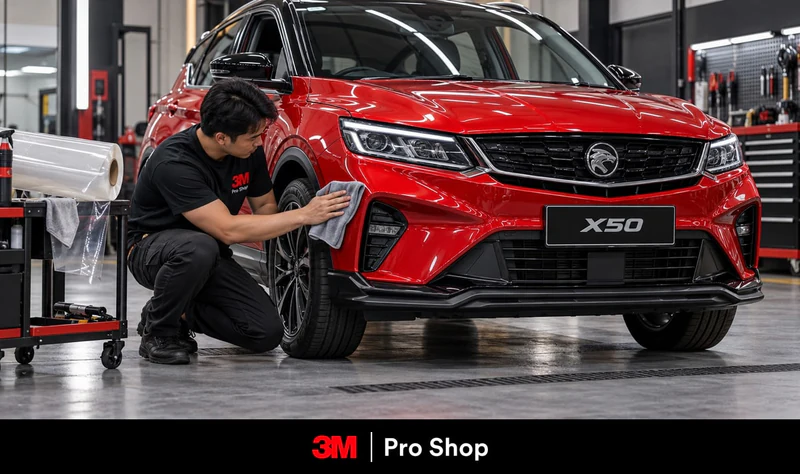
✧ Key Takeaways
- 3M paint protection film (PPF) should not go over ceramic coating. 3M's installation guidelines call for coating-free paint wherever the film goes.
- The coating only needs to come off the panels getting film, and an authorised paint-correction specialist or detailer should do the removal.
- After removal, a careful installer still runs 3M's full prep steps before fitting the film.
- Panels without film can keep their existing coating.
- A compatible coating can go on top of the film later for extra gloss and water beading.
You should not install 3M PPF over ceramic coating. 3M's installation guidelines call for coating-free paint, so the coating has to come off the panels that will get film first, while the rest of the car can keep it.
You had your car ceramic coated, and now you want paint protection film on the front. It is natural to ask whether the installer can put the film over the coating and save the coating you already paid for.
Some shops say it is fine once the coating has cured, and others refuse. For 3M paint protection film, 3M's installation guidelines side with removal. Once the coating is off those panels, your car gets the same benefits from 3M PPF as any other car. The only difference is one extra step at the start.
Why PPF struggles to stick over coating
Ceramic coating gives paint a slick surface that repels water and dirt. PPF needs its adhesive to stick to clean paint. When a coating sits between the adhesive and the paint, the film may not grip well, especially around edges and curves.
Adhesive does not get on well with a surface made to repel things, and the trouble usually shows up in three ways.
- Weak adhesion. The film does not hold as firmly as it should.
- Edge lifting. Edges are where film is under the most tension, so a weak bond usually shows up there first as lifting.
- Uneven finish. The film may not lie as flat over a coated panel as it does on clean paint.
Some installers say they have had good results putting film over cured coatings with certain products. Results vary by coating, film and conditions, and installing over a coating is not the 3M method. Edge lifting is one of the signs of a bad PPF installation, and on a coated panel it is hard to tell whether the coating or the install caused it.
3M's installation guidelines require coating-free paint however long the coating has cured, so waiting longer does not change anything. A cured coating is still an extra layer between the paint and an adhesive made to stick to prepared paint. That is also why a panel that looks smooth and clean is not necessarily ready for 3M PPF.
Coating comes off only the covered panels
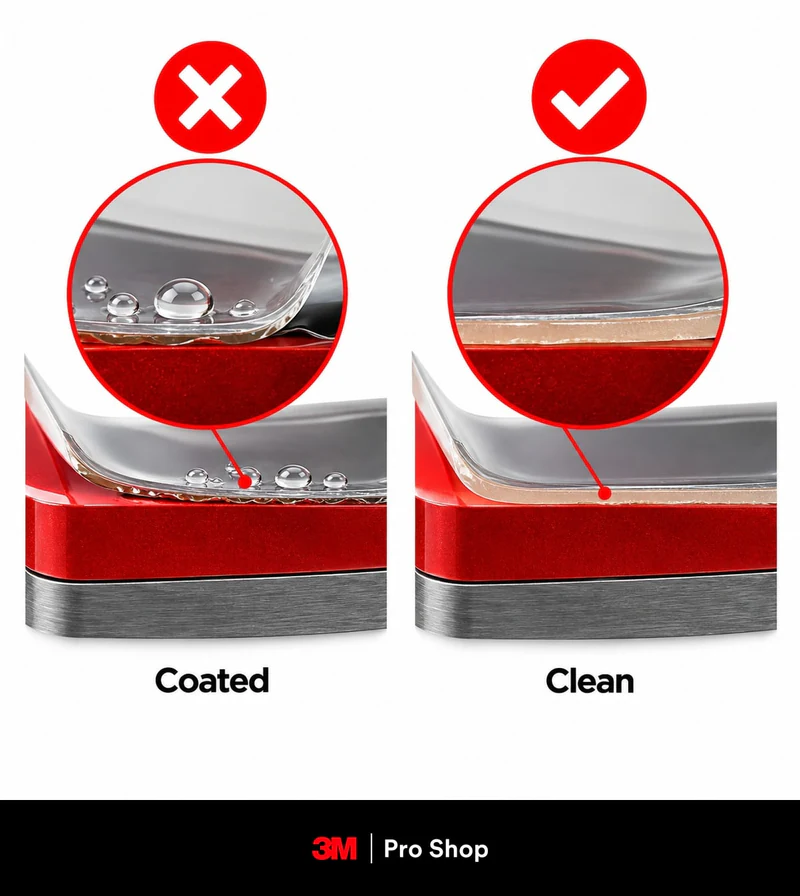
Ceramic coating only needs to come off the panels that will get PPF, not the whole car. A paint correction specialist or detailer handles removal using methods suited to the coating and paint. Panels that will not get film can keep their existing coating.
This is a professional job. Coatings are designed to resist chemicals and washing, so removal usually involves careful machine work and inspection. We do not recommend trying to strip a coating at home with household products, because it is easy to damage the paint or leave patches of coating behind.
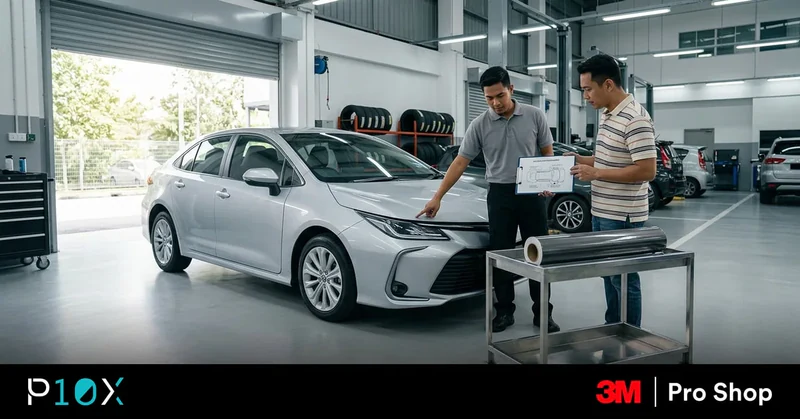
Before removal starts, your installer can mark exactly where the film edges will sit. Coating may need to come off slightly beyond the film edge, so the adhesive has clean paint all the way to the border. It is worth deciding how much PPF coverage you need based on how you drive before removal starts, so no coating comes off panels you do not plan to cover.
| Panel | Getting film? | Coating on paint | Later option |
| Full bonnet | Yes | Removed by a professional | Compatible coating on the film |
| Front bumper | Yes | Removed by a professional | Compatible coating on the film |
| Front fenders | Yes | Removed by a professional | Compatible coating on the film |
| Side mirrors | Yes | Removed by a professional | Compatible coating on the film |
| Headlights | Optional | Removed if covered with PPF | Your installer can advise on suitable options |
| Doors and door handles | Optional | Kept unless covered with PPF | Maintain existing coating if no film is fitted, or use a compatible coating on the film |
| Roof | Optional | Kept unless covered with PPF | Maintain existing coating if no film is fitted, or use a compatible coating on the film |
| Boot lid and rear bumper | Usually no | Kept | Maintain existing coating |
Say you want film on the full bonnet, front bumper, both front fenders and both side mirrors. That is six panels where the coating must come off. The roof, the four doors, the rear quarters, the boot lid and the rear bumper keep their coating. On a typical sedan with about 15 painted exterior panels, that leaves more than half the car still coated.
Paint preparation comes before film preparation
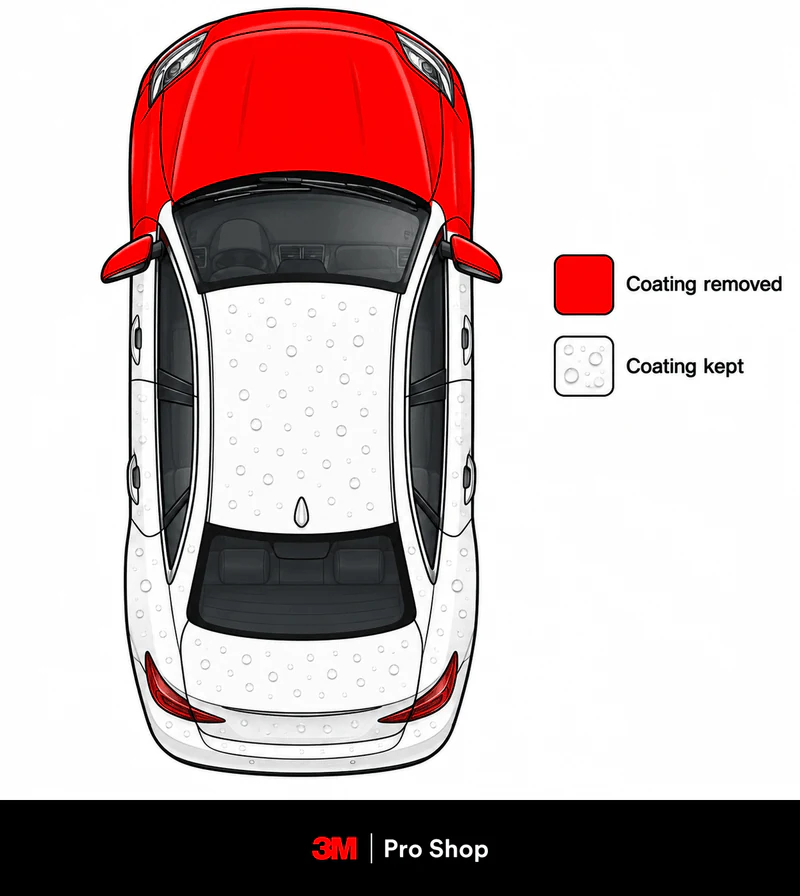
After ceramic coating is removed, 3M PPF preparation has five steps: check for remaining coating, use 3M General Purpose Adhesive Cleaner, use a non-ammonia glass cleaner, clay the surface, then wipe and inspect it. Each step removes something different before the film goes on.
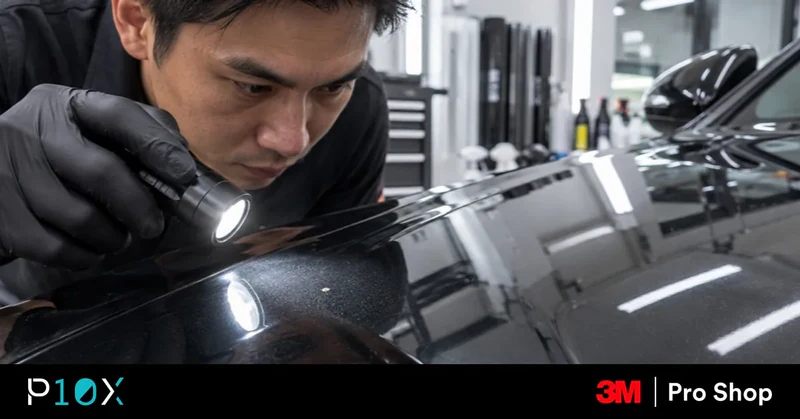
If the paint has swirls or light scratches, this is also the moment to correct them. Film covers marks but does not remove them, so this is the easiest time to deal with swirl marks before PPF goes on, especially on dark paint, where they show up most.
- Checking that no ceramic coating remains on the panels that will get film.
- Cleaning with 3M General Purpose Adhesive Cleaner to remove wax, tar and sealant residue.
- Cleaning with a non-ammonia glass cleaner to remove any oily residue left behind.
- Claying the surface with a clay bar such as 3M Perfect-It Clay Bar to lift bonded contaminants.
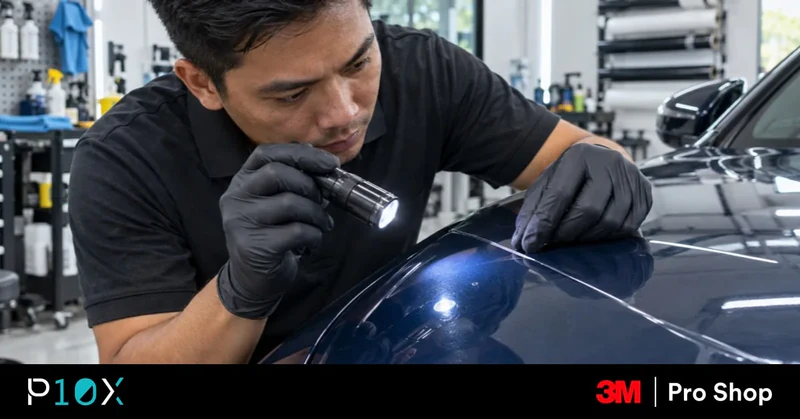
- Doing a final wipe and close inspection under good light before film goes on.
Rushed prep is also how dust ends up trapped under PPF. Taking the coating off does not replace these steps, because wax, tar, sealant residue and bonded dirt still have to come off before the panel is ready.
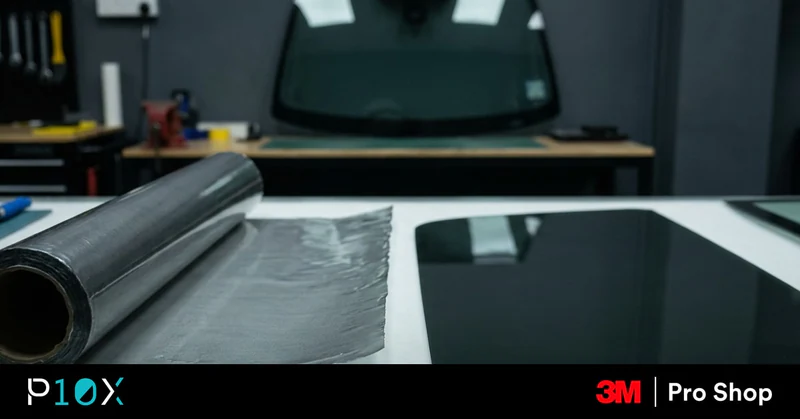
Our technician also prepares the film sheet itself before installation. That is a separate job from preparing the paint, and a well-prepared sheet cannot make up for a panel that has not been through 3M's full preparation steps.
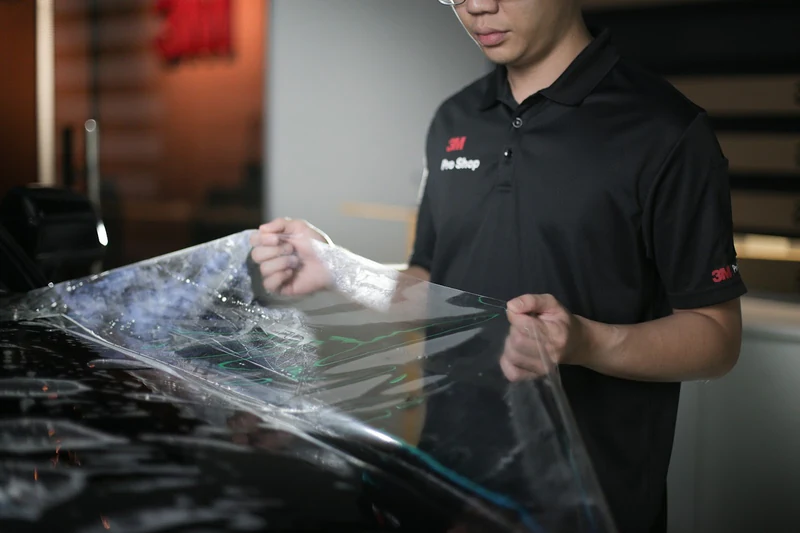
PPF fitting needs clean paint at every edge
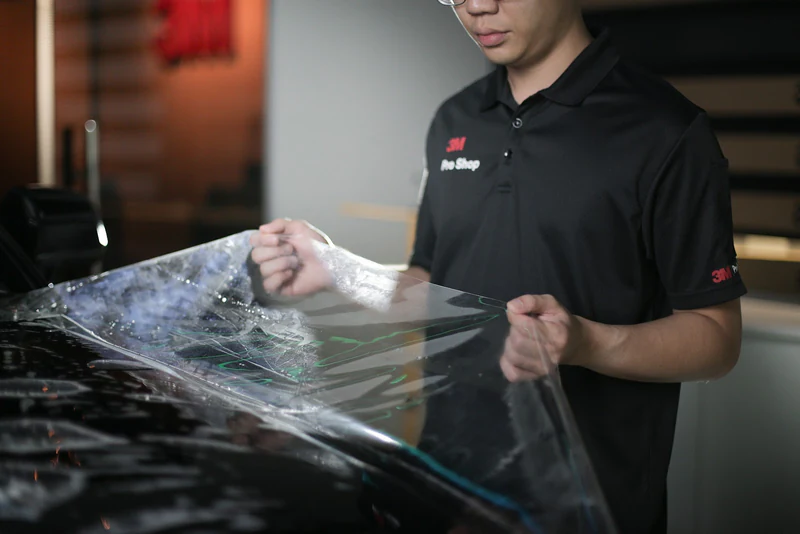
PPF needs prepared paint across the covered panel, including where the film ends. Ceramic coating left near an edge can leave the adhesive meeting a different surface from the rest of the panel. Agreeing where the film will stop tells everyone where the coating needs to come off.
With partial coverage, where the film ends matters as much as which panel it is on. A bonnet can be covered in full or only in part. You can ask the installer to show where the edge will sit before removal begins, rather than assuming that every bonnet installation covers the same area.
3M's adhesive is designed and tested on prepared paint, not on coatings with different chemistry. When every installer follows the same preparation, every job starts from the same clean surface. If a problem shows up later, nobody has to guess what was under the film.
Film is not permanent. One day it may need to come off, whether after many years of use or after a panel gets damaged. Removal is done with heat by a professional. A film bonded to clean paint releases in a predictable way. Over an old coating, it is much harder to say how the film will come away.
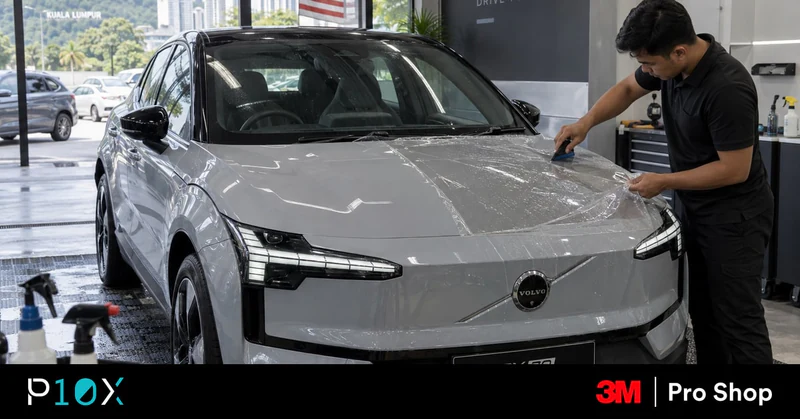
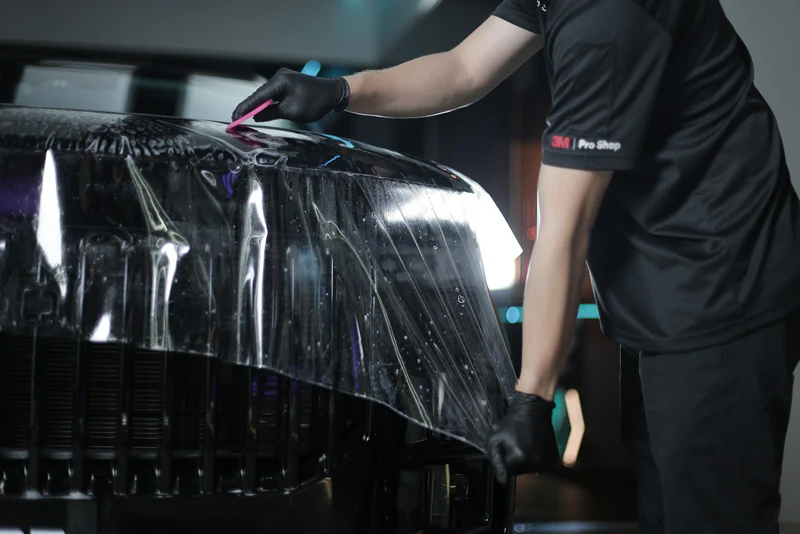
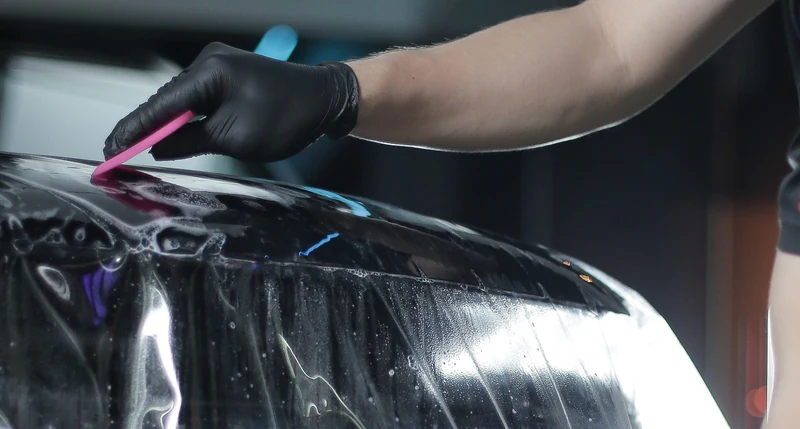
During fitting, an installer works the PPF onto the panel with a squeegee. That comes after paint preparation, not instead of it, and however carefully the film is laid, it cannot make up for coating left underneath.
Ceramic coating goes above the film
A compatible ceramic coating can go on top of 3M PPF, rather than underneath it. Newly installed film needs time before coating is applied, and your installer can advise how long to wait. The coating then sits on the film, while the film remains attached to prepared paint.
3M's care guide lists 3M Ceramic Coating and 3M Ceramic Boost Spray as options for use on 3M paint protection film. Applied on top of the film, a compatible coating adds gloss, water beading and easier washing. Keeping an existing paint coating underneath is not the way to get those benefits.
Not every coating made for paint is made for a film surface. You can ask which product the installer approves for the particular film you choose, rather than assuming the coating already on your car is suitable for reuse on top.
Preparation for coating the film should also be gentle. Polishing compounds and abrasive pads can scratch the film surface. The machine work used to strip coating from paint is not something to repeat on the PPF once it has been installed.
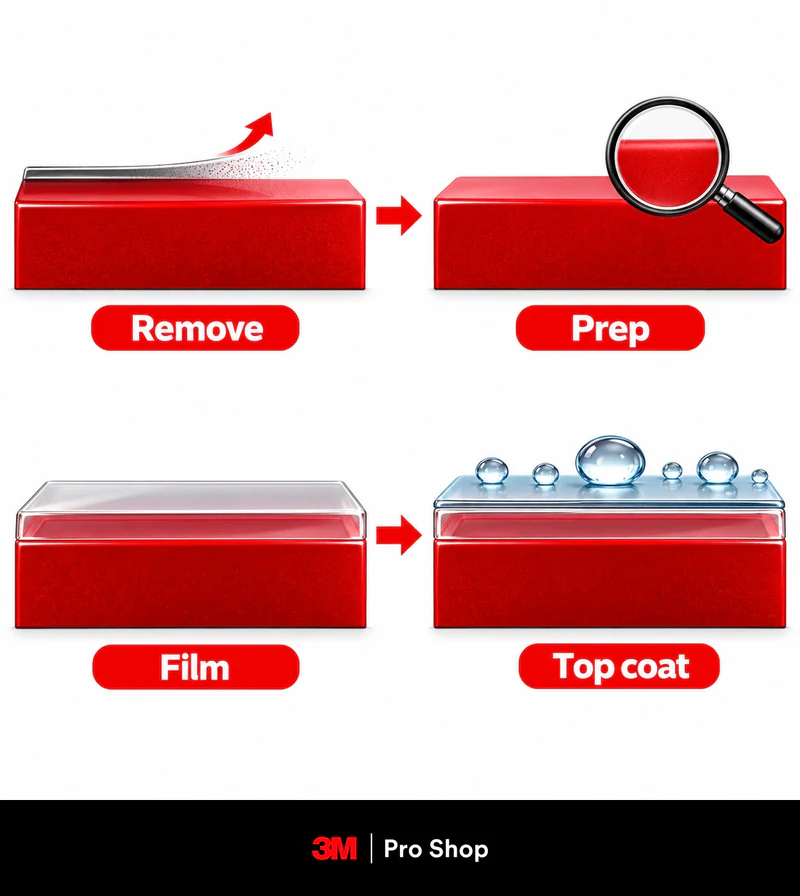
On a car that is already coated, ceramic coating comes off the paint first. The panel then gets the full preparation sequence, PPF goes onto clean paint, and a compatible coating can go on top afterwards once the newly installed film is ready. That way, the film's adhesive sits on paint, not on the old coating.
PPF and coating do different jobs
PPF adds a physical film over the paint, while ceramic coating changes how water and dirt behave at the surface. Coating can add gloss and water beading, but it is not a replacement for the film. You can choose PPF without adding another coating on top.
The film you choose matters too, because some 3M films already repel water on their own. 3M Pro Series 200 is about 8 mil (roughly 0.2 mm) thick, comes in gloss or matte, and is already self-healing, stain resistant and hydrophobic, so water beads on it before any coating goes on. Series 150 is a gloss film with high stain resistance and clarity. Series 50 is the gloss entry film.
That means water beading on a filmed panel does not prove a separate ceramic coating has been applied, and it does not tell you whether an old coating is still on the paint beneath the film.
Self-healing PPF and a self-healing coating are not the same thing. A coating on top does not take over the film's protection. The real question is whether you want a physical layer over the paint or only a change to its finish.
Ceramic coating, PPF and wax are not interchangeable. Coating adds shine, but it does not stop a stone from chipping paint. PPF provides a physical barrier against impact. So a coating you already have is not the same as the film you now want on the front of your car.
What if a shop recommends coating underneath?
If a shop offers to install PPF over ceramic coating, you can ask which film it uses, how it prepares the panels and who covers repairs if edges lift. You can also ask who removes the coating and which products can go on the film afterwards. For 3M PPF, coating-free paint is still required.
A different film or a shop's experience with a particular coating does not change the 3M installation method. You can share the coating brand and when it was applied, if you know them. That helps whoever removes it far more than being told the car has been detailed.
- Which film are you installing? If it is 3M film, the 3M guidelines apply.
- What happens if the edges lift? It is worth asking who covers the repair, and whether the coating would be treated as the cause.
- How will you clean the panel first? A proper answer should include the full prep sequence, not just a quick wipe.
- Who will remove the coating, and how? The answer should name who does the work and the method they use.
- Which panels will be stripped, and where will the film edges sit? A clear answer means the plan is set before any machine touches the paint.
- Which coating products are approved for the film afterwards? The shop should be able to name them before the job starts.
Workmanship matters as much as the film brand. Clean edges, properly wrapped corners and neat squeegee work are worth asking about before booking, along with the support you get after the job. A film name alone tells you none of that.
Washing and waxing after PPF installation
3M's PPF guidelines say to wait at least 72 hours before the first wash while the film cures. After that, a touchless wash or hand wash is preferred. Having a compatible coating on top does not change the washing and care rules for the film underneath.
3M's PPF guidelines recommend washing in the shade with a neutral shampoo. At home that might be the car porch or a basement carpark bay rather than the open driveway at 2pm. Drying the car soon after rinsing, and using a liquid wax, helps prevent water spots on the film. Strong alkaline, acidic or alcohol-based cleaners should stay off the film, and so should abrasive pads and brushes.
A pressure washer is fine within 3M's limits. That means a nozzle of at least 40 degrees with a tip guard, pressure of 80 bar or below, and water at 60°C or cooler. The wand should stay at least 30 cm from the panel and point straight at the surface, never at a film edge from a shallow angle. At a self-service wash bay, it is worth checking the nozzle and the pressure setting before you start.
After each wash, a quick walk around the car shows any lifting at the film edges, especially along the front of the bonnet and around the side mirrors. Tree sap, tar, road grime and other organic fallout should come off as soon as you spot them, because 3M's guidelines warn they can stain or damage the film if left. After a balik kampung drive on the PLUS highway, the front bumper and bonnet are worth checking that same evening.
If you would rather not coat the film at all, 3M's care guide gives wax intervals instead. For Pro Series 200 and Series 150, the guide recommends applying 3M Perfect-It Show Car Paste Wax within 3 to 6 months. For Series 50, the wax should go on within 3 months. Any other wax should be tested on a small hidden area first, and waxes with dyes, abrasive polishes and rubbing compounds should stay off the film.
Those care steps come after installation. Before then, you can plan around the first wash and the time the PPF needs to cure, rather than booking a wash as soon as you collect the car.
Planning PPF on a ceramic-coated car
If your car is already coated, you can still add PPF. What matters is the order. The coating comes off only where film will go, those panels get properly prepared, the film goes on, and a compatible coating can go on top afterwards if you want one.
If your car is new and you plan to do both, the simplest order is film first, then coating. That avoids paying to remove a coating you just applied.
At 3M Pro Shop by P10X, we follow 3M's preparation steps on every install, including coated cars. Any of our 3M Authorized Dealer locations can help you plan your film and coating in the right order.
Find out the best protection for your car
Visit a 3M Pro Shop and discover the cost-effective 3M Protective Film and Window Tint
Frequently Asked Questions
Can PPF go over a fully cured ceramic coating?
3M PPF cannot be installed over a fully cured ceramic coating. 3M's installation guidelines require coating-free paint, regardless of how long the coating has cured. An authorised paint-correction specialist or detailer should remove the coating first.
Will I lose the ceramic coating on my whole car if I add PPF?
Adding PPF does not mean removing ceramic coating from your whole car. The coating only needs to come off the panels getting film. The rest of the car keeps its coating.
Can I remove the ceramic coating myself?
We do not recommend removing ceramic coating yourself. Coatings are designed to resist chemicals and washing, so removal is a job for an authorised paint-correction specialist or detailer.
Can I put ceramic coating on top of PPF?
A compatible ceramic coating can go on top of PPF. 3M's care guide lists 3M Ceramic Coating and 3M Ceramic Boost Spray for use on 3M paint protection film. Your installer can advise when it is safe to apply the coating.
Should I coat first or film first on a new car?
On a new car, installing PPF before ceramic coating is simpler. You avoid paying to remove a coating you just applied, and you can add a compatible coating on top of the film afterwards.
What if my film starts lifting over an old coating?
If PPF starts lifting over an old ceramic coating, your installer should inspect the film. Lifting edges need professional attention.