
How Much PPF Coverage Do You Need for the Way You Drive?
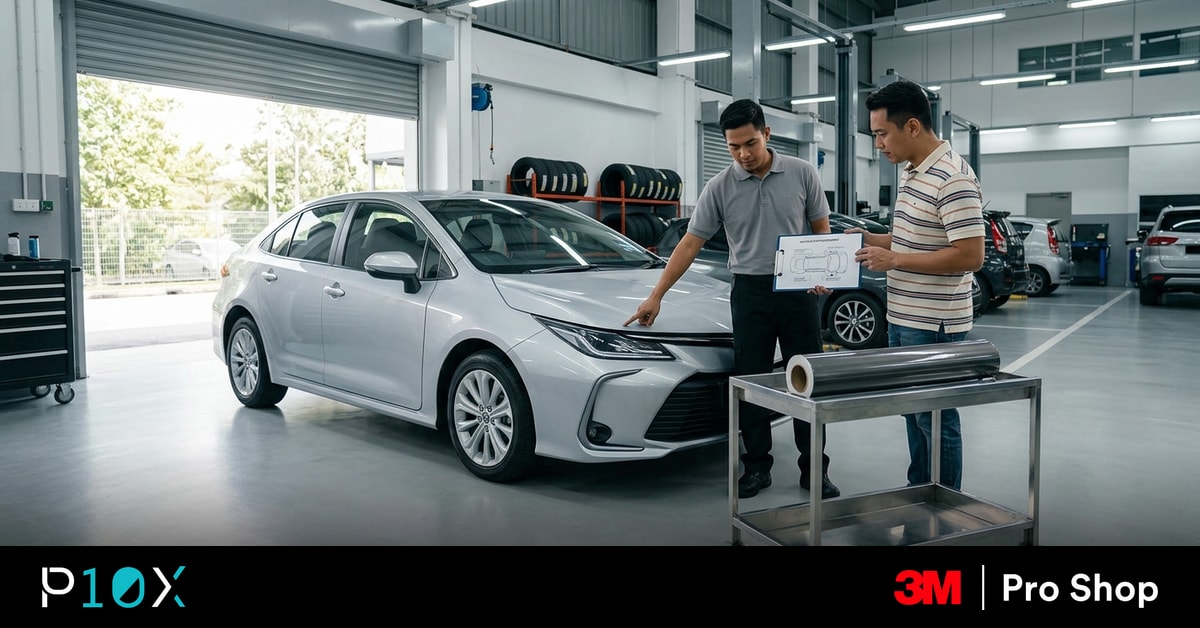
- Before you look at any quote, write down your usual cruising speed and how many car lengths you leave.
- Count how many of your weekly kilometres are highway and how many are town. The ratio picks your tier.
- Say out loud where the car sleeps. Basement, open lot or street. It changes which panels matter.
- Tell the shop how you wash the car. That decides more about the finish than the film grade does.
- Ask for the coverage list in writing and check it against your own answers, not against a package name.
How much PPF coverage you need has almost nothing to do with your car and almost everything to do with your right foot and how close you sit to the lorry in front. Two identical cars on the same road can reach five years old looking a decade apart.
On Lowyat, an owner who runs the North-South Expressway between JB, KL and Penang put it about as plainly as it can be put. Stone chips are friends to his bumper and headlamp, so that is exactly where his film went. Another owner in the same thread said he only filmed his headlight and foglight and left the rest bare.
You are probably holding a quote with three tiers on it and no honest way to tell which one is yours. The question of whether film earns its keep has been answered plenty of times. What almost nobody answers is how much of it you specifically need.
Why Speed Decides the Damage, Not Distance
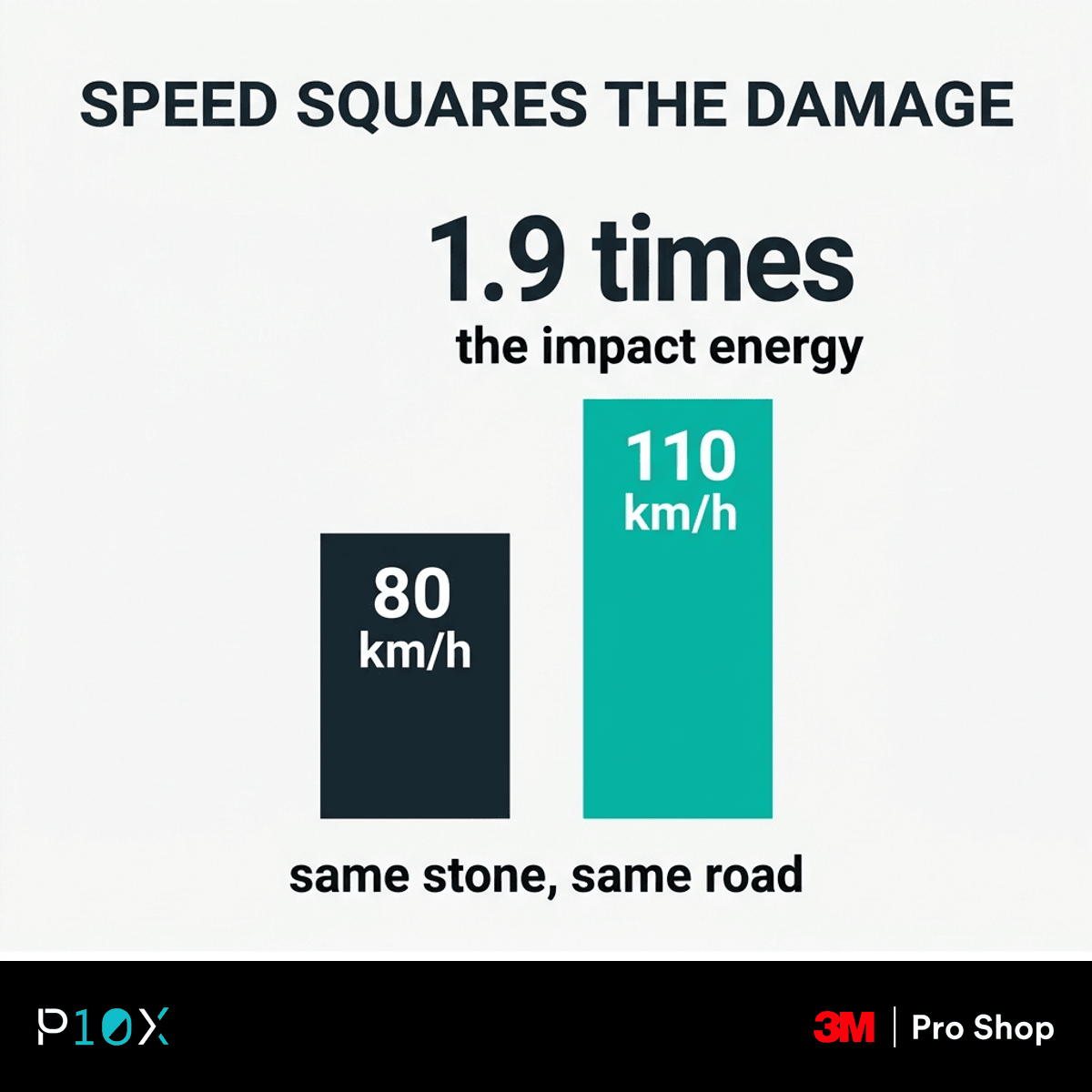
A stone does not care how far you drove. It cares how fast you were going when you met it. Impact energy rises with the square of speed, so the gap between a highway driver and a town driver is far wider than their odometers suggest.
That is the piece most coverage advice gets wrong. People assume kilometres are the unit of damage, so the person who drives more needs more film. Kilometres decide how often you meet debris. Speed decides what happens when you do, and the second one moves much faster than the first.
Here is the difference between two drivers. Take the same piece of grit on the same stretch of the PLUS, and treat the closing speed as roughly the car's own speed. Driver A cruises at 110 kilometres per hour. Driver B sits at 80. Energy scales with the square of speed, so the ratio is 110 divided by 80, squared, which is 1.89. Driver A's bonnet takes close to double the impact energy for the identical stone.
Following distance stacks on top of that. Sit two car lengths behind a lorry at speed and you are intercepting debris while it still carries most of the velocity the tyre gave it. Drop back to a proper gap and much of that has already bled off before it reaches you. Same road, same lorry, different bonnet.
Lane choice does the same thing quietly. The left lane on any Malaysian expressway is where the lorries are, and it is also where the road surface takes the most punishment and sheds the most loose material. A driver who overtakes and comes back left every few minutes spends far more of the journey in the debris stream than one who sits in the middle lane and stays there. Neither of them would describe that as a driving habit, but it is one, and it shows up on the bonnet.
How to Read Your Own Driving Week
Five questions, answered honestly, before you look at a single price. Write the answers down. They are worth more to a good installer than the make and model of your car.
Step 1: Name Your Real Cruising Speed
Not the limit. What you actually sit at on the PLUS when the road is clear. Anything at or above 110 puts you in the top tier of impact energy whether you like it or not.
Step 2: Count Your Following Distance
In car lengths, behind a lorry, at speed. Two or fewer means you are collecting debris at close to full velocity. Four or more and a lot of it has slowed before it arrives.
Step 3: Split Your Week Highway Against Town
Roughly what share of your weekly kilometres is open road. Above half and the front of the car is your whole problem. Below a quarter and your damage is happening in carparks instead.
Step 4: Say Where the Car Sleeps
Basement, open lot, or on the road outside the house. Each one produces a completely different set of marks over three years, and only one of them is about stones.
Step 5: Describe How It Gets Washed
Brush wash at the petrol station, hand wash at home, or a proper detailer. This is the answer that most changes what the paint looks like in year four.

That conversation is the whole job. A shop that quotes you a tier before asking any of those five questions is selling a package, not solving your problem, and the pre-film paint and glass check belongs in the same conversation.
What Each Coverage Tier Actually Buys
Three tiers, and they are not degrees of the same thing. Partial front buys you the two panels that take impacts. Full front buys you the whole leading face. Full body buys you the panels that get damaged standing still.
Partial front is the bonnet leading edge and the front bumper face. That is the pair the Lowyat driver on the North-South route arrived at by himself, and he arrived there because that is where his chips were. If your week is mostly highway and your budget is tight, this is the honest answer.
Full front adds the fenders, the headlights and the mirrors. The fenders take grit thrown backwards by your own front tyres, which sandblasts rather than chips. The headlights haze under our sun and cannot be resprayed the way paint can, which the headlight film article works through from both sides.
Full body adds everything behind the front doors. Rear quarters, roof, boot lid and its loading lip, rocker panels, rear bumper. Almost none of that damage arrives at speed. It arrives from groceries, luggage, trolleys, other people's doors and road spray, which is why a town driver can need more film than a highway driver despite driving less.
| Panel | What hits it | Impact risk | Which driver needs it | Suggested 3M series | Coverage tier |
|---|---|---|---|---|---|
| Bonnet leading edge | Debris at closing speed | Highest | Anyone above 90 on open road | Series 150 | Partial front |
| Front bumper face | Grit, tar, kerbs | Highest | Everyone | Series 150 | Partial front |
| Headlights | Stones and ultraviolet | High | Open lot parkers especially | Series 150 | Full front |
| Front fenders | Grit off your own tyres | High | Highway share above half | Series 100 | Full front |
| Side mirrors | Stones in the airflow | Medium | Highway share above half | Series 100 | Full front |
| Door cups | Fingernails and keys | Medium | Families and shared cars | Series 50 | Ala carte |
| Boot loading lip | Groceries and luggage | Medium | School run and mall drivers | Series 50 | Ala carte |
| Rocker panels | Road spray and grit | Medium | Wet season commuters | Series 100 | Full body |
| Rear bumper | Trolleys, bays, bags | Low to medium | Street and open lot parkers | Series 50 | Full body |
| Roof and rear quarters | Fallout and general wear | Low | Long term keepers | Series 100 | Full body |
Read the fourth column before the last one. If your answers from the section above do not put you in a row, that row is not your row, whatever the package on the counter says. Most owners find they belong in six or seven of the ten rows rather than in a neat tier, which is exactly why the ala carte version of this conversation usually ends up cheaper than the package version.
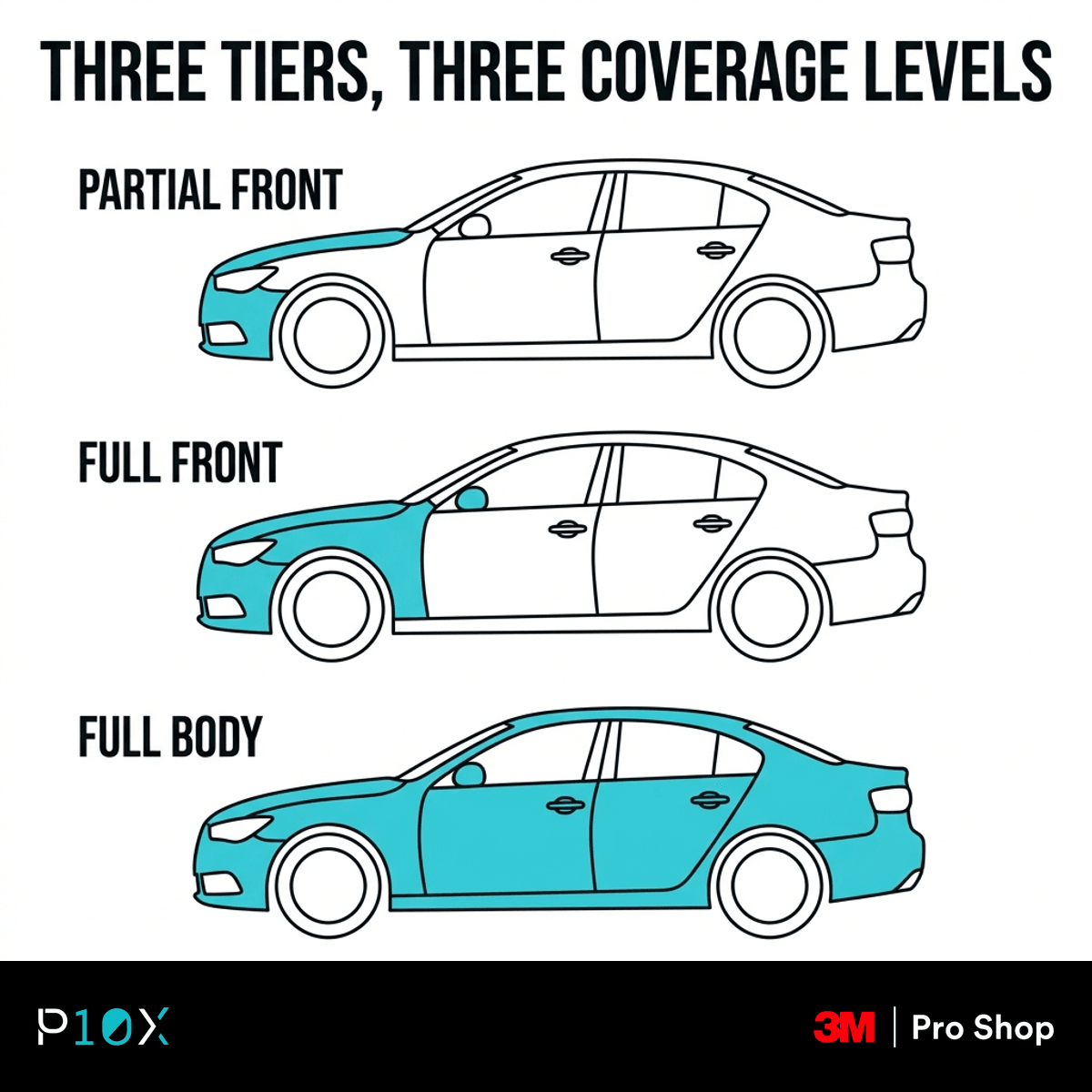
Notice that the three tiers do not get progressively better at the same job. They each solve a different job. Going up a tier because it sounds safer is how people end up paying for film on a roof that was never going to get hit.
That clip covers why owners reach for film in the first place, which is worth watching before you decide how much of it your particular week justifies.
Where You Park Changes the Answer
Your parking spot is a driving habit even though the car is not moving. A basement produces mechanical damage from pillars, trolleys and door edges. An open lot produces ultraviolet and heat damage across the horizontal panels. A street spot produces both plus everything a passing vehicle throws.
The basement case is the one people underestimate. Nothing hits the front of a car in a basement, so a full front does very little for you down there. What gets hit is the door edge, the door cup, the rear bumper corner and the mirror housing, none of which appear on a standard front package.
The open lot case pushes the answer upward, toward the roof and the bonnet as flat surfaces rather than as impact zones. Horizontal panels take the most ultraviolet, and they are also where organic fallout lands and sits until you wash it off. Film there is about the finish surviving rather than about stones.
The street case is the demanding one, because the car takes carpark damage and road damage in the same week without ever being driven for the second one. If your car sleeps on a road with traffic on it, treat yourself as one tier higher than your driving alone would suggest.
There is one more parking question worth asking yourself, and it has nothing to do with damage. How often does the car sit still for days at a time? A car that is driven every morning gets rinsed by rain and dried by airflow constantly. A car that sits for a week at a time lets whatever landed on it bond to the surface, and that is a different kind of wear that film handles well and paint does not.
4 Habits That Waste Good Film
Buying a tier that does not match your week, brush washing a filmed car, skipping the paint correction, and washing too soon after fitting. Three of the four are things you do afterwards, which is why film often disappoints people who bought the right product.
Buying the Tier Your Neighbour Bought
Coverage is personal. The person who does Karak twice a week and the person who does school runs in Bangsar need genuinely different lists, and neither list is a subset of the other.
Brush Washing a Filmed Car
This is the fastest way to make good film look bad. Hand washing is preferred, and if you use an automatic it should be touchless. Our condo washing guide covers doing it properly with no driveway.
Skipping the Correction Step
Film is clear, so whatever is on the paint underneath stays visible. Existing swirl marks get sealed in and stay sealed in until the film comes off.
Washing Inside 72 Hours
3M's own care guidance is to wait 72 hours after installation before washing. The adhesive is still settling, and an early wash at the wrong pressure is how edges start lifting.
Fixing all four costs you one conversation and one changed habit. Ignoring them costs you the difference between film that still looks invisible in year five and film you are apologising for.
Matching a 3M Series to Your Week
Series 150 on the panels that take impacts, Series 100 across the panels that take abrasion, Series 50 on the panels that take fingernails. Mixing them is normal and usually cheaper than one grade everywhere.
Series 150 Gloss is around 8 mil, specified for exceptional clarity with lower orange peel, high flexibility on difficult contours and a hydrophobic finish. On a high speed commuter it belongs on the bonnet edge, the bumper face and the headlights, because those three are where your speed is being converted into damage.
Series 100 Gloss sits at around 7.5 mil, specified as protecting against rocks, keys and salt, with an easy release liner and enough stretch for bulk installation. That stretch is why it suits the long panels, the fenders and the rockers, where the damage is a constant fine abrasion rather than a single hit.
Series 50 Gloss is the entry film at 185 microns, warranted against bubbling and cracking. Yellowing is not a covered defect on any 3M film. The films use ultraviolet inhibitors that resist yellowing as a product characteristic, which is a reason to buy quality film and not a reason to expect a replacement. The series comparison puts all three side by side.
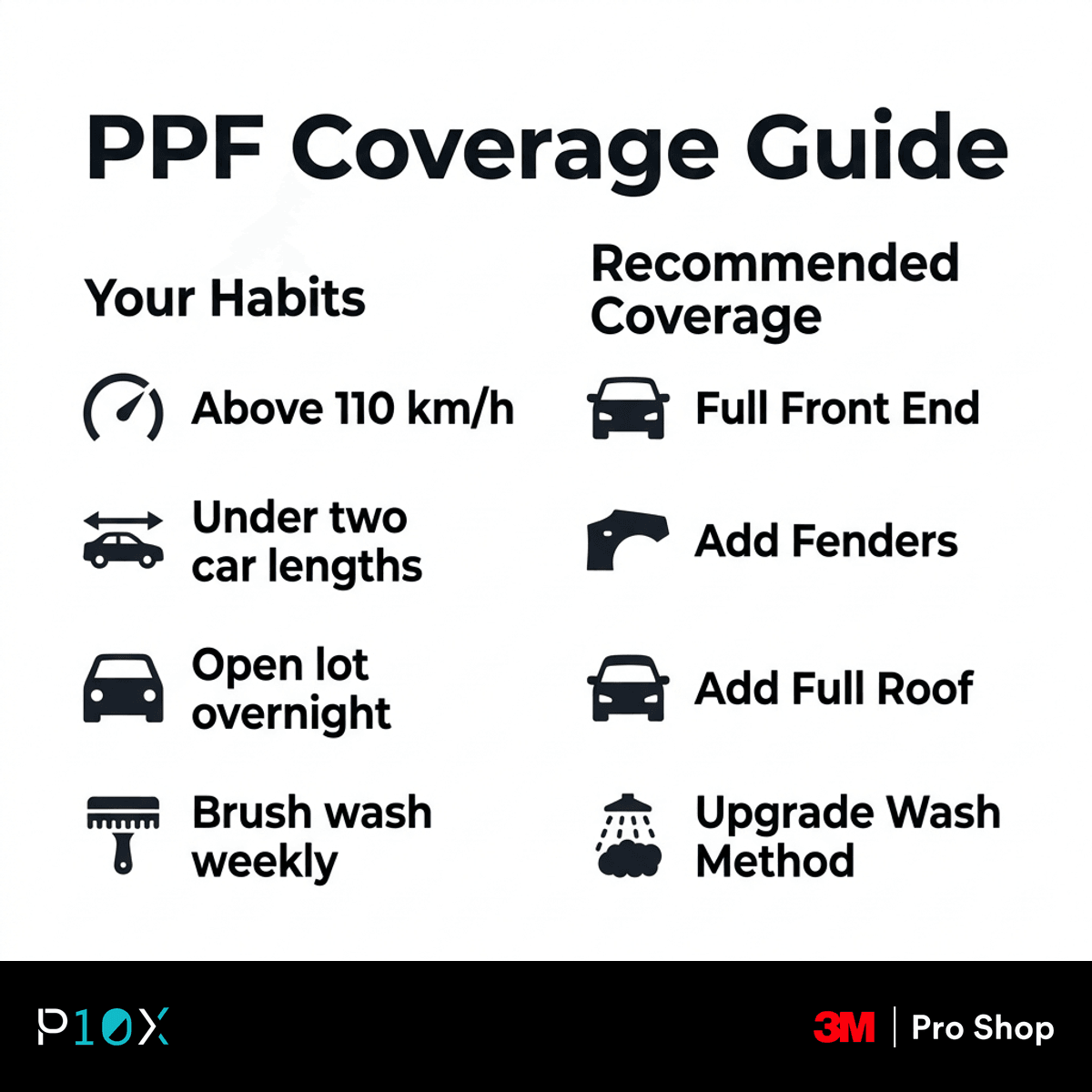
The last row of that list is not a joke. If you brush wash a car every week, changing that habit does more for the paint over five years than moving up a coverage tier does, and it costs nothing.

Once the list is agreed, the rest is workmanship. How flat the film sits, whether the edges are wrapped or trimmed, and whether any tension was designed into a panel that will spend five years trying to pull it back out.
The argument in that one is that the same brand of film gives different results depending on who fits it. That is true, and it is the reason the coverage list is only half of the decision.
Booking the Coverage That Fits You
Take your five answers with you. Cruising speed, following distance, highway share, where it parks, how it gets washed. Read them out before anyone quotes you anything, and ask which panels those answers point to.
Then get the list back in writing with a series named beside every panel. A tier name on a job sheet is not a specification, because two shops mean different things by it. A list of panels is checkable a year later, and a tier name is not. Our aftercare guide covers what changes about looking after the car once the film is on.
If you want the questions asked before the quote rather than after it, 3M Pro Shop by P10X works that way as standard and quotes ala carte rather than in fixed packages. The locations page has the nearest outlet.
PPF Coverage Questions Malaysian Drivers Ask
How much PPF coverage do I need on a daily car?
Start with the bonnet leading edge and the front bumper face, because those two take impacts at speed on any car. Move up to a full front if more than half your weekly kilometres are open road. Move up to full body if the car parks on a street or does a lot of carpark work.
Is full body PPF worth it if I mostly drive in town?
Often yes, but for a completely different reason than a highway driver would give. Town damage lands on the boot lip, the door cups, the rocker panels and the rear bumper, none of which a front package touches. You need more film, just not at the front.
Does driving faster damage paint more?
Yes, and the relationship is not linear. Impact energy rises with the square of speed, so a driver at 110 kilometres per hour takes roughly 1.9 times the energy of a driver at 80 from the same piece of debris on the same road.
How much does following distance matter for stone chips?
A lot. Sitting two car lengths behind a lorry means intercepting debris while it still carries most of the velocity the tyre gave it. A larger gap lets much of that bleed off first, on the same road behind the same vehicle.
Should I get PPF if my car is parked in a basement?
Probably, but not a front package. Basement damage is door edges, door cups, mirror housings and rear bumper corners, so an ala carte list built from those panels does more for you than a full front would.
Can I put 3M PPF on only some panels?
Yes, and mixing series across panels is normal. Series 150 on the impact panels, Series 100 on the long abrasion panels, Series 50 on the touch points. A good installer will quote it that way if you ask.
How soon after PPF can I wash my car?
3M's care guidance is to wait 72 hours before washing. After that, hand washing is preferred, and if you use an automatic wash it should be a touchless one rather than a brush wash.
Does PPF stop damage from a big stone?
Not always. Film absorbs and spreads the energy of small impacts so they never reach the paint, which covers most of what a Malaysian highway throws at you. A large stone at highway speed carries enough energy to deform the panel underneath, and no film changes that. What film changes is the hundreds of smaller hits that would otherwise each leave a mark.
Find out the best protection for your car
Visit a 3M Pro Shop and discover the cost-effective 3M Protective Film and Window Tint
Author

Kelvin Cheen
Kelvin is an Automotive Solutions Consultant and Branch Manager at 3M Pro Shop. With 4+ years of field experience in premium vehicle surface protection, Kelvin specializes in flagship 3M technologies, including 3M Crystalline Black optical film and Ceramic IR tints, 3M Paint Protection Film (PPF), etc. His focus is on delivering transparent, engineering-backed advice to car and EV owners, cutting through sales upsells to ensure customers choose the exact thermal rejection and paint protection tailored to their driving needs.
Experience the future of window tinting
Visit a 3M Pro Shop and discover the revolutionary Crystalline CR BLK film