
Jaecoo J5 Window Tint in Malaysia: What Percentage for Each Window
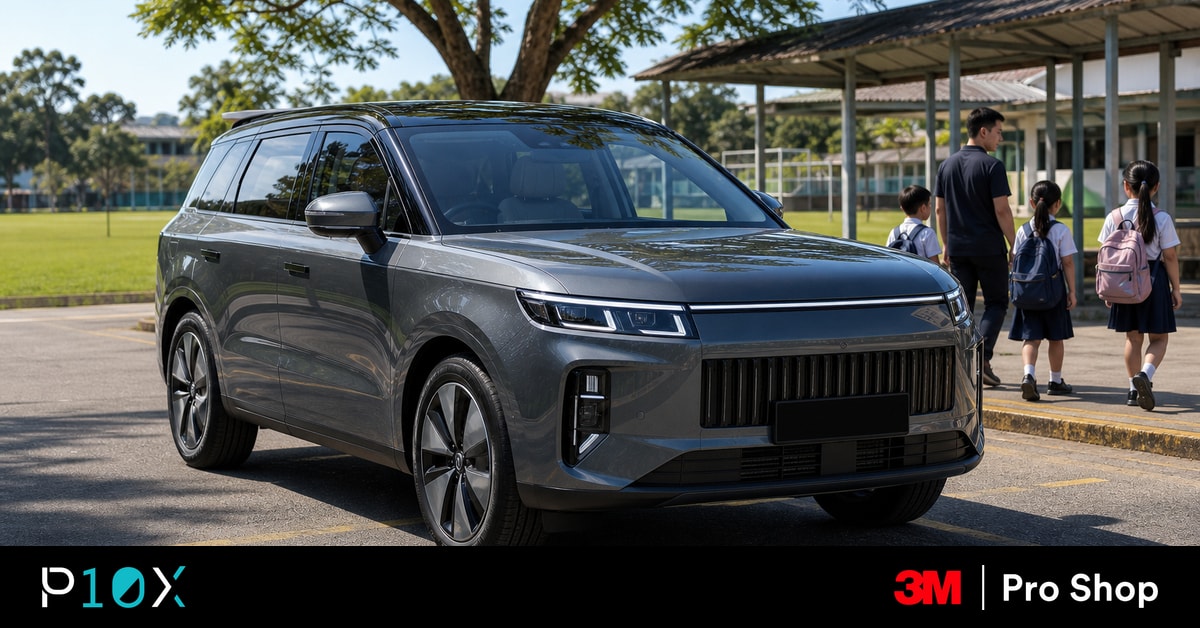
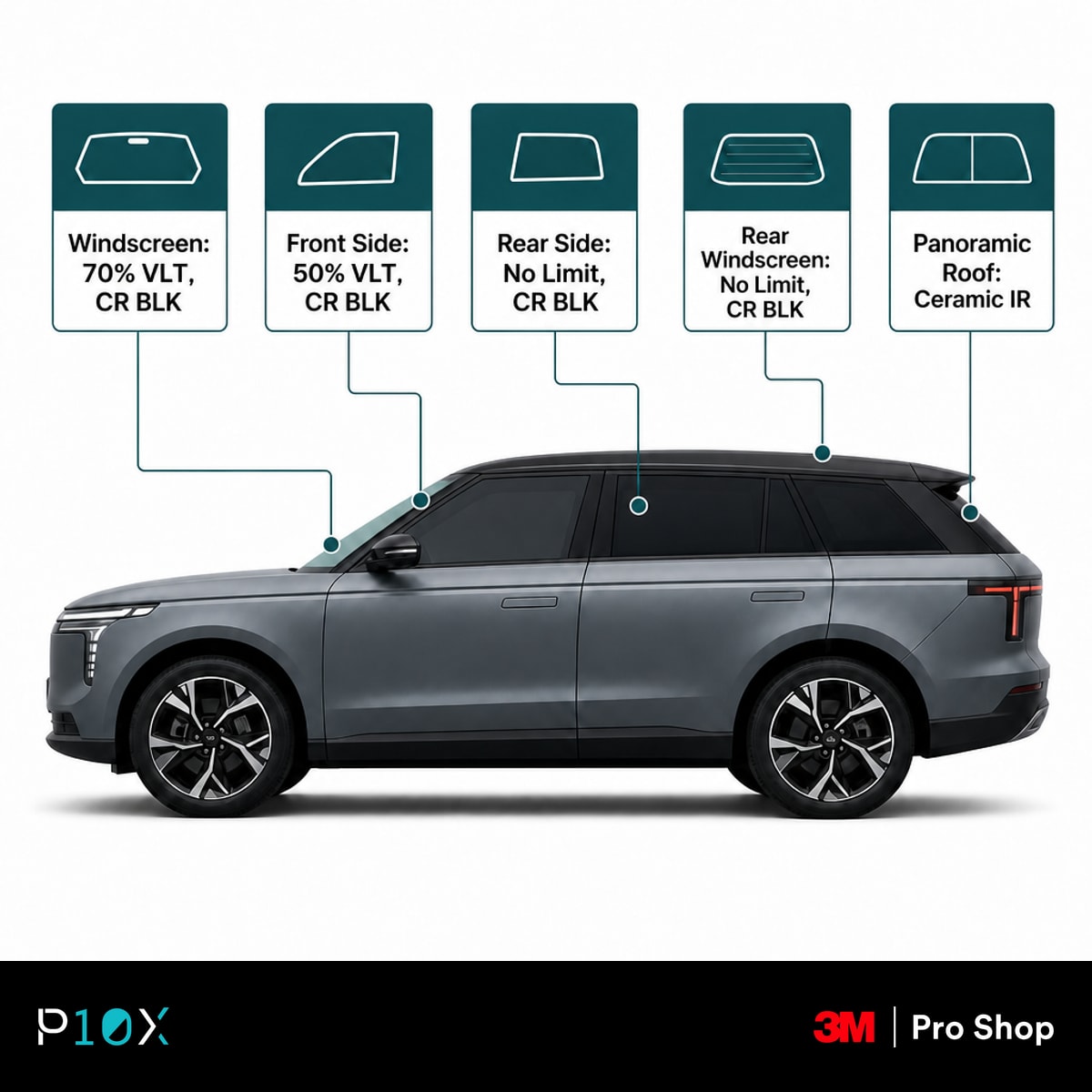
- JPJ asks for at least 70 percent light through your front windscreen and at least 50 percent through the front side windows. The rear side windows, the rear windscreen and the roof have no limit.
- The J5 gives you a panoramic roof on a B-segment footprint. Roughly the roof glass of a bigger SUV, over a smaller cabin, so the same sun heats less air faster.
- In the current Crystalline Black range the best heat rejection is CR BLK 50 at 68 percent, which happens to be exactly the legal shade for your front doors.
- The darkest shade, CR BLK 15, only reaches 64 percent. Darker is not cooler.
- Every shade blocks 99.9 percent of UVA and UVB, which matters most for whoever sits in the second row.
- Keep metallic and sputtered film off the windscreen. The J5's forward camera looks through that glass and its assist systems already get criticised.
Getting Jaecoo J5 window tint right in Malaysia comes down to five separate decisions, one for each pane, and the shade that suits your windscreen is not the shade that suits your rear doors. JPJ treats those windows differently and so should you.
The J5 is more interesting than most B-segment SUVs here because of what sits over your head. A panoramic roof on a car this size is generous, and it is the single biggest thing deciding how the cabin feels at 3pm. For the wider picture on film choice, start with why 3M window tinting suits Malaysian driving.
This is the window-by-window plan. What the law allows, what shade goes where, and the one film decision that is not really a choice on this car.
Why the J5 Panoramic Roof Heats Up Fast
What JPJ Allows on Each J5 Window
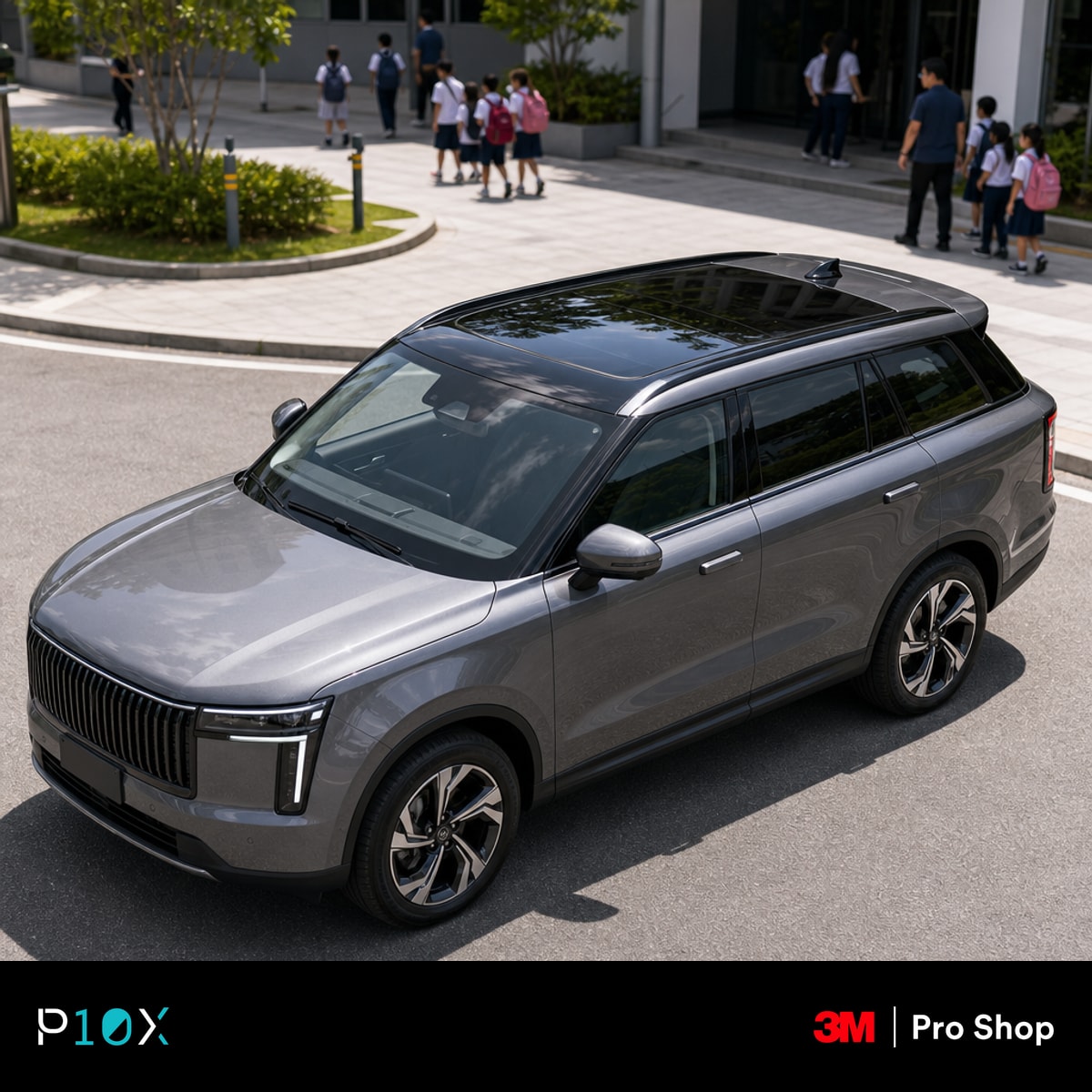
The rules are short and they are not the same for every pane. Your front windscreen has to let at least 70 percent of light through. Your front side windows have to let at least 50 percent through. The rear side windows, the rear windscreen and the roof have no limit at all.
Half the tint advice circulating in Malaysia gets this backwards, usually by swapping the front and rear numbers around. An owner following the wrong version ends up with a windscreen that fails inspection and a rear that is needlessly light, which is the worst of both. Check the figure against JPJ rather than against a shop's promotional post, and our breakdown of JPJ-compliant window tint covers how it is actually enforced.
The consequences are not trivial. A first offence carries a four-figure compound or a jail term of up to six months, and a repeat offence doubles both. On top of that an officer at a roadblock can require the film to come off there and then. Watching premium film get peeled off a car you collected three weeks ago at the side of the road is a bad morning and an expensive one. It comes back again at Puspakom time if you ever transfer ownership.
There is one more reason to stay legal on this particular car, and it has nothing to do with the summons. The shade that keeps you legal on the front doors also happens to be the best-performing shade in the range, which is the next section.

Best 3M Shade for Every J5 Window
Here is the short answer before the reasoning. CR BLK 70 on the windscreen, CR BLK 50 on the front doors, CR BLK 35 at the back, and Ceramic IR on the panoramic roof.
The shade codes are the light-through figures, so CR BLK 50 lets 50 percent of light through and CR BLK 70 lets 70 percent through. That means the number on the film tells you straight away whether it is legal on a given pane. Anything at 70 or above works on the windscreen. Anything at 50 or above works on the front doors. Everything else belongs behind the B-pillar or on the roof.
| Window | JPJ minimum light through | 3M shade that fits | Heat rejected | Why this one |
|---|---|---|---|---|
| Front windscreen | 70 percent | CR BLK 70 | 65 percent | Legal at the line and non-metallised, which the forward camera needs |
| Front side windows | 50 percent | CR BLK 50 | 68 percent | Highest heat rejection in the whole range, and exactly legal |
| Rear side windows | No limit | CR BLK 35 | 67 percent | Privacy for the second row with almost no heat penalty |
| Rear windscreen | No limit | CR BLK 35 | 67 percent | Matches the rear sides so the car reads consistent from behind |
| Panoramic roof | No limit | Ceramic IR | 63 percent | Neutral colour on the biggest pane, metal free, keeps the cabin from going dark |
Look down that heat column and something odd shows up. CR BLK 50 rejects more heat than CR BLK 35, and both reject more than the darkest film in the range. The full run is CR BLK 15 at 64 percent, 30 at 66, 35 and 40 both at 67, 50 at 68, 60 at 67, 70 at 65 and 80 at 59. The peak sits right in the middle. The darkest film available is four points worse than the one that is legal on your front doors, so going illegally dark on the front makes the car hotter and hands you a compound for the privilege.
Dark still does one thing well, and it is worth naming so you are not confused later. A dark film cuts glare hard, up to 81 percent at CR BLK 15, so the cabin feels dimmer and your eyes relax. Dimmer is not cooler though. If you want the range background, the Crystalline Black range replaced the original Crystalline in Malaysia at the end of 2025, so any shop still quoting you the old series is working from an old list.
How Much Sun Your Back Seat Actually Gets
If you bought the J5 as a family car, this is the section that matters most, and it is the one nobody puts a number on.
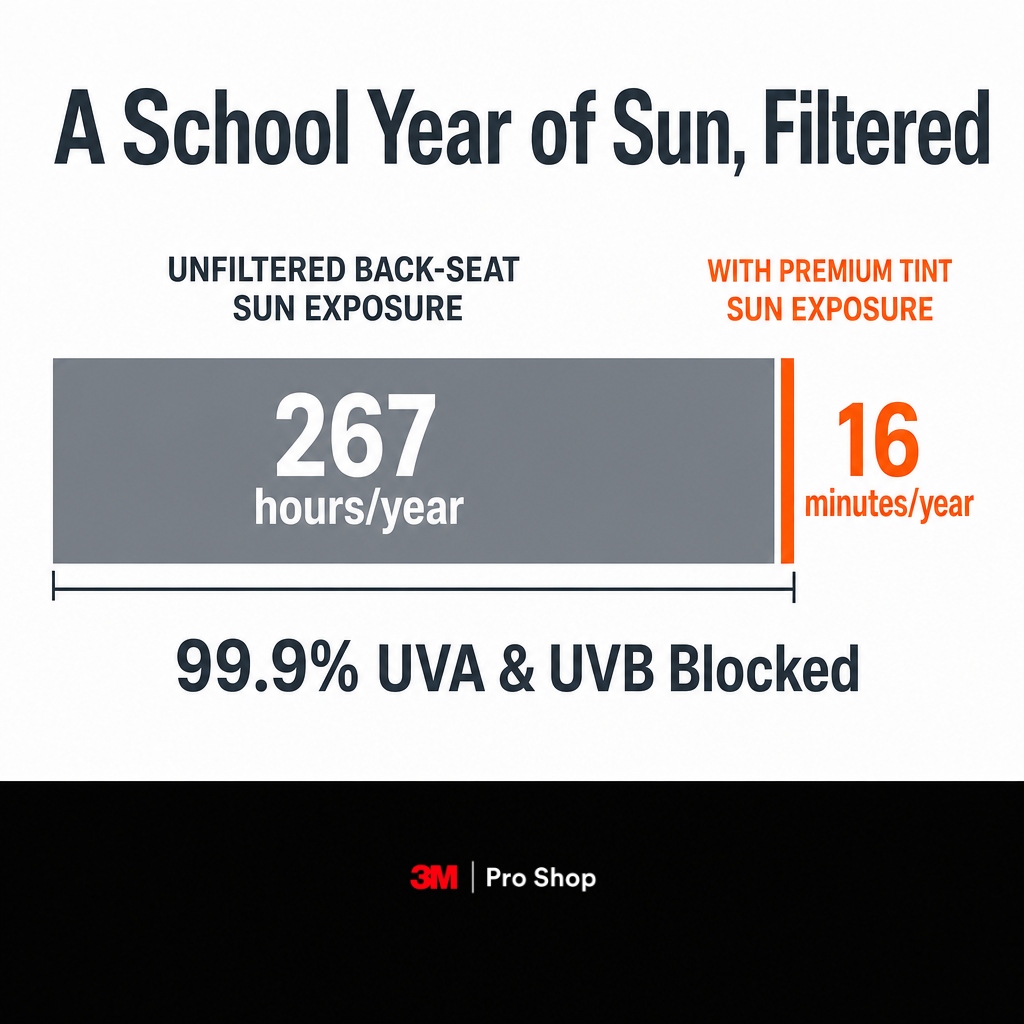
Work out the exposure. A school run of about 40 minutes each way, twice a day, five days a week comes to 400 minutes a week. Across roughly 40 school weeks that is 16,000 minutes, or about 267 hours a year with a child sitting in your second row while the sun comes through the side glass and down through the roof. That is not a trivial number. It is more than a full working week of sitting under Malaysian sun, spread out in 40-minute doses so you never notice it accumulating.
Now apply the film. Every shade in the Crystalline Black range blocks 99.9 percent of UVA and UVB, from the lightest to the darkest. Run 267 hours through that and what actually reaches the back seat across the entire school year comes to roughly 16 minutes of unfiltered sun. A whole year, reduced to a quarter of an hour. That number does not change if you go darker, which is the useful part, because you can put a legal, sensible CR BLK 35 in the rear and still get the full UV benefit.
This is also why the roof matters for the people you cannot see in the mirror. Rear passengers sit directly under the largest pane on the car with nothing above them, and unlike the driver they cannot angle away from it. Adding Ceramic IR up there cuts what arrives rather than what they feel afterwards. We covered the wider version of this in real UV protection in the back seat, including why glass alone does not do the job people assume it does.
Why Tint Choice Matters for J5 ADAS
The J5 carries a lot of driver assistance for its segment. Lane departure, lane keep, lane prevention, blind spot monitoring, adaptive cruise with traffic jam assist, autonomous emergency braking, a 540-degree surround camera view and a full set of parking sensors, all rated Level 2.
Most of that reads through the windscreen. The forward camera sits behind the top of the glass and it is looking through whatever you put there. This is the reason to keep metallic and sputtered film off the windscreen entirely on this car. Metallised construction can scatter and attenuate what passes through it, and the pane it would sit on is the one your assist systems depend on. The Crystalline Black range is non-metallized, which is why it is the right family here rather than merely a nice option.
There is a second reason, and it comes from the published Malaysian review of the car. The reviewer's main criticism of the J5 was that its ADAS needs refinement. That is a fair thing for a reviewer to say about a Level 2 system in a B-segment car, and it is also a warning for you as an owner. A system that already gets flagged as needing polish is not one you want to hand an extra obstacle to. Choose the film that leaves it alone.
Practically, this means two questions at the counter. Ask whether the film is non-metallised, and ask how they cut around the camera housing at the top of the glass. Any shop that works on modern cars will answer both without pausing. Our longer piece on film choice and driver-assist cameras goes into what happens when this gets ignored.
Mistakes J5 Owners Make Booking Tint
Four of these come up constantly, and knowing them before you book saves the whole redo.
The first is treating the car as one big window. Owners ask for one percentage and let the shop do the whole car in it. On a J5 that either leaves you illegal at the front or leaves you paying for light film at the back where you could have had privacy for free. Five panes, four answers.
The second is forgetting the roof entirely. It gets quoted as an afterthought or skipped to save a little, and it is the pane doing the most to the cabin. If the budget has to stretch, the roof is a stranger place to economise than the rear doors.
The third is opening the windows too early. Fresh film has not fully bonded for the first few days and the J5's door glass passes through a rubber sweep every time it moves. Shops that know their job will tell you to leave the windows shut for about three days. Do it, because a fine scratch dragged down a new film is not something that buffs out.
The fourth is judging the finish on day one. Malaysian humidity means the moisture trapped under fresh film takes longer to clear than it would in a drier country. Small haze and tiny water pockets in the first week are normal and disappear on their own. Anything still there after two weeks is a conversation with your installer, not something to accept.
Book It Before the First Balik Kampung
If you have just collected the J5, the window to get this done is now, before the first long drive north. A tinted car and an untinted car feel like different vehicles on the PLUS at 2pm, and the difference lands hardest on whoever is sitting in the back with the sun coming through the roof.
The plan is short enough to say in one line at the counter. CR BLK 70 on the windscreen, CR BLK 50 on the front doors, CR BLK 35 on the rear glass, Ceramic IR on the panoramic roof. That combination is legal everywhere it needs to be, puts the best-performing shade in the range on the pane you sit closest to, and treats the roof as the separate problem it actually is.
If you are in the J5 EV rather than the petrol car, all of the above still applies and the case gets slightly stronger. The air conditioning on an EV draws from the same battery that moves the car, so heat you stop at the glass is range you keep, and we ran the numbers on that in what tint does for EV range. Ask your installer for the heat rejection figure at the exact shade you are buying rather than the headline number for the series, and you will know what you are actually getting.
Find out the best protection for your car
Visit a 3M Pro Shop and discover the cost-effective 3M Protective Film and Window Tint
Jaecoo J5 Window Tint FAQ
What tint percentage is legal for a Jaecoo J5 in Malaysia?
At least 70 percent light through the front windscreen and at least 50 percent through the front side windows. The rear side windows, the rear windscreen and the panoramic roof have no legal limit, so you can go as dark as you like on those.
Does the Jaecoo J5 panoramic roof need tinting?
It is the pane doing the most to your cabin temperature, so yes, treat it as a priority rather than an extra. The J5 carries close to the roof glass of a much larger SUV over a smaller cabin, which means the same sun heats less air.
Will window tint affect the Jaecoo J5 ADAS cameras?
Non-metallised film like the Crystalline Black range does not interfere with them, and the film is cut around the camera housing at the top of the windscreen anyway. Metallic and sputtered films are the ones to keep off this pane.
What is the best tint for a Jaecoo J5 in Malaysia?
CR BLK 50 on the front doors is the highest heat rejection in the range at 68 percent and it is exactly at the legal limit. Pair it with CR BLK 70 on the windscreen, CR BLK 35 at the back and Ceramic IR on the roof.
Is the Jaecoo J5 rear glass already tinted?
The rear glass carries a factory shade, but it is nothing like the dark privacy glass some larger SUVs ship with, so adding CR BLK 35 back there still makes a visible and measurable difference for both privacy and heat.
How long after tinting a Jaecoo J5 before you can open the windows?
About three days. The door glass moves through a tight rubber sweep every time it drops, and film that has not finished bonding will pick up a scratch from it.
Does tinting help on the Jaecoo J5 EV?
More than on the petrol car, because the air conditioning runs off the drive battery. Every bit of heat the film stops at the glass is load the climate control does not have to pull back out of your range.
Author

Kelvin Cheen
Kelvin is an Automotive Solutions Consultant and Branch Manager at 3M Pro Shop. With 4+ years of field experience in premium vehicle surface protection, Kelvin specializes in flagship 3M technologies, including 3M Crystalline Black optical film and Ceramic IR tints, 3M Paint Protection Film (PPF), etc. His focus is on delivering transparent, engineering-backed advice to car and EV owners, cutting through sales upsells to ensure customers choose the exact thermal rejection and paint protection tailored to their driving needs.
Experience the future of window tinting
Visit a 3M Pro Shop and discover the revolutionary Crystalline CR BLK film