Proton eMAS 7 Window Tint: What the Data Says About Comfort and EV Range
Window tint for the Proton eMAS 7 is one of the first upgrades many owners do after picking up the car, and that is easy to understand in Malaysia's heat. But on an EV, tint is not only about comfort or privacy. It can change how hard the air conditioning works, how much battery power goes into cooling, and how many kilometres you get per charge.
This article breaks down the real data behind that connection. You will see published research on AC and EV range loss, the specific numbers for the eMAS 7's battery and efficiency, and what tint specifications to prioritise if your goal is to keep the cabin cool while protecting your driving range. Whether you drive the 49.52 kWh Prime or the 60.22 kWh Premium, the logic is the same: less heat entering the cabin means less energy spent fighting it.
Why the Proton eMAS 7 Cabin Heats Up Fast
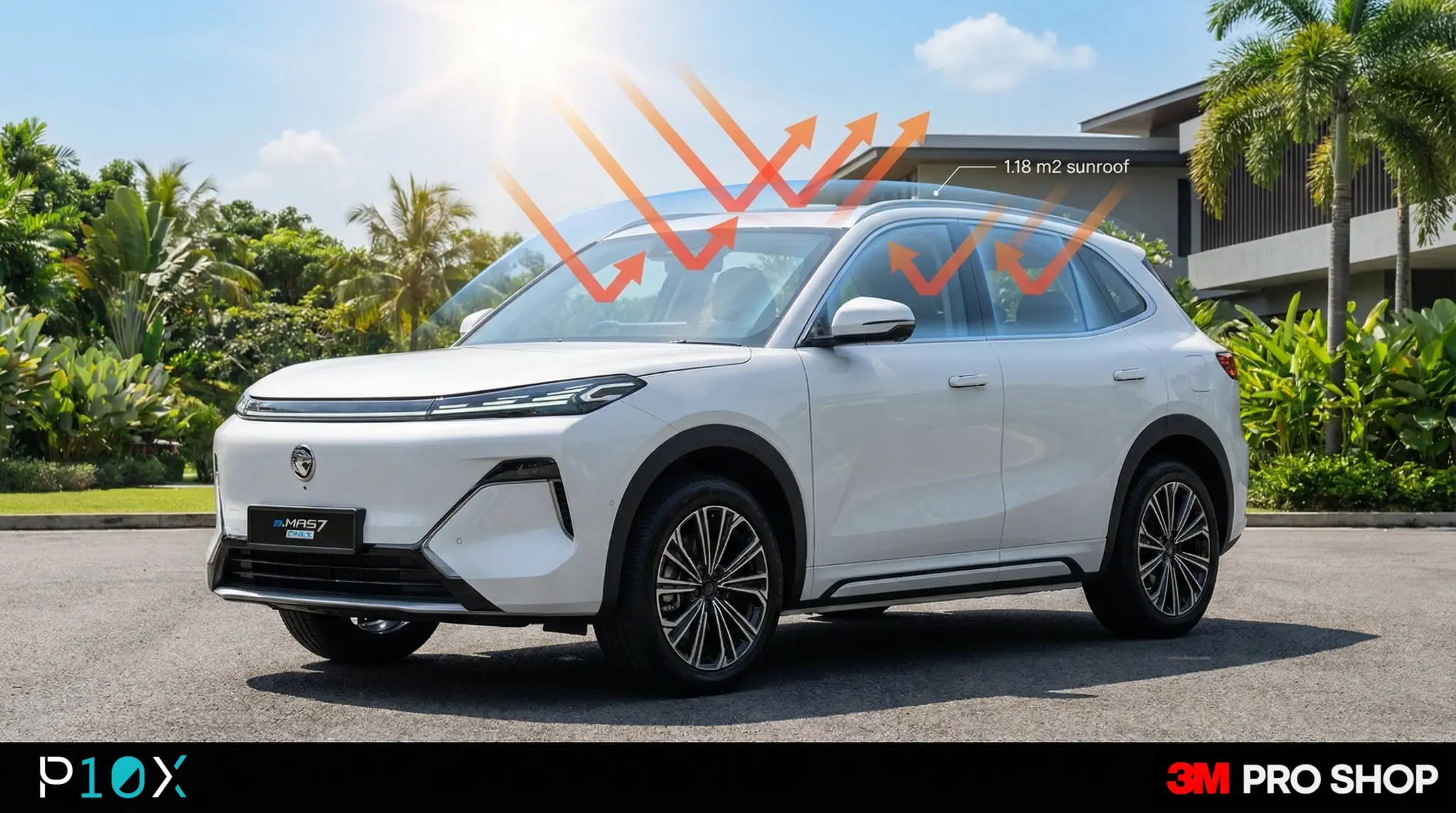
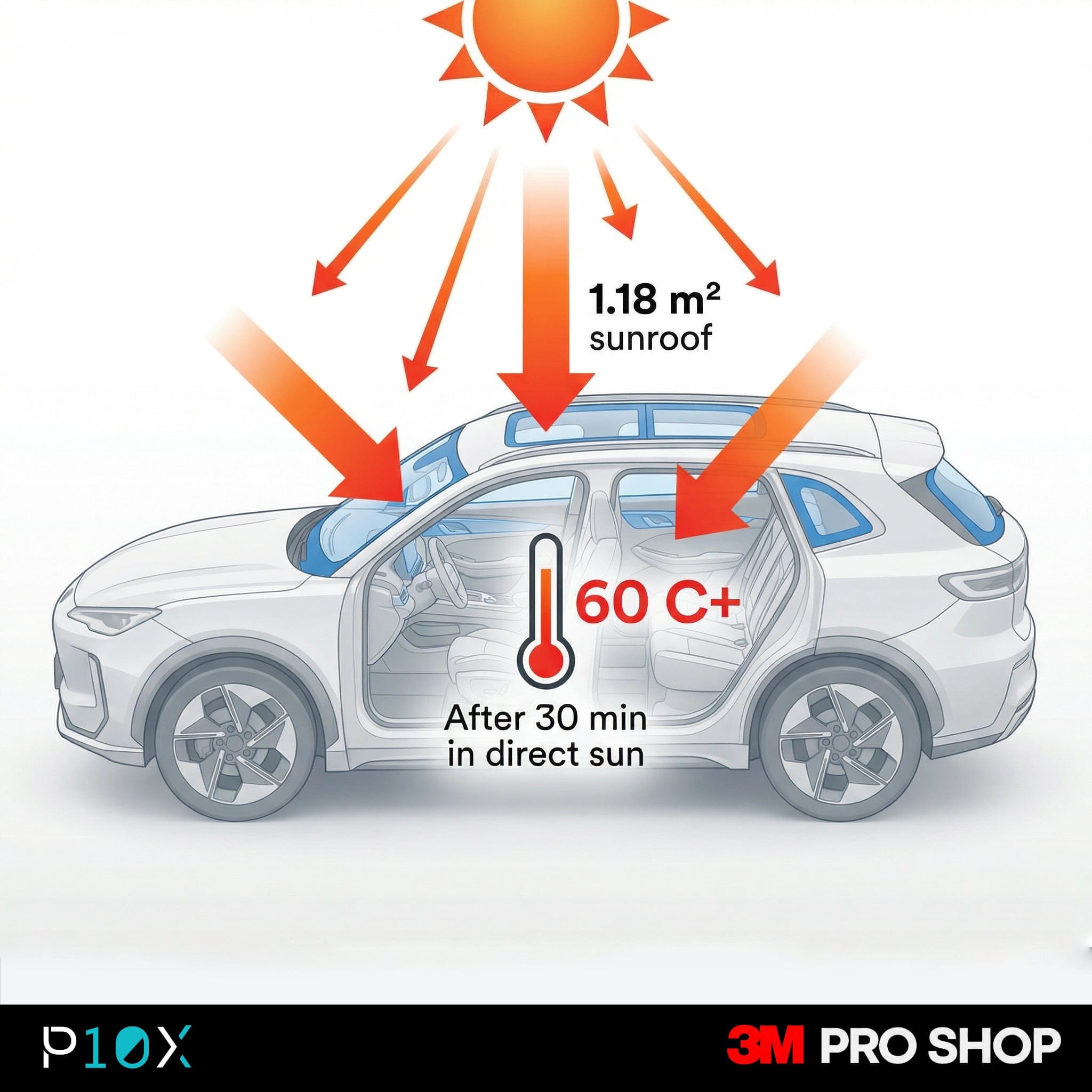
The eMAS 7 Premium comes with a 1.18 m² panoramic sunroof with sunshade. That is a large surface of glass directly above the driver and passengers, absorbing and transmitting solar energy straight into the cabin. Even with the built-in sunshade closed, infrared radiation still passes through glass and heats the interior surfaces.
Add to that the standard windshield, front side windows, rear windows, and rear windshield. In total, the eMAS 7 has a significant glass area relative to its cabin volume. Park it outdoors in Kuala Lumpur between 10 AM and 3 PM, and cabin temperatures can exceed 60 degrees Celsius within 30 minutes. The steering wheel, dashboard, and seats absorb that heat and radiate it back, creating a heat trap before you even start driving.
For a petrol car, this is uncomfortable. For an EV, it triggers an immediate and measurable drain on range the moment you turn on the air conditioning.
If you have ever opened your eMAS 7 door after a lunch meeting and felt that wall of heat hit you, that is the problem in action. Most owners instinctively set the AC to 18 or 19 degrees and crank the fan speed to maximum just to make the cabin bearable. That burst of cooling draws heavily from the battery for the first 10 to 15 minutes of every drive.
Blasting Your AC in Hot Weather Costs 17% of Your EV Range and 12 km Every Hour
In a petrol car, running the AC barely dents your fuel gauge. The compressor piggybacks off the engine, so you never really notice the cost.
In an EV like the eMAS 7, there is no engine to piggyback off. Your AC, cabin fan, and battery cooling all pull from the exact same battery that moves the car. Think of it this way: every time you crank the AC to full blast after parking in the sun, your battery is powering two jobs at once: driving you and cooling you. That makes air conditioning one of the biggest hidden drains on your driving range.
Published research puts firm numbers on this.
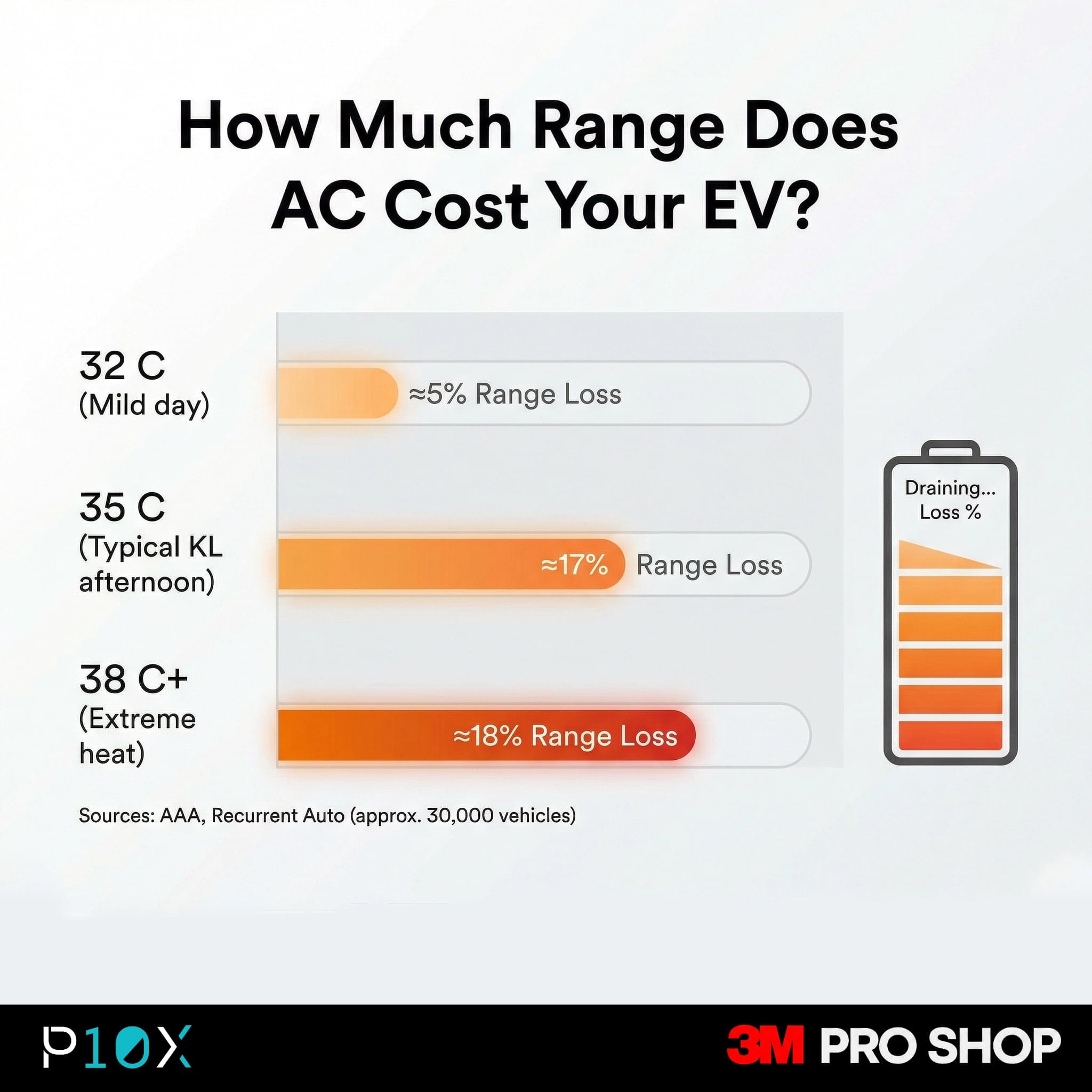
- The American Automobile Association (AAA) tested multiple EVs and found that driving at 35 degrees Celsius with air conditioning reduced average range by 17%. For context, Kuala Lumpur regularly hits 33 to 35 degrees during the day between March and September.
- Recurrent Auto, a US battery analytics firm, analysed real-world data from approximately 30,000 electric vehicles. Their findings showed roughly 5% range loss at 32 degrees Celsius, rising to 17 to 18% in more extreme conditions above 38 degrees.
- Gridserve, a UK EV infrastructure provider, measured AC power draw at approximately 3 to 4 kW during active use. At that rate, running AC continuously costs roughly 12 km of range per hour on a typical EV.
These are not theoretical figures. They come from controlled tests and large-scale real-world datasets. The pattern is consistent across every study: the hotter it gets, the harder the AC works, and the faster range drops.
To put it in everyday terms: if you are used to setting your AC at 20 degrees with fan speed on high for most of your drive, your battery is working noticeably harder than someone whose cabin starts cooler and only needs the AC at 23 degrees on a moderate fan setting. That difference in AC effort is where the range gap comes from.
How Much Range Does Your eMAS 7 Lose to Air Conditioning in Malaysian Heat?
The Proton eMAS 7 EV is available in two battery configurations. The Prime carries a 49.52 kWh AEGIS Short Blade LFP battery rated at 345 km WLTP. The Premium carries a 60.22 kWh pack rated at 410 km WLTP.
Real-world testing adds useful context. SoyaCincau's live road test of the eMAS 7 Prime recorded 352 km on a single charge with AC running between 21 and 23 degrees throughout the drive. A six-month ownership review by WaxOnWattOff recorded a lifetime efficiency of 14 kWh per 100 km, with a real-world city range of about 320 km from 100% to 10% state of charge on the Premium variant.
Now apply the AC impact. If air conditioning accounts for 15 to 17% of total energy use in tropical heat (consistent with the AAA and Recurrent findings), that translates to roughly 48 to 55 km of range on the Premium's 320 km real-world city figure.
This is where window tint enters the equation. Published research on cabin temperature reduction shows that quality window film can lower interior temperatures by up to 8 degrees Celsius compared to untinted glass. A cooler starting cabin temperature means the AC reaches its target faster and cycles less aggressively throughout the drive.
Fleet testing on EVs operating in hot climates has measured 8 to 12% better range efficiency in tinted vehicles compared to untinted ones. Even at a conservative estimate, reducing AC energy consumption by 15 to 20% through effective tinting could recover 7 to 11 km per full charge on the eMAS 7 Premium.
Here is what that looks like in practice. Say you normally charge your eMAS 7 Premium every four days for your daily KL commute. With proper tinting, your AC does not have to work as hard on every trip, so you might stretch that to every four and a half or five days instead. Over a year, that could mean 10 to 15 fewer charging sessions. If you charge on public DC at RM1.60 per kWh, that adds up to a few hundred ringgit saved annually.
There is also the comfort side. With good tint, you can get into your car after parking at Mid Valley or KLCC and the cabin is noticeably less punishing. Instead of blasting the AC at 18 degrees on max fan for the first 15 minutes, you might only need 22 or 23 degrees at a normal fan speed to feel comfortable right away. That gentler AC usage is exactly what preserves your range.
What Window Tint Specs Actually Matter for an EV
Not all window films perform the same, and the numbers that matter most for an EV owner are different from what a typical buyer might focus on.
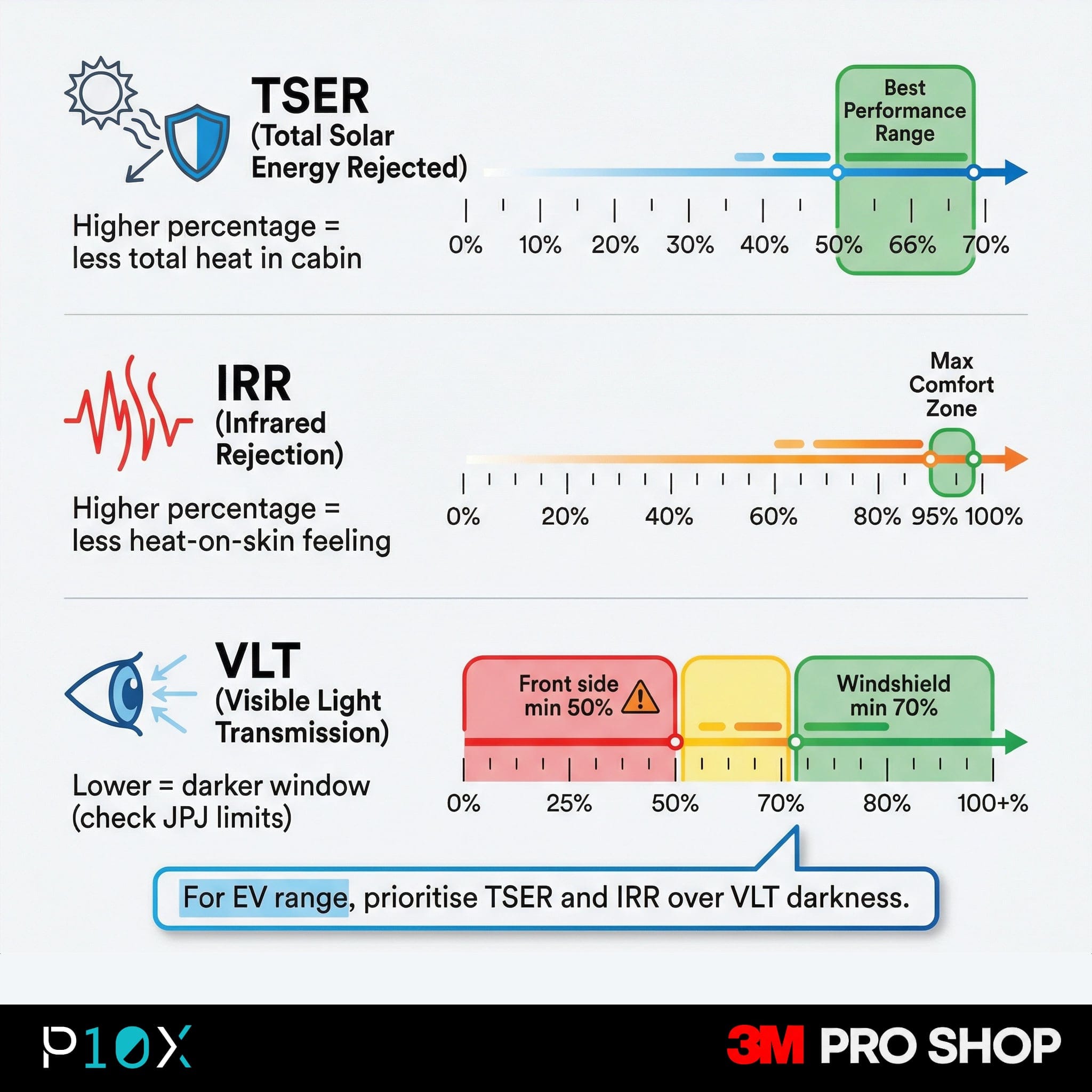
- TSER (Total Solar Energy Rejected) measures the percentage of total solar energy blocked by the film and glass together. This includes visible light, infrared, and ultraviolet energy. A higher TSER means less total heat entering the cabin. For EV range preservation, TSER is the single most important spec to compare.
- IRR (Infrared Rejection) measures how much infrared energy the film blocks in the 900 to 1,000 nm wavelength range. Infrared makes up roughly half of the sun's energy and is the primary source of the "heat on skin" feeling. Films with 95%+ IRR significantly reduce that sensation even at lighter VLT levels.
- VLT (Visible Light Transmission) measures how much visible light passes through the film. Lower VLT means a darker window. VLT affects privacy and appearance, but it does not directly correlate with heat rejection. A high-quality film at 50% VLT can reject more heat than a cheap dark film at 20% VLT.
- Non-metalised construction matters for the eMAS 7 specifically. The car uses Level 2 ADAS with cameras and sensors behind the windshield, plus GPS, 5G connectivity, and Touch 'n Go RFID for Malaysian toll systems. Metalised films can interfere with these RF-based signals. Smart Tag uses infrared rather than radio frequency, so any film with very high IR rejection (above 90% IRR) may affect it regardless of metallic content. Any tint you install on the eMAS 7 should be confirmed as non-metalised to protect RF signals, and moderate IRR is preferred for Smart Tag compatibility.
When comparing films, prioritise TSER and IRR over darkness. A film that looks light but blocks more energy will do more for your range and comfort than a film that looks dark but absorbs heat and re-radiates it into the cabin.
Think of it this way: you might see two cars parked side by side in the same open lot. One has a cheap, very dark tint. The other has a lighter but high-TSER ceramic film. When both owners get in after two hours, the car with the lighter ceramic film will have a noticeably cooler cabin. Darkness does not equal coolness. The technology inside the film is what keeps the heat out.
How to Maximise Heat Rejection on Every Window Within JPJ Limits
Malaysian JPJ regulations cap how dark you can go on certain windows, but they do not cap how much heat your film can reject. The goal is to push TSER and IRR as high as possible on every piece of glass while staying within the legal VLT floors. For a full breakdown of JPJ requirements and how to avoid fines, see our guide on JPJ-compliant window tint. Basically, the windshield must allow at least 70% VLT, front side windows at least 50% VLT, and rear windows have no minimum limit.
Here is how to approach each window on the eMAS 7 with heat rejection as the priority. The specs below are based on the 3M Crystalline CR BLK range, which offers eight shade options from CR BLK 15 (darkest) to CR BLK 80 (lightest). Each shade delivers a different balance of TSER, IRR, and VLT, so you can pick the right one for each window based on how much heat rejection you need and what JPJ allows.
- Windshield: CR BLK 70 delivers 97% IRR at 78% VLT. This is the largest single piece of glass facing direct sun while driving, so even a modest TSER gain here makes a noticeable difference to AC load. The JPJ floor of 70% VLT limits you to lighter shades, but CR BLK 70 at 78% VLT still delivers 97% infrared rejection and 43% TSER. That means almost all infrared heat hitting the windshield gets blocked before it reaches you, even though the glass still looks nearly clear. If you have ever felt the sun burning your arms through the windshield on a highway drive, this is the fix.
- Front side windows: CR BLK 40 hits 54% TSER and 98% IRR right at the 50% VLT JPJ floor. JPJ allows you to go darker here with a 50% VLT minimum. CR BLK 40 sits right at that limit with 50% VLT, delivering 54% TSER and 98% IRR. The jump in heat rejection compared to the windshield shade is real and noticeable, especially for the driver's right arm and the front passenger side that often faces direct afternoon sun.
- Rear side windows and rear windshield: CR BLK 15 pushes TSER to 62% with 98% IRR. No VLT limit applies here, so this is where you can maximise total heat rejection. CR BLK 15 at 17% VLT delivers the highest TSER in the range at 62%, with 98% IRR and 99.9% UV rejection. For the eMAS 7's rear passengers, this makes the biggest difference in cabin comfort, particularly on longer drives where the rear AC vents alone may not keep up with solar heat pouring through untinted glass.
- Panoramic sunroof (Premium variant): your biggest heat entry point, no VLT limit. The 1.18 m² glass panel sits directly above your head and your rear passengers. No JPJ restriction applies to the sunroof, so installing a dark CR BLK shade (such as CR BLK 15 or CR BLK 30) here gives you maximum heat rejection where it matters most. This is strongly recommended even if you use the built-in sunshade regularly. The sunshade blocks visible light but does not block infrared heat as effectively as a ceramic window film. If you have ever noticed your rear passengers complaining about feeling warm even with the AC running, the untinted sunroof is likely the reason.
If you are tinting for the first time, understanding the full car window tint installation process helps set expectations on timing and aftercare.

How 3M Crystalline CR BLK Fits the eMAS 7
The 3M Crystalline CR BLK Series uses over 200 layers of multilayer optical film combined with ceramic nano-technology. It rejects up to 64% of total solar energy (TSER), up to 98% of infrared energy (IRR, 900 to 1,000 nm), and up to 99.9% of UV radiation.
For eMAS 7 owners, three characteristics stand out.
First, the film is non-metalised, so it does not interfere with ADAS cameras, Touch 'n Go RFID, GPS, or 5G signals. This is non-negotiable for a connected EV packed with sensors and driver-assist features.
Second, even at lighter shades (CR BLK 70 at 78% VLT and CR BLK 80 at 88% VLT), the film maintains strong infrared rejection at 95 to 97% IRR. This means you can install a JPJ-compliant shade on the windshield and front windows without sacrificing thermal performance.
Third, the neutral charcoal-black tone matches the eMAS 7's factory glass appearance cleanly, avoiding the brownish or blue colour shifts that some films develop over time. The result looks like a factory upgrade rather than an aftermarket add-on.
If you are weighing different options, comparing TSER and IRR at the same VLT level is the most objective way to evaluate film performance across brands. For a detailed breakdown, see our 3M crystalline tint comparison guide. For a full 3M window tint price breakdown covering all tiers from XP to Crystalline CR BLK, that guide covers what you are paying for at each level.
To explore options and book an installation at any 3M Pro Shop in the Klang Valley, visit our locations page or browse the full window tint product range.
Protecting Your eMAS 7's Efficiency Starts at the Glass
The Proton eMAS 7 is a capable, efficient EV for Malaysian roads. Protecting that efficiency starts with managing how much solar heat gets into the cabin before the AC has to deal with it. Every degree of cabin temperature you keep out reduces the workload on your air conditioning and preserves energy for driving.
For eMAS 7 owners who want to go deeper into EV-specific protection, our guide on Perodua QV-E window tint and PPF covers similar principles applied to Malaysia's other homegrown EV and is worth a read for comparison.
Choose your film based on data, not darkness. TSER, IRR, and signal compatibility matter more for your range and comfort than how dark the window looks from outside. If you are unsure which shade and film tier fits your driving pattern, compare the TSER and VLT figures, then speak to a certified 3M Pro Shop for a spec-based recommendation.
Frequently Asked Questions
Does window tinting void the Proton eMAS 7 warranty?
Aftermarket window tinting is a standard modification and does not void the vehicle manufacturer's warranty in Malaysia. However, the eMAS 7 owner's manual cautions installers about using heat blowers near interior trims during installation. Choose an experienced installer who is familiar with EV-specific precautions to avoid any accidental damage.
Can window tint interfere with the eMAS 7's ADAS cameras or sensors?
Metalised window films can interfere with cameras, radar, and wireless signals. Non-metalised films based on ceramic or multilayer optical technology do not cause this problem. Always confirm that the film is non-metalised before installation, especially on the windshield where the ADAS forward camera is mounted.
Should I tint the panoramic sunroof on the eMAS 7 Premium?
In most cases, yes. The 1.18 m² panoramic sunroof allows significant solar energy into the cabin even with the factory sunshade closed. A ceramic film with high IRR on the sunroof noticeably reduces heat buildup, particularly for rear passengers. The cost of adding the sunroof to your tint package is relatively small compared to the comfort and efficiency gain.
How much driving range can I realistically recover from window tinting?
Based on published research, quality ceramic window tint may reduce AC energy consumption by 15 to 20% in hot conditions. For the eMAS 7 Premium, that translates to a conservative estimate of 7 to 11 km per full charge in daily city driving. The benefit compounds over time with daily use in Malaysian heat.
What does JPJ-compliant window tint mean for the eMAS 7?
JPJ requires at least 70% VLT on the front windshield and at least 50% VLT on the front side windows. Rear windows and the rear windshield have no VLT restriction. Any film installed on the front-facing windows must meet these limits. First-offence fines for non-compliant tint can reach RM2,000. For a full walkthrough, see our guide on JPJ-compliant window tint in Malaysia.
Author

Fabian
He is passionate about revolutionizing the car protection services industry by bringing innovation and transparency to a traditionally opaque and often misunderstood field. His mission is to educate end users on the true benefits and importance of car protection, aiming to replace outdated practices with honest, customer-focused solutions. With a fresh approach to car tinting, paint protection film (PPF), and detailing services, he is committed to delivering a superior customer experience that sets a new standard in the market. He welcomes discussions about the future of the automotive industry and is eager to connect with like-minded professionals who share his vision for innovation, integrity, and excellence.
Experience the future of window tinting
Visit a 3M Pro Shop and discover the revolutionary Crystalline CR BLK film