
Driving Into Singapore With a Tinted Malaysian Car: What to Check

- Tinted windows do not automatically mean you need to remove the film before a Singapore trip.
- Singapore's published limit for front side windows is 70% VLT, meaning the glass must let at least 70% of visible light through. That is stricter than Malaysia's 50%, so tint that passes JPJ can still fall short of the figures set by Singapore's Land Transport Authority (LTA).
- Singapore's rules exempt some cars brought in by people who live outside Singapore, but only under set conditions. LTA can confirm whether your car qualifies.
- You will need a valid Vehicle Entry Permit (VEP) approval, an activated Autopass card, road tax and insurance that covers use in Singapore.
- A meter reading of the finished glass shows its actual VLT. The film's rating on the invoice does not.
Entering Singapore in a Malaysian car with window tint does not automatically mean the film has to come off. What matters is whether your car, and the way you use it, meets Singapore's entry requirements. A shop's “JPJ-legal” label or another driver's smooth trip through the checkpoint cannot tell you that.
The two countries publish different tint limits, and Singapore also makes an exception for some cars brought in temporarily. Whatever tint you have, your Vehicle Entry Permit (VEP), Autopass card and other documents need to be in order too.
Singapore's tint limits are stricter than Malaysia's for side and rear windows
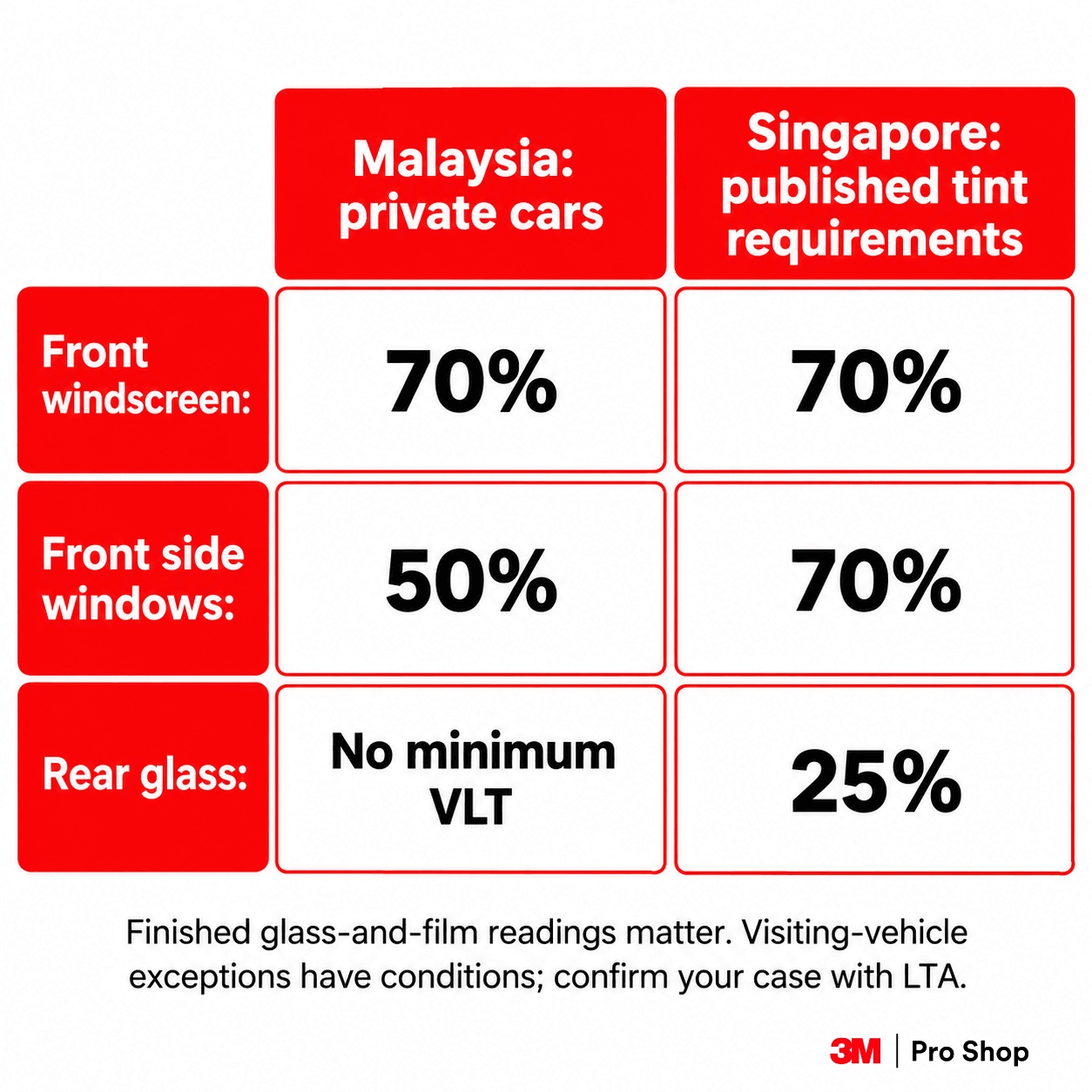
Singapore's published limit for front side windows is 70% VLT, compared with 50% in Malaysia. VLT, or visible light transmission, is the percentage of visible light passing through the glass, so a higher figure means lighter tint. Singapore also sets a 25% minimum for rear glass, which Malaysia does not set for private cars.
Here are the published minimum figures side by side:
| Window | Malaysia: private car minimum VLT | Singapore: published minimum VLT |
|---|---|---|
| Front windscreen | 70% | 70% |
| Front side windows | 50% | 70% |
| Rear side windows | No minimum VLT | 25% |
| Rear windscreen | No minimum VLT | 25% |
Under Malaysia's JPJ window tint rules, a private car's rear glass has no minimum VLT as long as the car has working side mirrors. That means very dark rear tint that is fine in Malaysia can still fall below Singapore's 25%. The tint guidance published by Singapore's Land Transport Authority (LTA) also says the film must not be reflective.
What counts is the reading through the glass and film together, not the film's rating on its own. A film sold as “70% VLT” does not guarantee that the finished windscreen measures 70%, because the original glass already reduces light transmission. A shop can take a meter reading of each window after fitting 3M window tint or any other film, and record the results for you.
Some visiting cars are exempt from Singapore's tint rules, but only under set conditions
Some cars visiting Singapore from outside the country are covered by an exception to the usual vehicle rules, but being registered in Malaysia does not qualify a car on its own. Whether the exception applies depends on who brings the car in, whether the stay is temporary and which registration certificate the car holds.
This exception comes from Rule 3(6) of Singapore's Road Traffic (Motor Vehicles, Construction and Use) Rules. It covers cars that someone who lives outside Singapore brings in for a temporary stay. For these cars, most of the rules on how a car is built and equipped (Part II of the rules) do not apply. These include the safety glass rule, which is also where Singapore sets its limits on tinted glass. But the car must hold a registration certificate of the type listed in Singapore's Road Traffic (International Circulation) Rules.
If you plan to rely on this exception, you can ask LTA how it applies to your registration, residence and planned use. Sending your car's details and any measured VLT readings helps LTA answer for your specific car, and a written reply is worth keeping with your travel records.
If you drive into Singapore often, the safer choice is tint that meets LTA's published figures and is not reflective, so you are not relying on the exception at all. A tint shop can suggest films that meet those figures. Going lighter does not have to make the car hotter, since some lighter 3M films still block a lot of heat.
What to sort out before the trip: VEP, Autopass and SG Arrival Card
According to LTA's entry guidance, a Malaysian private car needs a valid Autopass card, road tax, insurance covering use in Singapore, a VEP approval email and proper front and rear licence plates. It is best to apply through LTA's VEP and Autopass portal at least two weeks before you travel.
Not every driver can use a car registered outside Singapore. Under LTA's guidance, these people cannot keep or use one in Singapore: Singapore citizens, permanent residents, Singapore residents and holders of several passes, including the Long-Term Visit Pass, Dependant's Pass and Student's Pass.
If you renew your road tax or insurance, you can update the details on the same portal so LTA's records match.
Autopass is a card you insert into the card reader at the immigration booth on entry and exit. Your approval email explains how to collect and activate it. LTA's guidance asks drivers to insert the card even when the barrier is already lifted. Each card is encoded for one vehicle, so a card issued to another car should not be used.
From 2 November 2026, LTA will not accept applications for cars registered outside Singapore that have outstanding fines, so it is worth settling any Singapore vehicle fines before you apply.
You can find the charges for your travel dates on LTA's VEP fee page and calculator. From 1 January 2027, the VEP fee for cars registered outside Singapore rises from S$35 to S$50 a day. The fee will apply on all days except weekends and Singapore public holidays, and the 10 free VEP days a year and free weekday VEP hours will end. Cars without an On-Board Unit (OBU) will also pay a flat Electronic Road Pricing (ERP) fee of S$10 for each ERP operational day they are driven on Singapore roads.
Each traveller may also need an SG Arrival Card, which is an immigration requirement separate from the car's VEP. Singapore's Immigration & Checkpoints Authority (ICA) requires the card to be submitted within the three days before arrival, including the day of arrival, unless the traveller is exempt. Singapore citizens, permanent residents and long-term pass holders entering through Woodlands or Tuas are among the exempt groups. Whether a passenger needs one depends on their own status, so ICA's current list is worth checking for everyone in the car.

On the day of travel, it is worth keeping these in the car. According to LTA's entry guidance, authorised officers may ask to see:
- the vehicle registration certificate
- valid road tax
- the certificate of insurance covering the vehicle's use in Singapore
- the vehicle's Autopass card
- LTA's VEP approval email
It also helps to keep your tint invoice, warranty registration and any VLT readings taken after installation. The invoice and warranty show which film was fitted, by whom and when. The readings show how much light each window lets through.
Who to ask: LTA for entry rules, a tint shop for VLT readings
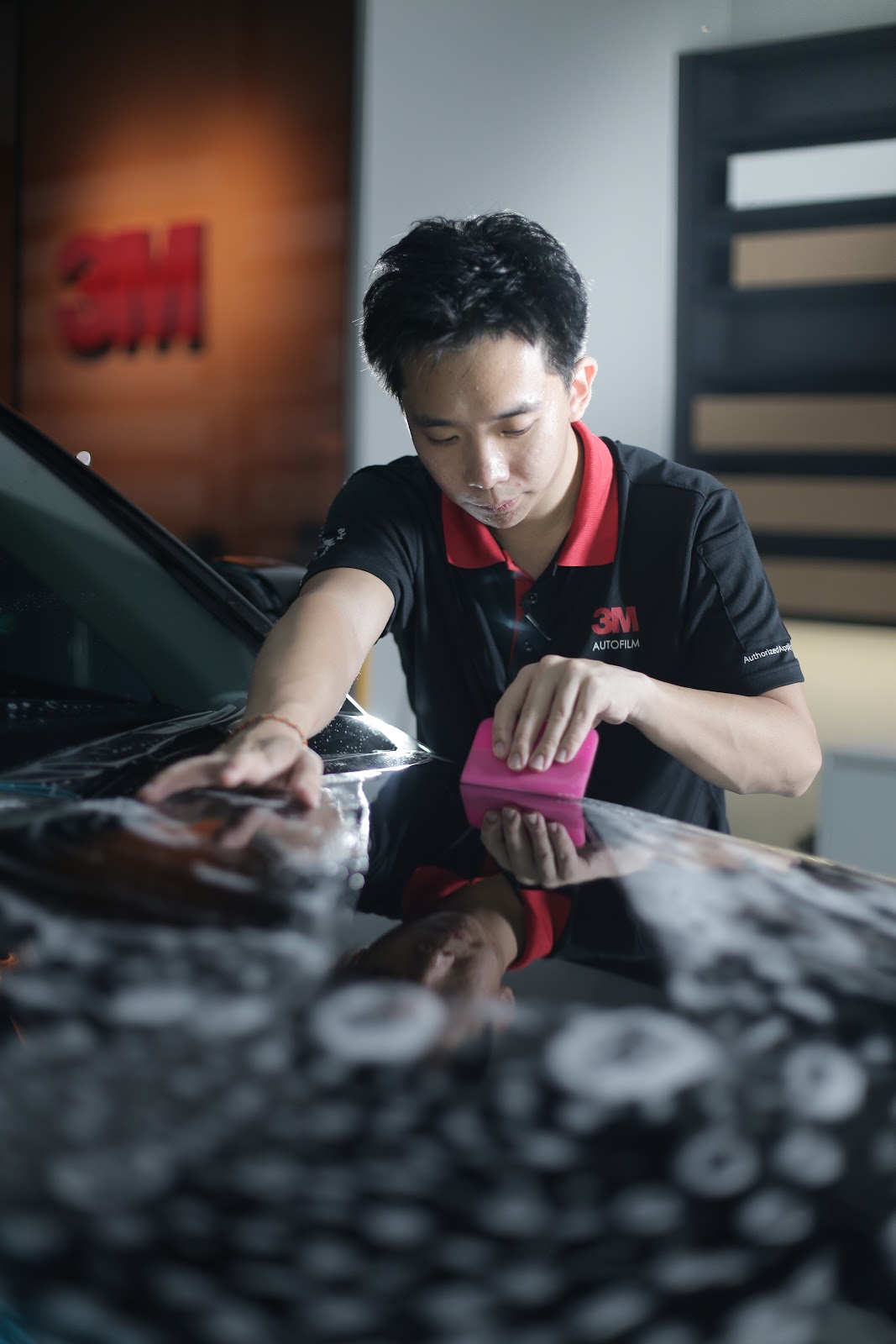
If your tint is darker than LTA's published figures and you plan to rely on the exception, LTA can confirm your case before you travel. At 3M Pro Shop by P10X, a 3M Authorized Dealer, our installers can measure your glass and suggest replacement film for any window that needs it, such as a lighter shade for the front side windows. You can find the nearest outlet on our locations page.
Find out the best protection for your car
Visit a 3M Pro Shop and discover the cost-effective 3M Protective Film and Window Tint
Frequently asked questions
Will tint that passes JPJ be accepted in Singapore?
Not automatically. Singapore's published limit for front side windows is 70% VLT, compared with 50% in Malaysia, and Singapore also sets at least 25% for rear glass, which Malaysia does not set for private cars. So tint that passes JPJ can still fall short of LTA's figures unless your car is covered by the exception for visiting cars.
What is the legal tint limit in Singapore?
LTA's tint guidance sets at least 70% VLT for the front windscreen and front side windows, and at least 25% for the rear windscreen and rear side windows. Film must not be reflective. Some visiting cars fall under an exception, so these figures may not settle every case.
Do I need a VEP for a day trip?
Yes. A Malaysian private car needs a valid VEP even if you enter and leave Singapore on the same day. You also need the car's own Autopass card, valid road tax and insurance covering use in Singapore.
Can my car be turned back at the checkpoint over tint?
It can. LTA's entry guidance says cars that break Singapore's rules, and cars without the required valid documents, may be turned back. It also warns of enforcement action if such a vehicle is found in Singapore. A tint invoice or an earlier smooth trip does not guarantee entry.
What if my front windows measure less than 70% VLT?
That is below LTA's published figure for front windows. You can ask LTA whether the exception for visiting cars covers your trip. If you would rather meet the published figure, a tint shop can suggest lighter replacement film and measure the finished glass.
Is reflective tint allowed in Singapore?
Not under LTA's published tint requirements, which say film must not be reflective. Being registered in Malaysia does not make reflective film acceptable by default.
Do I need to remove all my tint?
Not just because the car is tinted. You can start by finding out which requirements apply to your car and checking its measured VLT. If a change is needed, an installer can tell you which windows need new film, so you may not need to strip every window.
Author

Kelvin Cheen
Kelvin is an Automotive Solutions Consultant and Branch Manager at 3M Pro Shop. With 4+ years of field experience in premium vehicle surface protection, Kelvin specializes in flagship 3M technologies, including 3M Crystalline Black optical film and Ceramic IR tints, 3M Paint Protection Film (PPF), etc. His focus is on delivering transparent, engineering-backed advice to car and EV owners, cutting through sales upsells to ensure customers choose the exact thermal rejection and paint protection tailored to their driving needs.
Experience the future of window tinting
Visit a 3M Pro Shop and discover the revolutionary Crystalline CR BLK film