
Self-Healing PPF vs Self-Healing Coating: Why Coating Alone Falls Short for Malaysian Cars
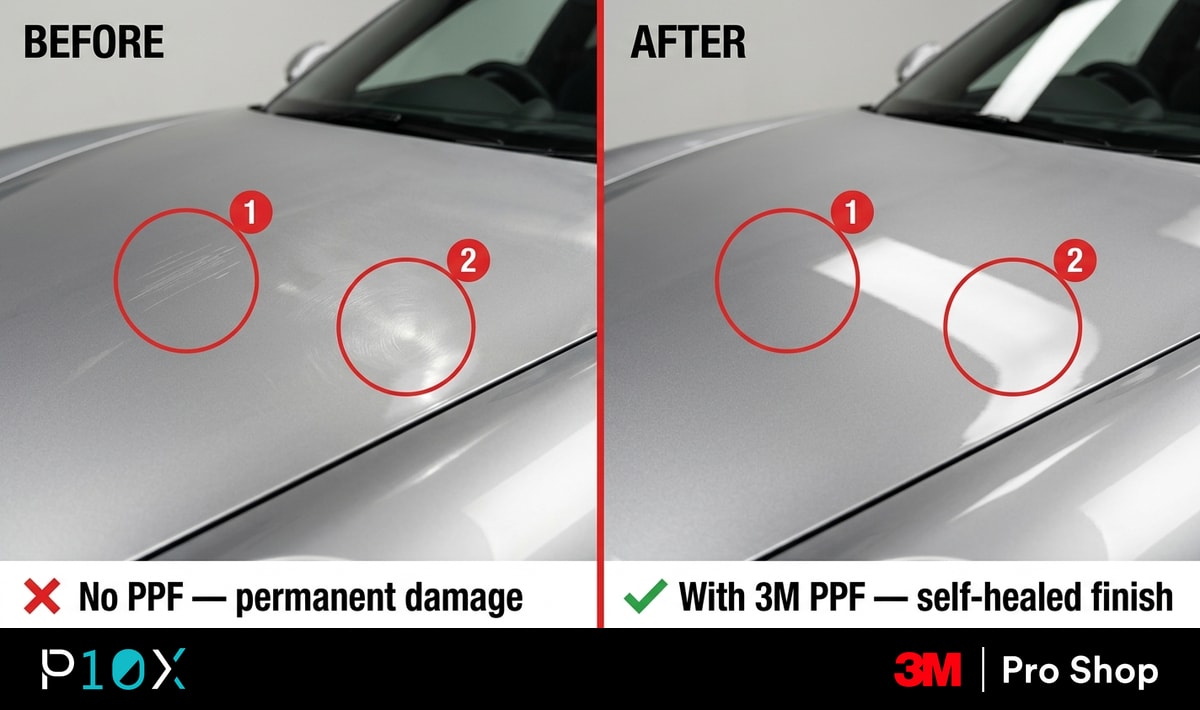
- Self-healing PPF uses an elastomeric TPU top coat that physically rebounds after light scratches. Self-healing ceramic coatings only close micro-marring inside a thin ceramic polymer.
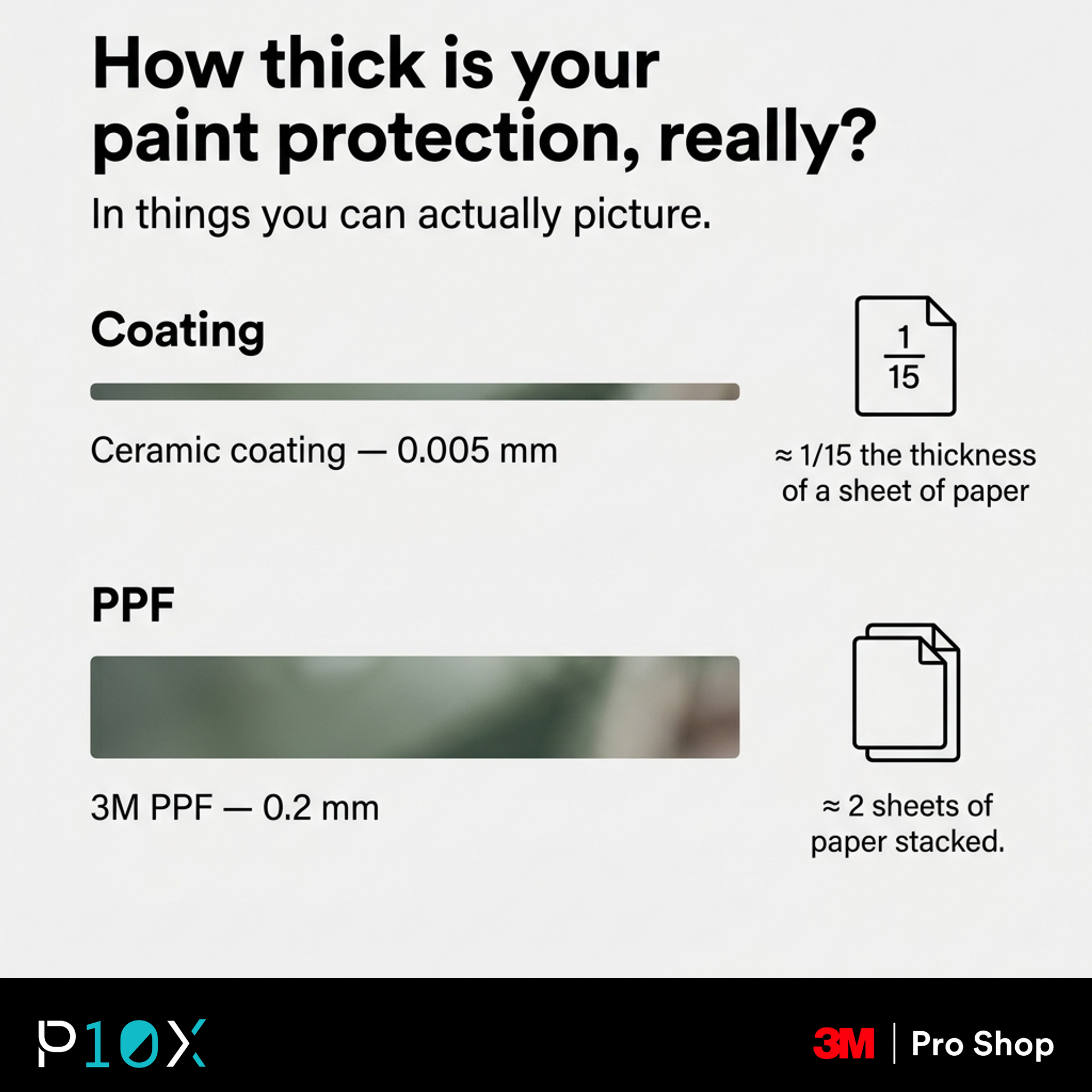
- 3M PPF is about 7.3 to 8 mil thick (roughly 0.185 to 0.2 mm) and absorbs impact. A ceramic coating is only 2 to 5 microns thick (0.002 to 0.005 mm) and cannot absorb a stone chip.
- Malaysian ambient heat of 33 to 35 degrees Celsius passively activates 3M PPF self-healing every day. Most coatings need around 60 degrees Celsius of surface heat before they soften.
- For Klang Valley daily drivers, layering 3M PPF Series 150, 100 or 50 with a coating gives both physical protection and easy cleaning.
- Pricing starts from around RM 11,000 for a full-car Series 50 install and goes up to RM 24,000 for Series 150. The right tier depends on your car value, mileage and highway exposure.
When it comes to self-healing PPF vs coating for Malaysian cars, the technology behind each product decides whether scratches truly disappear or just look hidden for a moment. Both products claim to "heal" your paint, but they use very different materials, at very different thicknesses, and deliver very different results after a stone chip on the PLUS highway or a fingernail gouge near the door handle.
This guide breaks down what self-healing actually means for PPF and for ceramic coating, where each one physically stops working, and which combination fits a Malaysian car owner's budget and daily drive. By the end you will know whether to choose coating, PPF, or both, and which 3M series matches your situation.
What Is Self-Healing Paint Protection, Really?
Self-healing paint protection is the surface returning to its original state after a light scratch. Paint protection film does this through an elastomeric TPU top coat that physically rebounds. Most self-healing ceramic coatings only close micro-marring inside the ceramic polymer layer, which is why the two products cannot be used interchangeably.
Paint protection film self-healing comes from a top layer made of thermoplastic polyurethane, often shortened to TPU. TPU is a flexible polymer with shape memory. When a light scratch or swirl mark deforms the film, the polymer warms up a little, remembers its original flat shape, and reflows back. The healing happens within the thickness of the film, on top of your factory paint.
Self-healing ceramic coating is different. A ceramic coating is a thin liquid layer that hardens into a silica-based shell on your clear coat. Some premium formulas embed a thermoplastic polymer inside the ceramic matrix, which can flow slightly when heated. That flow can close very shallow marring inside the coating layer itself, but only if the scratch has not cut through to the clear coat below.
In short: PPF heals by rebounding a physical film. Coating heals only within a glass-thin shell. For the full picture on what PPF actually delivers in Malaysia, see our guide on 3M paint protection film benefits, cost and longevity.
Why Self-Healing Matters for Malaysian Car Paint
Self-healing matters in Malaysia because our tropical climate already activates it every day. At 33 to 35 degrees Celsius ambient, plus direct sun on the bonnet, 3M PPF self-healing works passively with zero effort from the driver. Stacked against Malaysian roads and monsoon grit, that daily rebound is not a nice-to-have, it is a core part of paint survival here.
Klang Valley drivers also face stone chips on the PLUS, NKVE and LDP, hot-park cycles that push cabin temperatures past 52 degrees Celsius, monsoon grit that acts like sandpaper in a wash bay, and constant swirl marks from touch and brush car washes. Light swirl marks from a weekend car wash often disappear by the next afternoon on a PPF-protected panel. A simple aftercare routine stretches that benefit further. Read our PPF aftercare in Malaysia guide for the wash rules and timing that match our climate.
Resale value is the other stake. A bonnet full of stone-chip gouges and dull clear coat can cut a used-car offer by thousands of ringgit, and the hit compounds fast on premium cars. Self-healing PPF keeps the factory paint underneath untouched, so the car shows fewer kilometres than it has driven. If you want to see how that plays out in ringgit for common Malaysian models, read our breakdown of the paint protection film ROI for Malaysian car owners.
How PPF and Coating Self-Healing Actually Work
PPF and coating self-healing work through different materials and different trigger temperatures. PPF uses a thick elastomeric film that flexes and rebounds. Coating uses a thin ceramic polymer that softens and reflows only at higher temperatures. Malaysian sun already activates PPF every day, while coating-only cars often need hot water or a heat gun to see any healing effect. PPF every day, while coating-only cars often need hot water or a heat gun to see any healing effect.
How TPU memory rebounds the film
The 3M PPF top coat is an elastomeric TPU layer engineered with shape memory. When a branch, fingernail or trolley edge deforms the film, the polymer chains store the deformation as stress. Warming the surface releases the stress and the polymer returns to its original flat state. This happens within the 7.3 to 8 mil thickness of 3M PPF Series 50, 100 and 150, so the repair sits physically on top of your paint.
How ceramic polymers close micro-marring
Self-healing ceramic coatings embed a thermoplastic polymer inside the silica ceramic base. When the surface reaches around 60 degrees Celsius (140 degrees Fahrenheit), the polymer chains become mobile enough to close very shallow marring within the coating layer. The ceramic itself does not heal, and any scratch that cuts through to the clear coat below stays visible.
How heat activation differs by product
Malaysian noon sun on a dark bonnet can easily push surface temperature above 55 degrees Celsius, which helps both products. The difference is passive activation. 3M PPF rebounds throughout the day in normal driving, while most coatings only heal when you deliberately park in direct sun or pour warm water over the panel.
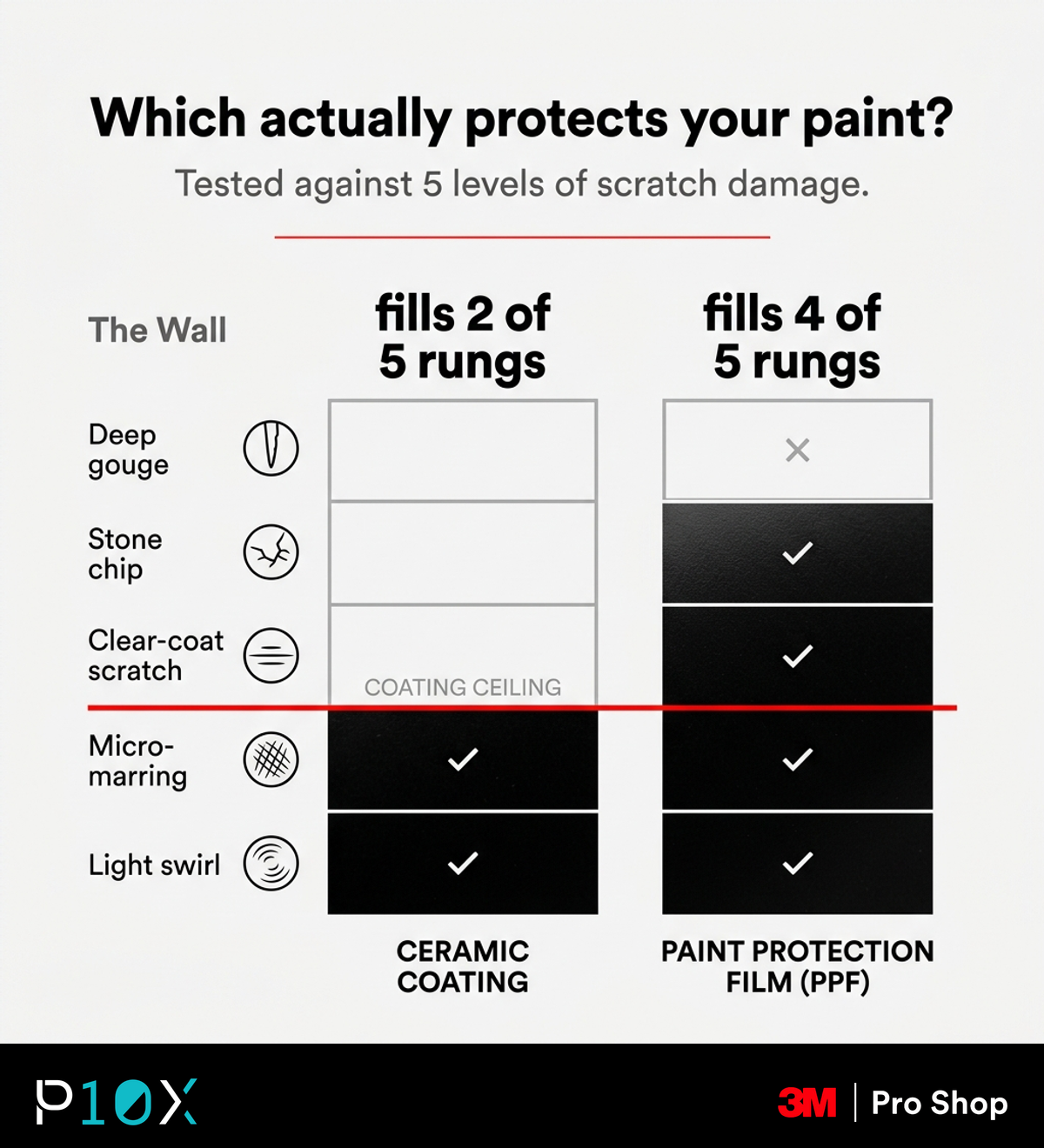
3 Scratch Depths a Coating Cannot Repair
A ceramic coating simply does not have the thickness or flexibility to repair scratches that break the clear coat or absorb impact. At 2 to 5 microns thick, a ceramic coating is tens of times thinner than 3M PPF Series 100 (about 7.5 mil or 0.19 mm). The three scratch depths below are common on Malaysian roads and all of them demand PPF, not coating, for real protection.
Clear-coat scratches past the top layer
Once a scratch cuts through the ceramic coating into the original factory clear coat, the coating is physically gone at that point. No amount of heat will bring it back. A PPF film in the same scenario simply absorbs the scratch within its elastomeric layer and often self-heals the mark completely.
Stone chips from highway debris
Stone chips on PLUS, NKVE and LDP are one of the top paint-damage complaints from Klang Valley drivers. A stone flying off a lorry tyre at 90 km/h lands with enough force to chip through a 5-micron coating and dent the paint beneath. A 7.3 to 8 mil PPF layer acts like a shock absorber, flexing to take the hit while the paint below stays intact.
Key, trolley and fingernail gouges
Car park dings from trolleys, keys and fingernails cut cleanly through any coating and into the clear coat. PPF, because it is a physical film, absorbs the cut into itself. Light versions of these gouges often self-heal. Deeper cuts remain in the film but the paint below stays factory fresh, and a damaged PPF section can be re-skinned without a respray.
PPF vs Coating: Head-to-Head Scratch Repair
PPF heals and blocks. Coating beads and adds gloss. In a head-to-head on scratch repair, PPF wins on every line that matters for Malaysian roads: impact absorption, deeper self-healing, and long-term replacement cost. Coating still has a role for hydrophobic shine and easier cleaning, but it is not a scratch-repair product. For the full series-by-series spec sheet, see our breakdown of 3M PPF in Malaysia.
| Property | Self-Healing PPF | Self-Healing Coating |
|---|---|---|
| Material | Elastomeric TPU film + adhesive | SiO2 ceramic + thermoplastic polymer |
| Thickness | 7.3 to 8 mil (0.185 to 0.2 mm) | 2 to 5 microns (0.002 to 0.005 mm) |
| Self-healing depth | Light scratches, swirl marks, fine gouges within film | Micro-marring only within the ceramic layer |
| Impact protection | Absorbs stone chips and trolley dings | None. Impact passes straight through |
| Chemical resistance | Resists bird droppings, tar and fuel spills | Strong against bird droppings and water spots |
| Hydrophobic finish | Yes, strong on Series 150 | Yes, often very strong |
| UV protection | Engineered against yellowing, bubbling and cracking | Some UV inhibition, thinner layer |
| Typical lifespan | Up to 5 years (Series 150), up to 3 years (Series 100 and 50) per brochure. Confirm with your 3M Pro Shop dealer. | 1 to 5 years depending on formula |
| Typical Malaysian cost (full car) | RM 11,000 to RM 24,000 | RM 1,500 to RM 5,000 |
| Best for | Stone-chip defence, scratch healing, resale value | Easy washing, water beading, added gloss |
5 Coating Myths Malaysian Car Owners Believe
Ceramic coating marketing has created a handful of stubborn myths in Malaysia. The five below are the ones that most often lead car owners to skip PPF and regret it a year later: that coating heals all scratches, replaces PPF, lasts a decade untouched, stops stone chips, and is equivalent to PPF self-healing. Each is busted in turn with the real chemistry and thickness.
"Coating heals all scratches" myth, busted
Coatings only close micro-marring within the coating layer. Any scratch that reaches the clear coat is permanent until polished or resprayed.
"Coating replaces PPF" myth, busted
Coating and PPF do different jobs. Coating adds a hydrophobic gloss. PPF physically blocks stone chips. A 5-micron coating cannot absorb what an 8-mil PPF absorbs.
"Coating lasts 10 years unchanged" myth, busted
Coatings degrade under Malaysian UV, monsoon acidity and detergent wash cycles. Even premium formulas need decontamination, top-up layers and a careful aftercare routine to hit their stated lifespan.
"Coating stops stone chips" myth, busted
No 2 to 5 micron product can stop a highway stone. Only PPF, which is tens of times thicker, can absorb the impact without transferring it to the paint.
"All self-healing is the same" myth, busted
PPF self-healing is elastomeric and physical. Coating self-healing is a thin thermoplastic effect limited to marring. Calling both "self-healing" is a marketing shortcut, not a technical match. The quality of the install matters too, which is why we only recommend certified 3M Pro Shop PPF installers in Malaysia who follow the correct surface prep and cleanroom standards.
When to Layer PPF, Coating, or Both
The right protection stack depends on how you use your car, not just how expensive it is. The decision tree below matches common Malaysian car owner profiles, from daily commuter to weekend luxury, EV, and ride-share, to the 3M Pro Shop combined packages, with ringgit bands you can plan a budget around.
Daily KL commuter setup
High-kilometre daily driver on Federal, LDP and KESAS, parked at open office lots. Recommended: 3M PPF Series 100 Gloss on bonnet, bumper, headlights, side mirrors and door cups, plus Crystalline Black CR BLK tint for heat and glare control. Combined Package 1 (Series 100 plus Crystalline) starts at around RM 17,000.
Weekend and luxury car setup
Low mileage, premium sedan or SUV, garaged, driven for weekends and balik kampung trips. Recommended: full-car 3M PPF Series 150 Gloss for maximum clarity and hydrophobic finish, plus Crystalline Black CR BLK tint. Combined Package 2 (Series 150 plus Crystalline) starts at around RM 22,000. Add RM 1,000 for large vehicles and RM 2,000 for MPVs.
Malaysian EV owner setup
EV with heavy A/C load in tropical heat, frequent highway trips, and the softer paint common on Tesla, BYD, and the new Proton and Perodua EV class cars. Recommended: 3M PPF Series 100 or 150 on the high-impact panels plus Crystalline Black CR BLK on all windows to cut solar load and stretch range. For an EV-specific worked example, see our Perodua QV-E PPF and window tint guide.
Ride-share and fleet setup
High mileage, long daily hours, rotating passengers, budget sensitive. Recommended: 3M PPF Series 50 Gloss on bonnet and bumper to protect the highest stone-chip zones, plus XP or Ceramic IR tint depending on passenger comfort priority. Ala-carte bonnet PPF on medium vehicles starts from around RM 1,250 (Series 50), which makes it a targeted, affordable upgrade for fleet owners.
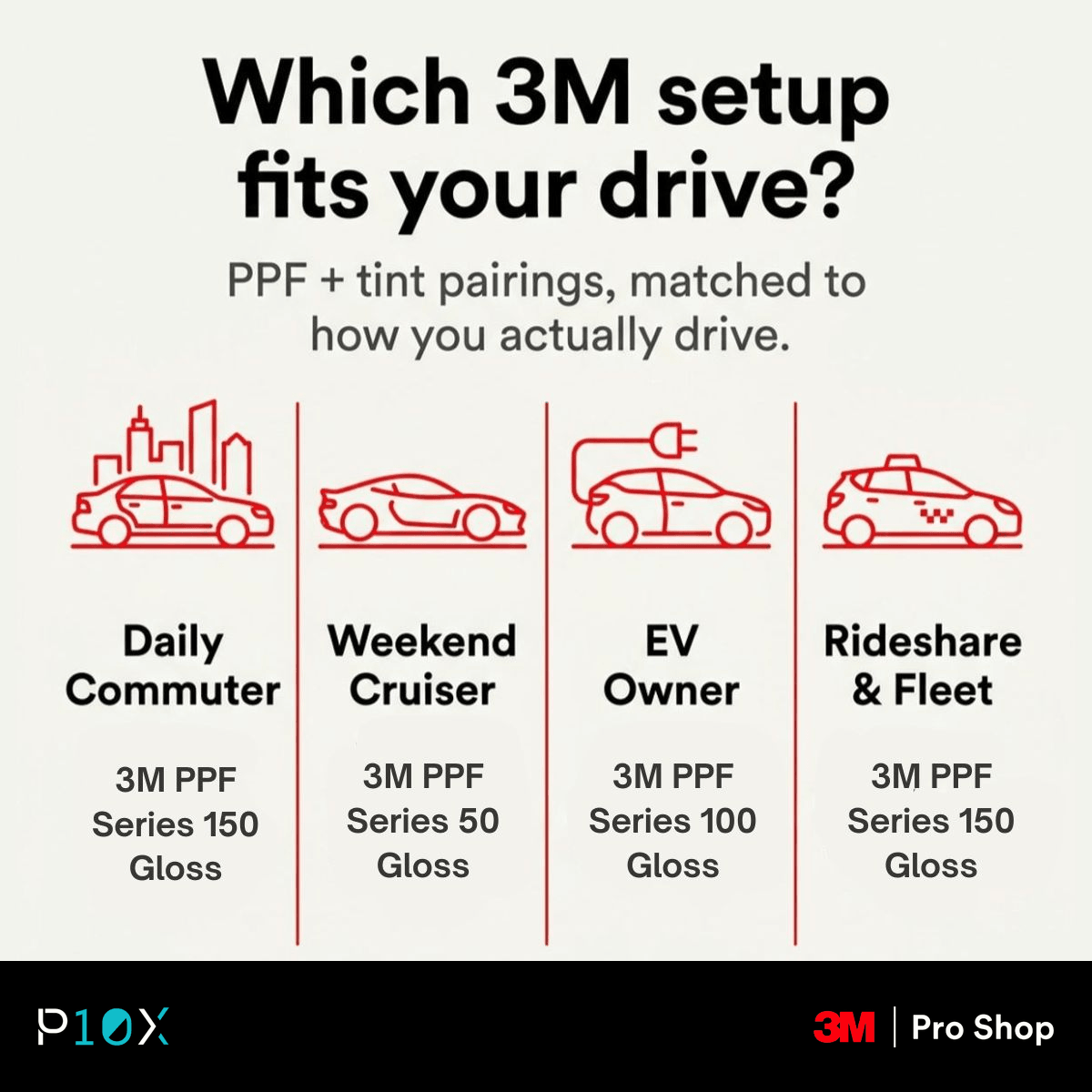
If your car is new, plan PPF on pick-up day, not after the first stone chip. If your car is already on the road, start with the highest-impact zones (bonnet, bumper, headlights, side mirrors and door cups) and layer a coating on top for gloss and easier washing. For daily Klang Valley drivers, Series 100 plus Crystalline Black CR BLK is a sensible balance. For weekend and luxury cars, Series 150 is the clear pick.
Every 3M Pro Shop install is done by certified technicians with cleanroom-grade surface prep, followed by the 72-hour wash wait, pH-neutral hand-wash rule, and a clear in-writing warranty. Talk to a certified 3M Pro Shop dealer about your actual route, parking habits and budget to price each PPF zone in ringgit.
Find out the best protection for your car
Visit a 3M Pro Shop and discover the cost-effective 3M Protective Film and Window Tint
Self-Healing PPF vs Coating FAQ
Is self-healing PPF better than self-healing ceramic coating?
Yes for scratch repair and stone-chip defence. 3M PPF is tens of times thicker than a ceramic coating and physically absorbs impacts that coating cannot. Coating is still useful for hydrophobic gloss and easier washing, so most Malaysian owners combine both.
Does ceramic coating really self-heal scratches?
Only micro-marring within the ceramic layer, and only when heat softens the thermoplastic polymer embedded in the coating. A scratch that reaches the factory clear coat is permanent until it is polished or resprayed.
Can PPF and ceramic coating be used together?
Yes. PPF goes on first on the paint, then ceramic coating goes on top of the PPF for water beading and gloss. This layered order is the most common premium package at 3M Pro Shop.
How long does self-healing PPF last in Malaysia?
Up to around 5 years for 3M PPF Series 150, and up to around 3 years for Series 100 and Series 50 per the product brochures. Actual lifespan depends on aftercare, parking and how quickly contaminants are cleaned off. Always confirm the exact warranty with your 3M Pro Shop dealer.
What kinds of scratches can a ceramic coating not fix?
Anything that cuts past the coating layer. That includes most clear-coat scratches, all stone chips from highway debris, and deep keys, trolleys and fingernail gouges. These need PPF or a proper paint repair.
How much does self-healing PPF cost in Malaysia?
Full-car 3M PPF starts from around RM 11,000 for Series 50, RM 15,000 for Series 100, and RM 19,000 for Series 150. Ala-carte bonnet jobs on medium vehicles start from around RM 1,250.
Does Malaysian weather activate PPF self-healing?
Yes. Ambient 33 to 35 degrees Celsius, combined with direct sun on a dark bonnet, already reaches the passive activation range for the 3M PPF elastomeric top coat. This is a local advantage that cooler climates do not share.
How fast does PPF self-heal in Malaysian sun?
Light swirl marks usually disappear within minutes once a panel reaches roughly 40 to 50 degrees Celsius, which is normal on a dark bonnet under midday sun. In shaded parking or overcast monsoon weather, the same marks may take a few hours. Rinse with warm water if you want to speed it up.
Author

Fabian
He is passionate about revolutionizing the car protection services industry by bringing innovation and transparency to a traditionally opaque and often misunderstood field. His mission is to educate end users on the true benefits and importance of car protection, aiming to replace outdated practices with honest, customer-focused solutions. With a fresh approach to car tinting, paint protection film (PPF), and detailing services, he is committed to delivering a superior customer experience that sets a new standard in the market. He welcomes discussions about the future of the automotive industry and is eager to connect with like-minded professionals who share his vision for innovation, integrity, and excellence.
Experience the future of window tinting
Visit a 3M Pro Shop and discover the revolutionary Crystalline CR BLK film