
Tesla Model Y Window Tint in Malaysia: What Percentage for Each Window
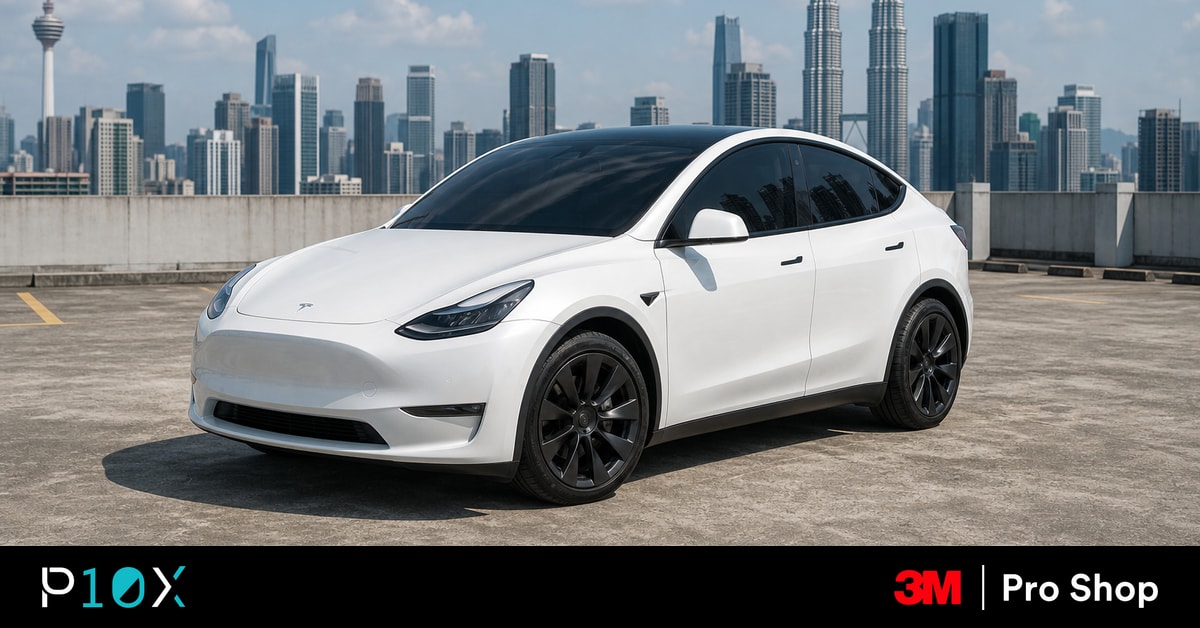
- JPJ asks for at least 70 percent light through your front windscreen and at least 50 percent through the front side windows. The rear side windows and the rear windscreen have no limit.
- Your Model Y does not have the same glass all round. The front is close to clear. The rear is already dark from the factory and already blocking most of the infrared.
- The money goes up front. That is where the glass is clear and where the law is tightest.
- In the current 3M Crystalline Black range the best heat rejection is CR BLK 50 at 68 percent. The darkest shade, CR BLK 15, only manages 64 percent. Darker is not cooler.
- CR BLK 50 is also exactly the legal shade for your front side windows. You do not have to break the law to get the best film.
- The glass roof is the biggest single pane on the car and the one sitting over your head in every jam.
Getting the Tesla Model Y window tint right in Malaysia is really one question asked five times, once for every piece of glass on the car. The answer is different for each one, because JPJ treats them differently and because Tesla did not fit the same glass all the way round.
Most tint advice treats a car as one big window. Pick a number, do the whole car, done. That works on a Myvi. On a Model Y it wastes your money, and up front it can get you a summons. For the wider picture on film choice, start with why 3M window tinting suits Malaysian driving.
This is the window-by-window answer. What the law allows, what your car already has, and what to actually put on each pane.
Model Y Glass: What You Already Have
Model Y Tint: What JPJ Actually Allows
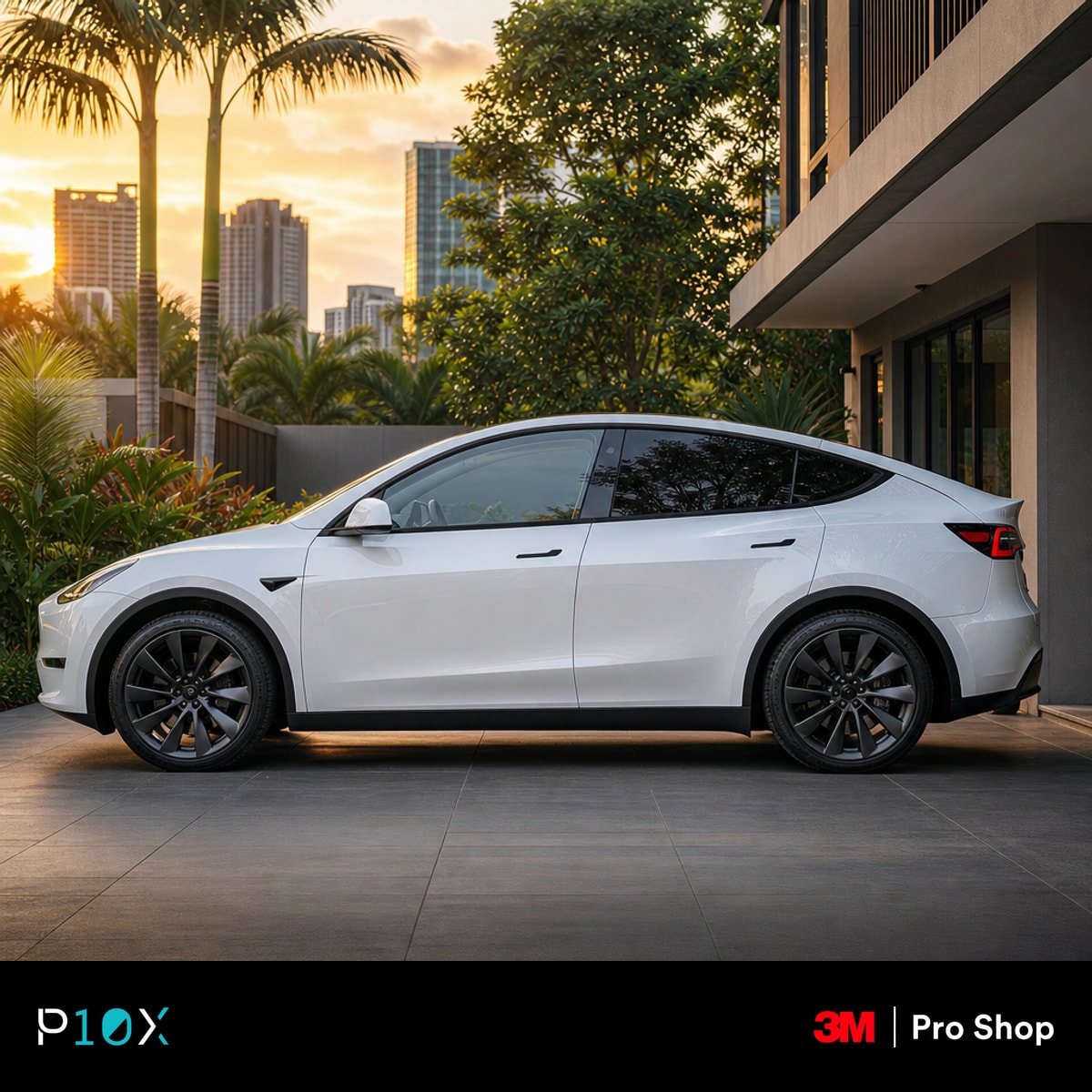
The rules are short, and they are not the same for every window. Your front windscreen has to let at least 70 percent of light through. Your front side windows have to let at least 50 percent through. The rear side windows and the rear windscreen have no limit at all. You can go as dark as you like back there.
That last part surprises people, because half the tint advice floating around Malaysia has the numbers backwards. One article written specifically for Tesla owners in this country states the front side limit as 70 percent and the rear as 50 percent. Both are wrong, and an owner following it would end up with a windscreen that fails and a rear that is needlessly light. Check the number against JPJ, not against a shop blog. Our own breakdown of JPJ-compliant window tint walks through the enforcement side.
The penalty for getting it wrong is not a slap on the wrist. A first offence carries a four-figure compound or a jail term of up to six months, and a repeat offence doubles both. On top of that an officer at a roadblock can tell you to strip the film there and then. If you have just paid for premium film on a new car, watching someone peel it off at the side of the Jalan Duta roundabout is not the morning you had planned. It also comes back at Puspakom time, which is a separate headache if you ever sell the car.
None of this is your installer's call to make for you. Their job starts once you have picked the shade, shrinking the film to the curve of the windscreen with a heat gun the way the photo below shows, then trimming it to fit.

Best Tint Shade for Every Model Y Window
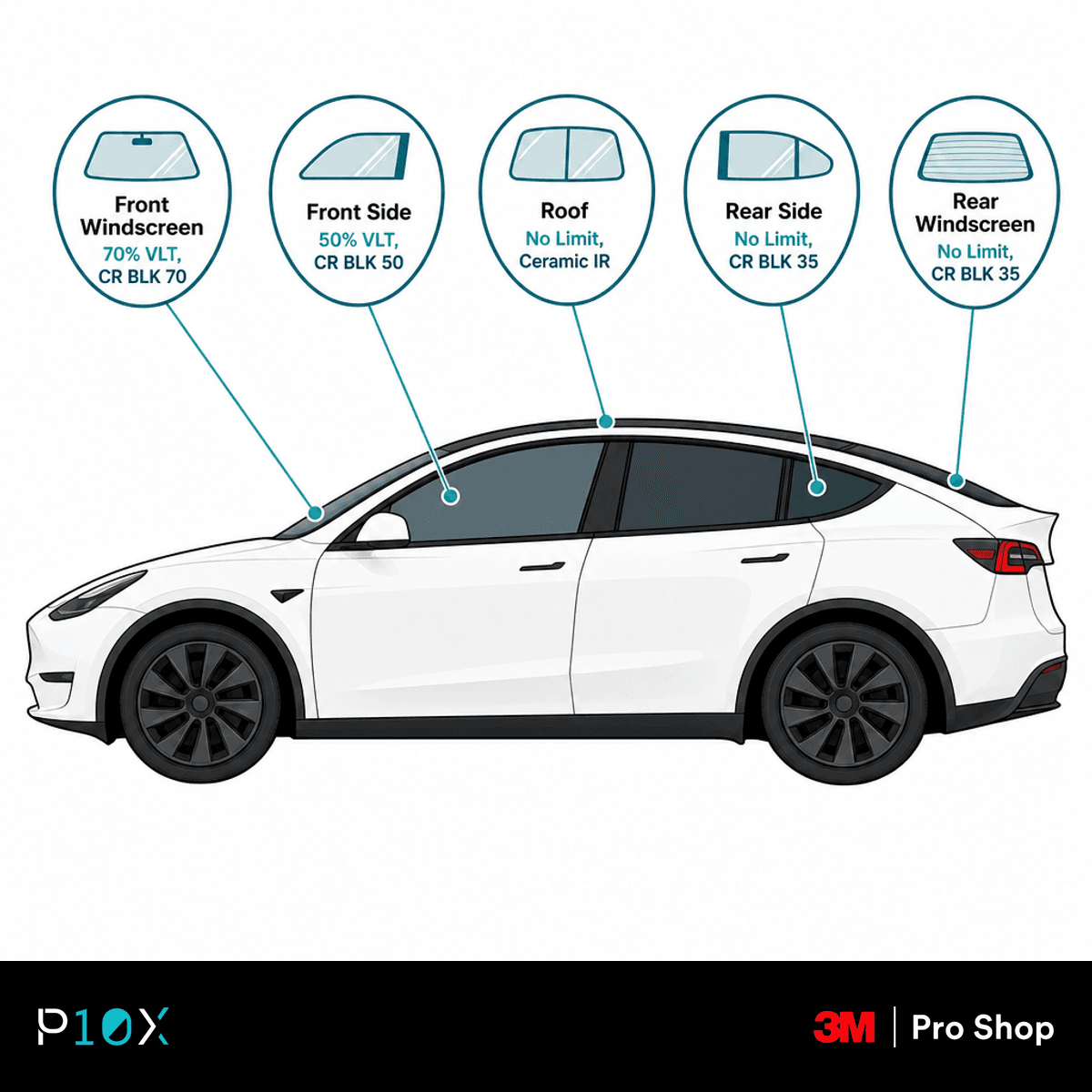
Here is the short answer before the reasoning. CR BLK 70 on the windscreen, CR BLK 50 on the front doors, CR BLK 35 or nothing at all at the back, and Ceramic IR on the roof.
Two things decide the shade for any given window. The first is what the law will accept on that pane. The second is how much work the factory glass is already doing there. Once you line those two up, the answer for each window falls out on its own, and it stops looking like one big number for the whole car.
The shade codes are the light-through figures, so CR BLK 50 lets 50 percent of light through and CR BLK 70 lets 70 percent through. The code tells you straight away whether a shade is legal on a given window. Anything at 70 or above works on the windscreen. Anything at 50 or above works on the front doors. Everything else belongs behind the B-pillar.
| Window | JPJ minimum light through | What the car already has | 3M shade that fits | Why this one |
|---|---|---|---|---|
| Front windscreen | 70 percent | Close to clear, around 80.5 percent | CR BLK 70 | Stays legal and adds heat and UV blocking on the pane you sit closest to |
| Front side windows | 50 percent | Close to clear, same glass as the windscreen | CR BLK 50 | Best heat rejection in the range at 68 percent, and exactly on the legal line |
| Rear side windows | No limit | Already dark, around 21.5 percent | CR BLK 35, or leave it alone | Factory glass already blocks most infrared, so the extra gain is small |
| Rear windscreen | No limit | Same dark factory glass | CR BLK 35, or leave it alone | Same reasoning as the rear sides |
| Glass roof | No limit | Factory tinted with an infrared coating | Ceramic IR | Biggest single pane on the car and the one directly over your head |
The pattern is worth saying out loud. Spend up front, go light at the back, and give the roof its own decision. If your rear seats carry a child every school run, add the CR BLK 35 for the extra UV and glare. If the back is mostly empty and you are buying tint to stop the cabin cooking, put that money into the front and the roof instead.
One note on the range itself. The original Crystalline series is no longer sold in Malaysia as of December 2025, and Crystalline Black has taken over as the flagship. If a shop is still quoting you the old range, they are working off an old list. Crystalline Black is what you will actually be fitted with, so the CR BLK codes are the ones to say out loud when you book. The map below puts the same five answers back onto the car so you can check them off pane by pane.
Why the Darkest Tint Is Not Coolest
Ask anyone in a Malaysian carpark and they will tell you darker means cooler. On the current 3M range that is simply not true, and the numbers say so plainly.
Total solar energy rejection across the Crystalline Black shades runs like this. CR BLK 15 blocks 64 percent. CR BLK 30 blocks 66 percent. CR BLK 35 and CR BLK 40 both block 67 percent. CR BLK 50 blocks 68 percent. CR BLK 60 blocks 67 percent, CR BLK 70 blocks 65 percent and CR BLK 80 blocks 59 percent. The peak sits at 50, right in the middle. The darkest film in the range is four points worse than the shade that is legal on your front doors.
Put a number on what that costs you. On a clear Klang Valley afternoon the sun delivers roughly 1,000 watts on every square metre it hits. CR BLK 50 stops about 680 of those watts per square metre. CR BLK 15 stops about 640. That is a 40 watt gap on every square metre of glass. Your Model Y front side windows are roughly 0.55 square metres each, so about 1.1 square metres across both doors. Going illegally dark on the front sides therefore lets roughly 44 watts more heat into the cabin than staying legal does, and hands you a compound on top of it. You pay twice for the privilege of being hotter.
There is a second reason people think dark equals cool, and it is worth naming. A dark film cuts glare, so the cabin feels dimmer and your eyes relax. That is a real comfort gain and it is why CR BLK 15 leads the range on glare reduction at up to 81 percent. But dimmer is not cooler. If your cabin still feels hot after a fresh install, the shade is usually not the problem, and we have covered why heat rejection can feel weak in more detail.
The chart below lays the whole range out in one go, and the shape of it is the point. The tallest bar sits in the middle, not at the dark end.

Why the Model Y Glass Roof Runs Hot
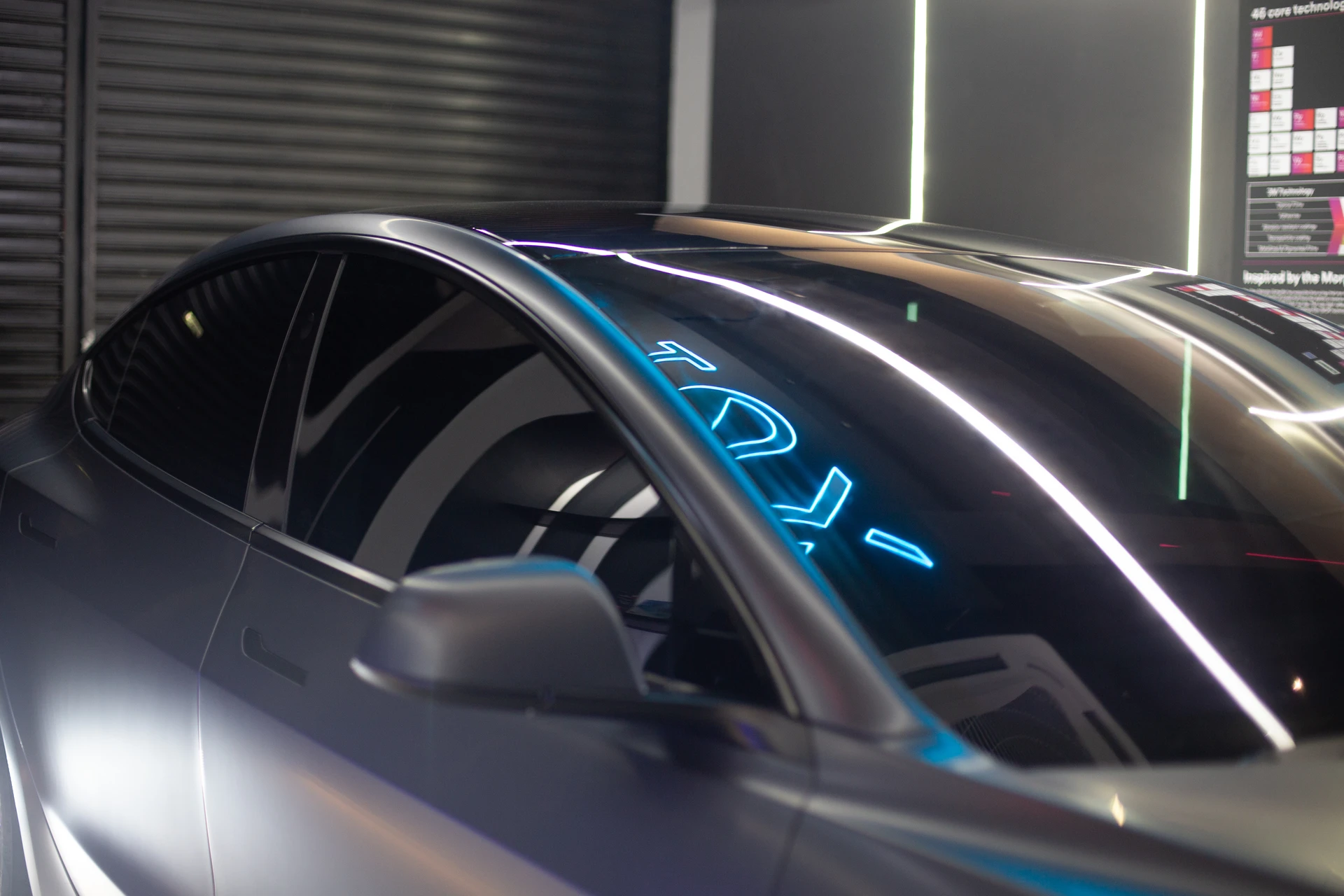
The roof is the pane nobody plans for and everybody complains about. It runs almost the full length of the cabin, it is the only piece of glass with the sun hitting it straight on at midday, and it sits directly above your head.
Owners are loud about this. On the biggest Tesla owner forum there is a long-running thread where people describe the roof as too hot to touch and report the cabin sitting far above the outside temperature after an hour parked in the sun. Those are owners in temperate countries. Park on a rooftop level at Mid Valley at 1pm and you are dealing with a harder version of the same problem. The roof is factory tinted and does carry an infrared coating, which is why the cabin is not worse than it is, but coated glass still soaks up heat and radiates it downward.
You have three honest options and none of them is magic. Ceramic IR film on the roof adds real infrared blocking with a neutral colour that will not turn the cabin into a cave. Tesla sells a fitted sunshade for the roof, which physically blocks the light but has to be put up and taken down. Cabin Overheat Protection and pre-cooling from the app do not touch the heat coming in, they just deal with it after the fact, and they draw from the battery to do it. Most owners who are serious about comfort end up doing the roof film and using the app to pre-cool before they walk out of the mall.
If you would rather hear the per-window numbers than read them, the clip below runs through the legal limits in about a minute.
Model Y Tint Jobs: What Goes Wrong
A Model Y is not a hard car to tint, but it has three specific traps and a shop that does not know the car will walk into all of them.
The first is the camera housing at the top of the windscreen. The Model Y runs a camera suite and several of those cameras look forward through the top of the glass. Film has to be cut cleanly around that housing, and it has to be film that does not sit in the light path. This is the main reason to keep metallic and sputtered film off a Tesla windscreen entirely. We have written up how film choice interacts with driver-assist cameras if you want the technical version.
The second is the door glass. The Model Y has frameless-style door glass that drops slightly every time you open the door and rises again when you shut it, and it passes through a tight rubber sweep on every cycle. Fresh film has not fully bonded for the first few days, and that sweep will drag a fine scratch down the film every time the window moves. Shops that know Teslas will tell you not to open the windows for the first three days. Shops that do not will hand you the keys and say nothing, and you will find the scratch three weeks later. This is a known problem across Tesla, BYD and other tight-seal cars.
The third is simple impatience. Malaysian humidity means the moisture trapped under fresh film takes longer to clear than it would in a drier country, and a car collected at 5pm and driven straight into a jam with the air-conditioning on full is not helping the film settle. Give it a few days before you judge the finish. Small haze and tiny water pockets in the first week are normal and clear on their own. Bubbles that are still there after two weeks are not, and that is a conversation to have with your installer.
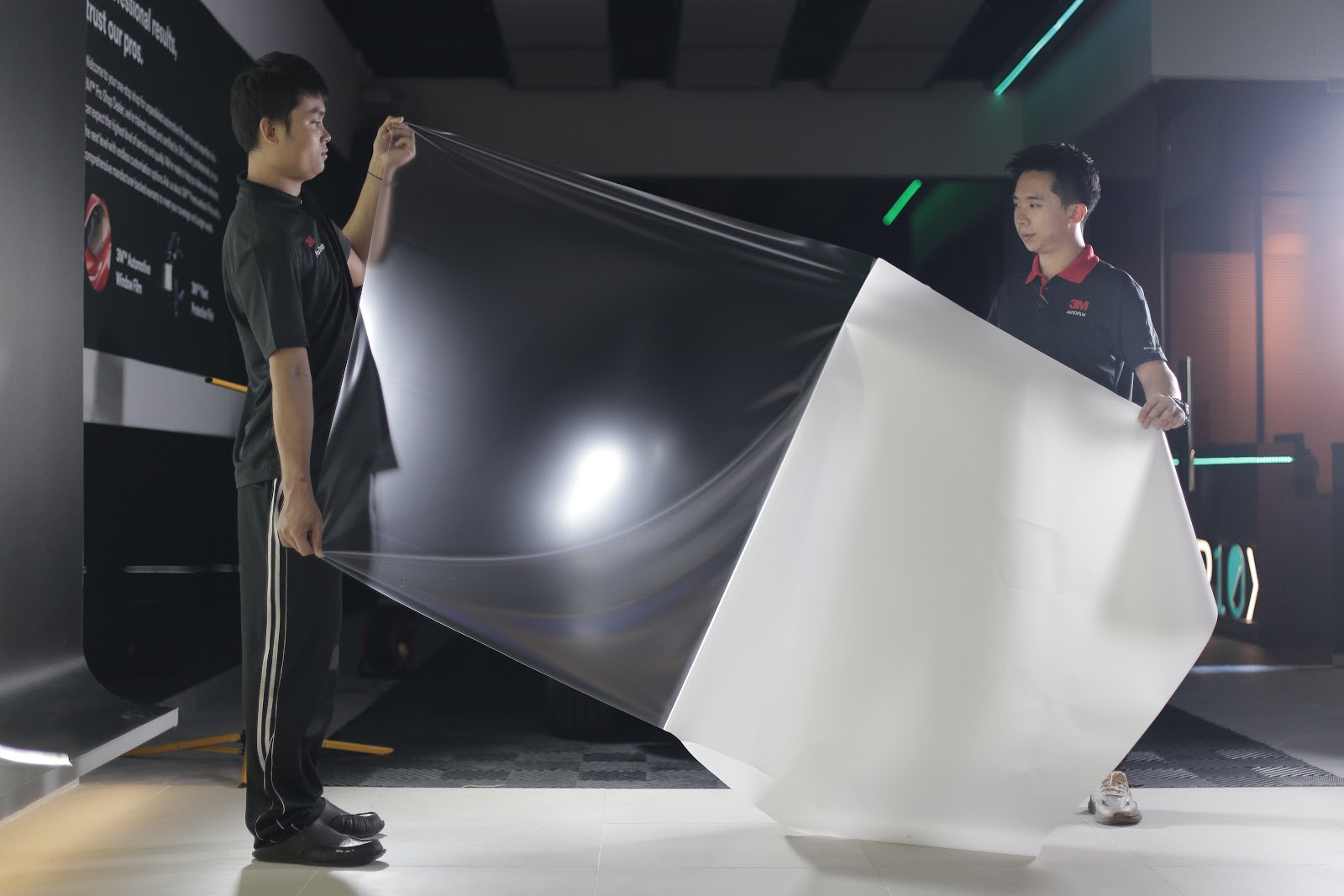
Most of what decides your finish happens before the film ever touches the car, in the handling and cutting stage the photo below shows. A clean cut and a clean room do more for the result than the shade you picked.
Book Your Tint Before the First Jam
If you take one thing away, take this. Your Model Y needs four different answers, not one. CR BLK 70 on the windscreen, CR BLK 50 on the front doors, something light or nothing at all at the back, and a separate decision for the roof.
The car has already done half the job for you at the rear. Spend where the glass is clear and where you actually sit. And do it before the first proper long drive, because the difference between a tinted and untinted front door on the North-South Expressway at 2pm is the difference between arriving comfortable and arriving with a sore left arm.
When you book, ask the shop three things: whether they have tinted a Model Y before, how they cut around the camera housing, and how many days to leave the windows shut. If they cannot answer all three, keep looking. You can find a certified installer through 3M Pro Shop by P10X.
If you still want to see the difference between the old Crystalline and the Crystalline Black that replaced it, the clip below puts the two side by side.
Find out the best protection for your car
Visit a 3M Pro Shop and discover the cost-effective 3M Protective Film and Window Tint
Tesla Model Y Window Tint FAQ
What tint percentage is legal for a Tesla Model Y in Malaysia?
At least 70 percent light through the front windscreen and at least 50 percent through the front side windows. The rear side windows and rear windscreen have no legal limit, so you can go as dark as you want back there.
Does the Tesla Model Y glass roof need tinting?
It is already factory tinted with an infrared coating, so it is not bare glass. But it is the largest pane on the car and it takes the sun straight on at midday, so adding a Ceramic IR film is the single biggest comfort upgrade available on a Model Y in Malaysian conditions.
Can you tint the Tesla Model Y front windscreen in Malaysia?
Yes, as long as the finished glass still lets at least 70 percent of light through. A CR BLK 70 film sits at that line. Avoid metallic or sputtered film on this pane because of the cameras mounted behind the top of the glass.
Is the Tesla Model Y rear glass already tinted from the factory?
Yes. Owner measurements put the rear glass at around 21.5 percent light transmission with roughly 91.5 percent infrared rejection straight from the factory, which is why adding film back there gives a much smaller gain than adding it up front.
Will window tint affect the Tesla Model Y cameras?
Non-metallised film like the Crystalline Black range does not interfere with the cameras, and the film is cut around the camera housing anyway. Metallic and sputtered films are the ones to avoid on a Tesla windscreen.
How long after tinting a Model Y before you can open the windows?
Leave them shut for about three days. The Model Y door glass moves through a tight rubber sweep every time you open the door, and that sweep will scratch film that has not finished bonding.
Does tinting a Tesla Model Y improve its range?
Indirectly and modestly. Less heat entering the cabin means the air-conditioning works less hard, and on an EV that load comes out of the same battery that moves the car. It will not transform your range figure, but it makes the climate control's job easier on every hot afternoon.
Author

Kelvin Cheen
Kelvin is an Automotive Solutions Consultant and Branch Manager at 3M Pro Shop. With 4+ years of field experience in premium vehicle surface protection, Kelvin specializes in flagship 3M technologies, including 3M Crystalline Black optical film and Ceramic IR tints, 3M Paint Protection Film (PPF), etc. His focus is on delivering transparent, engineering-backed advice to car and EV owners, cutting through sales upsells to ensure customers choose the exact thermal rejection and paint protection tailored to their driving needs.
Experience the future of window tinting
Visit a 3M Pro Shop and discover the revolutionary Crystalline CR BLK film