✧ Key Takeaways
- Neither film contains metal. Crystalline Black combines more than 200 thin optical layers with nano-ceramic. Ceramic IR uses nano-ceramic that absorbs heat.
- Crystalline Black has a charcoal look, while the Malaysian Ceramic IR brochure describes Ceramic IR as a cool blue shade with a neutral, low-reflection finish. You can compare samples against your own glass to see which you prefer.
- On 3M's green-tinted Auto 75 test glass, CR BLK 70 and Ceramic IR 70 both reject 51% of total solar energy (TSER), even though Crystalline Black's infrared rejection figure is much higher. Infrared rejection alone does not tell you how much solar heat a film keeps out.
- You can compare the exact shade codes using figures for the same test glass. After fitting, a visible light transmission (VLT) reading shows how much light passes through your glass and film together.
3M Crystalline Black does not automatically keep out more solar heat than Ceramic IR, even though the films are made differently and have different colours. Heat rejection depends on the exact shades. On 3M's green-tinted test glass, some matching shades reject the same share of total solar energy.
Both are part of the 3M window tint range, and both offer shades from light to dark. When comparing 3M Crystalline Black with 3M Ceramic IR, use the figures for the shades you would actually fit, such as CR BLK 70 and Ceramic IR 70. A range’s highest figure may belong to a different shade.
If both films are on your quote, you need to know what Crystalline Black offers that Ceramic IR does not, rather than choose it just for the flagship name. If your shortlist includes other brands too, you can compare the named films and shades in our 3M Crystalline tint comparison.
Crystalline Black is not the original Crystalline
Crystalline Black (CR BLK) came after the original 3M Crystalline. An older review or specification sheet for 3M Crystalline may therefore describe a different film. Your quotation should say whether you are getting Crystalline Black or the original Crystalline, rather than just using the Crystalline name.
XP is another series in the 3M range, not another name for Crystalline Black. If XP is on your quotation too, you can compare 3M XP with Ceramic IR instead.
An older Crystalline review may describe a different shade or appearance. It cannot tell you how a CR BLK sample will look against your own glass.
This reel shows the original Crystalline film. It is not a test of Crystalline Black or Ceramic IR.
Matching shades can reject the same amount of heat
Crystalline Black does not always reject more heat. On the same 3M test glass (6 mm green-tinted car glass), CR BLK 70 and Ceramic IR 70 both let through 64% of visible light and reject 51% of total solar energy.
Crystalline Black's infrared rejection figure is much higher, but these two shades reject the same share of total solar energy on this glass. These figures come from 3M's Crystalline technical sheet (August 2025) and Ceramic IR technical sheet (July 2021).
VLT tells you how much visible light passes through. TSER tells you how much total solar energy is rejected under the stated test conditions. These figures use 3M's Auto 75 test glass, which is 6 mm green-tinted car glass with 73% starting VLT. Your windscreen may give a different result.
| Film on 3M's Auto 75 test glass | VLT | TSER | Infrared rejection (IRR, narrow infrared band) | Infrared energy rejection (IRER, wide infrared band) |
| CR BLK 70 | 64% | 51% | 97% | 65% |
| Ceramic IR 70 | 64% | 51% | 78% | 66% |
Both films let in the same amount of light and reject the same share of total solar energy on this glass. Crystalline Black's 97% infrared rejection, compared with Ceramic IR's 78%, does not mean it blocks proportionally more heat overall. Those infrared figures alone do not make Crystalline Black the better choice.
Both contain ceramic and neither contains metal
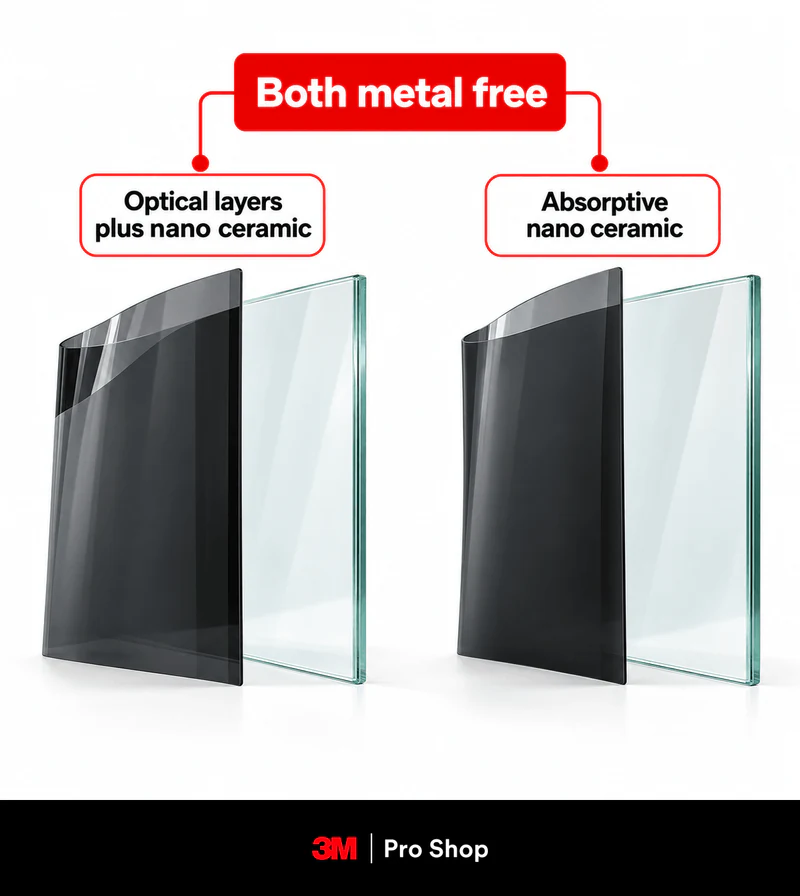
Both films contain ceramic and neither contains metal. Crystalline Black combines more than 200 very thin optical layers with nano-ceramic, while Ceramic IR uses nano-ceramic that absorbs heat. You do not need to choose Ceramic IR just to get ceramic in the film.
Those catalogue results do not confirm that either film will meet your windscreen's legal light limit. On this test glass, both films end up at 64% VLT, which is below the 70% minimum for a normal private car's front windscreen in Malaysia. Your windscreen may let through a different amount of light to begin with. A reading after fitting checks the actual glass and film together. A shade number is not a guarantee that the tint meets the law.
Infrared figures measure different ranges of light
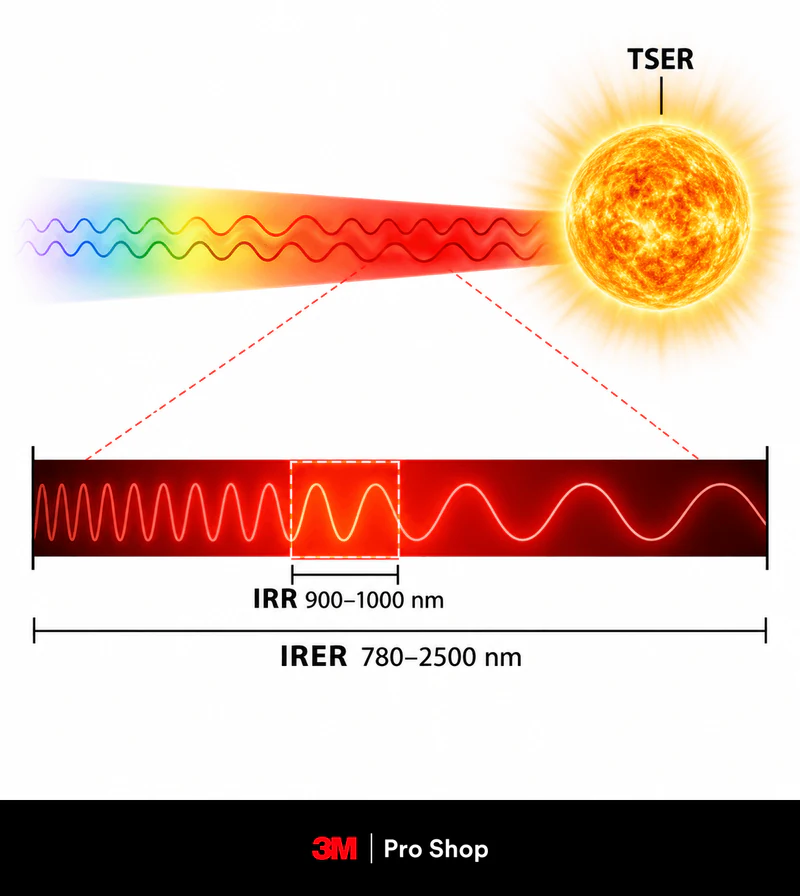
Infrared rejection (IRR) and infrared energy rejection (IRER) measure different parts of the sun's infrared heat, and neither is the same as TSER. In the 3M sheets, IRR covers a narrow band from 900 to 1,000 nanometres, while IRER covers a much wider band from 780 to 2,500 nanometres.
A nanometre is the unit used for the wavelength of light. IRR is measured on the film and its liner alone, without glass. IRER is measured with the film on glass and also counts the heat the film soaks up and then gives off into the car.
A film can have a high rejection figure over the narrow infrared band and a lower figure over the wider band. Those percentages answer different questions. Comparing them as though they measured the same sunlight would give you the wrong impression of how much heat the film keeps out.
In the table above, Crystalline Black's IRR is much higher, while Ceramic IR's IRER is one percentage point higher. Both results can be true because IRR and IRER measure different parts of infrared heat in different setups. That gap of one percentage point on test glass does not prove that you would feel a difference inside your car.
For total solar heat, TSER is more useful than either infrared figure alone, provided you compare the shade you need on the same type of test glass. It does not tell you how many degrees cooler your car will be. Sunlight reaches other windows and the body, while parking time and your air-cond affect how hot the cabin gets and how quickly it cools. A brochure percentage helps you compare films, not predict the temperature when you open the door.
Test glass changes the published result
A film can have different published results on different glass. Both technical sheets give figures for green tinted and clear glass. If you compare one film on clear glass with the other on green tinted glass, you cannot tell how much of the difference comes from the films themselves.
For example, CR BLK 70 is listed at 78% VLT and 43% TSER on 6 mm clear glass. Ceramic IR 70 is listed at 78% VLT and 41% TSER on the same clear glass specified in the sheets. These are the two results to compare, rather than mixing either with the Auto 75 figures.
This gap of two percentage points in TSER comes from 3M's published test figures, not a test on a real car. It does not promise a difference in cabin temperature. The two sheets were also published at different times, so these are not results from one side-by-side test on the same day or the same car.
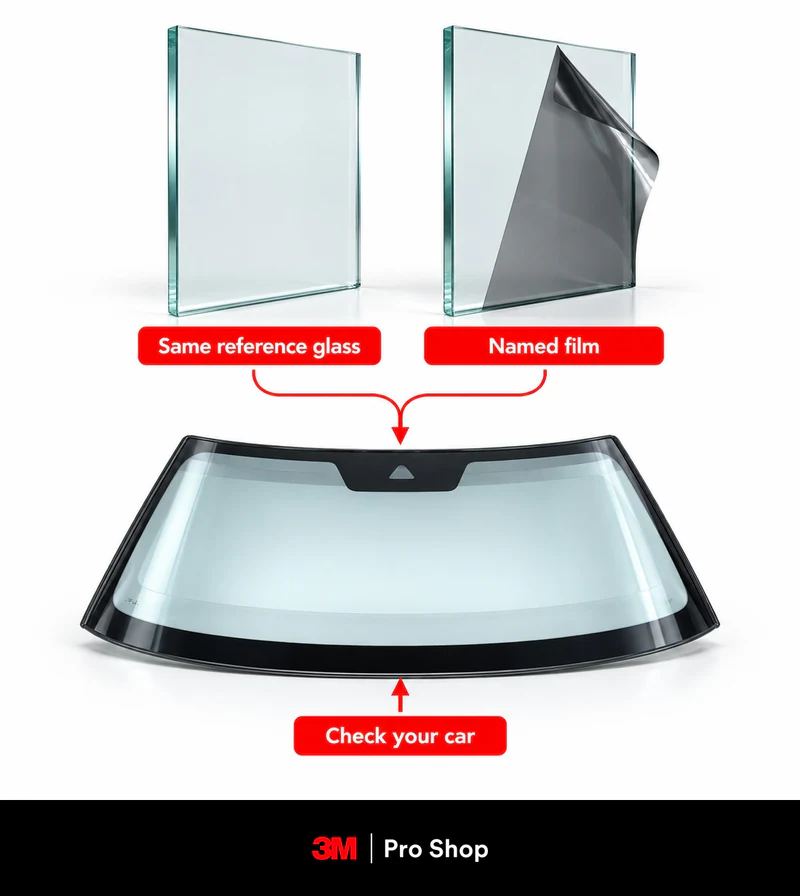
You also cannot take a VLT result for film already fitted to test glass and simply multiply it by your own glass's VLT. That published result already includes a piece of glass. If someone estimates your VLT, you can ask which film and glass figures they used. That helps you distinguish an estimate from a reading on your car. Only a reading taken on your car measures how much light passes through the finished glass and film together.
Charcoal or cool blue: which look suits you?
3M's Malaysian product information describes a charcoal finish for Crystalline Black and a cool blue shade with a neutral, low-reflection finish for Ceramic IR. These descriptions are a useful starting point. Your existing glass and the surrounding light affect how the film looks once fitted.
Two samples with similar VLT can still differ in colour or reflections, so VLT alone does not tell you which look you will prefer.
You may simply prefer Crystalline Black's charcoal colour. That preference does not mean it rejects more heat. Ceramic IR can be a reasonable choice if you prefer how it looks, as long as the shade gives you the heat rejection you need and lets enough light through to meet the legal requirements for your car.
A sample can look different from inside and outside the car. Factory tinted glass affects its colour, and a loose sample in bright light may not look the same once fitted. Your windscreen and door glass can differ too. Seeing the sample against each window is more useful than choosing a colour from a screen.
Crystalline Black's charcoal appearance is part of what changed from the original Crystalline. CR BLK introduced darker charcoal shades. If those are the samples you prefer, having CR BLK and the shade number on your quote confirms that you are choosing the newer range.
More light passing through a film does not, by itself, guarantee a clear view at night. Rain, reflections, scratches, haze and your eyesight still affect what you can see. Tint cannot repair damaged glass. Your tint still needs to meet the legal VLT limit, but that alone cannot guarantee a clear view in every driving condition.
What about your phone signal and cameras?
Neither series contains metal. 3M's Ceramic IR technical sheet specifically lists mobile phone and GPS compatibility. A film without metal is not necessarily suitable for covering every camera or sensor area. Your car's equipment may have requirements of its own.
Before fitting, you can point out any chips, scratches or loose trim on your car. It is also worth discussing how the installer will keep the fitting solution away from nearby switches and electronics.
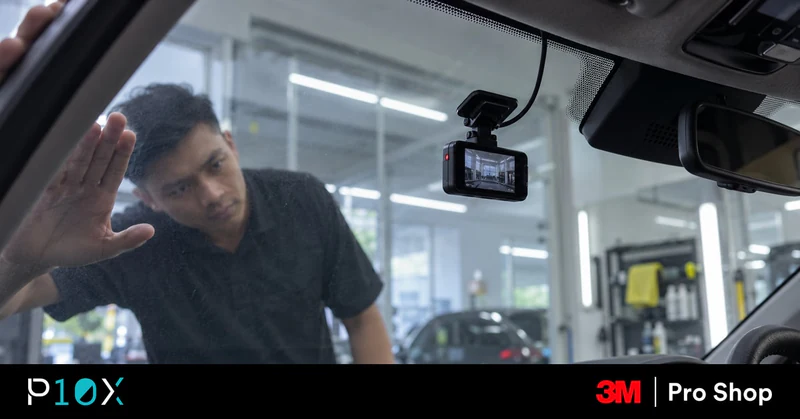
A dashcam may sit where the installer needs to reach the glass. Mobile phone and GPS compatibility does not tell you whether that device can stay in place while the film is fitted.
You can point out a dashcam or other device on the glass before the installer prepares and cuts the film for your windows. Neither series guarantees that every accessory will work perfectly. Having the film name and shade written down also helps if you need to check what was fitted after you collect the car.
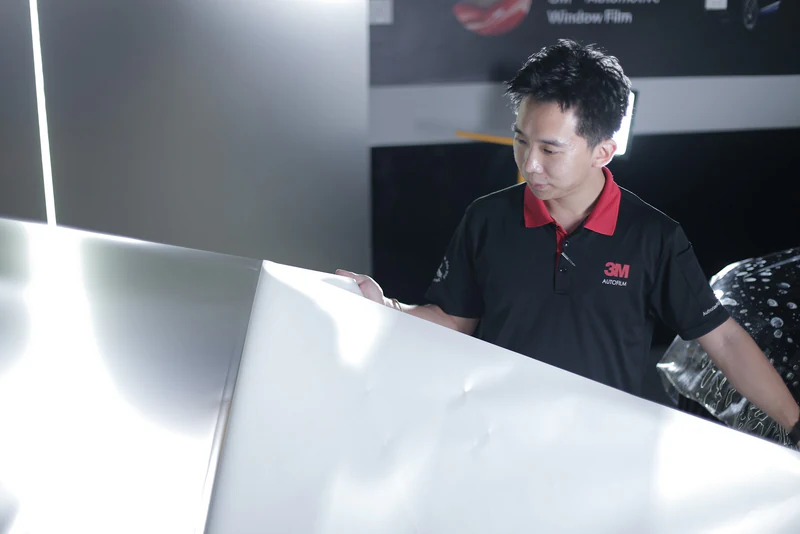
Your quotation needs more than a series name
Your quotation should name the film and shade for each window, rather than one series for the whole car. That includes the windscreen, side windows, rear windscreen and any glass roof. If old tint is coming off, you can also ask for removal and glass preparation to be listed in the quotation.
Each piece of glass needs a VLT reading with the film fitted. PUSPAKOM's July 2025 statement explains that it follows JPJ specifications and measures the glass and film together. For a normal Malaysian private car, the front windscreen needs at least 70% VLT and the front side windows at least 50%. Choosing either series does not guarantee those readings.
When you collect your car, you can ask for the windscreen and front side window VLT readings. You can compare those readings with the JPJ compliant window tint limits. A car tint checklist can record the condition of your glass before fitting, the film you agreed to and any concerns you notice when collecting the car.
During installation, fitting solution lets the film slide into position on the glass before it is pressed down. Ask the installer how to care for the new tint while it dries. If water remains under the film or a patch worries you, the installer can check it rather than you trying to press or smooth it out.
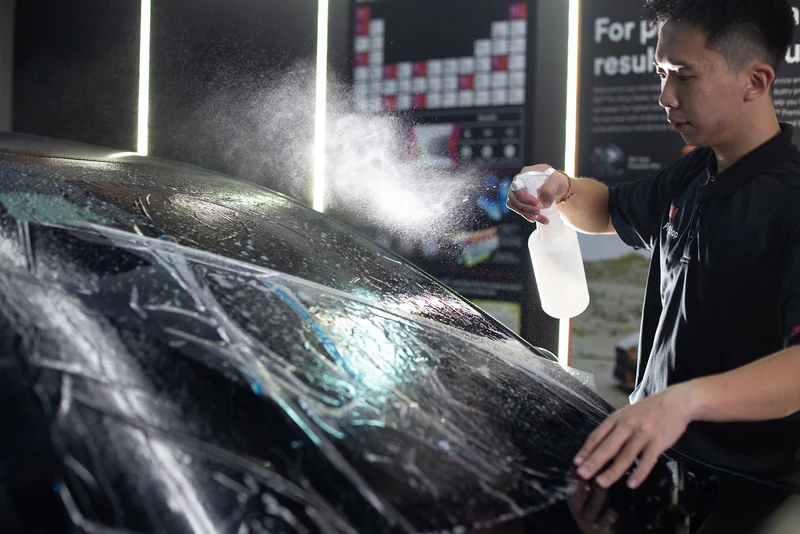
Tint cannot replace air-cond in a parked car
Heat through a side window while driving is different from heat built up in a car parked outside for hours. A hot steering wheel alone does not tell you which film you have or whether it is damaged.
Changing the film may change how much solar energy comes through the glass, as well as its shade and appearance. Heat can still enter through other windows and the body and remain inside. If your car is still hot after tint, the film itself, where you park and how long it stays there all help explain why.
You may not need to replace the tint on every window if the existing tint is in good condition and your main complaint is a hot dashboard after parking. Explaining when and where the car feels hot helps the installer understand what you want to improve. That gives them more to go on than a request for a higher infrared rejection figure alone.
Crystalline Black or Ceramic IR for your car?
Crystalline Black makes sense if you like its charcoal look and want its higher IRR rating, which measures rejection over a narrow part of the infrared range. You may prefer Ceramic IR if you like how it looks once fitted to your car and the shade provides the heat rejection you need.
CR BLK 70 and Ceramic IR 70 reject the same share of total solar energy on 3M's Auto 75 glass. The Crystalline Black name alone does not mean a shade keeps out more heat than its Ceramic IR match.
Whichever series you prefer, your quotation should list the shade for each window so you know what film you are getting. A VLT check after fitting measures how much light passes through your glass and film together.
If you want to compare the samples on your own glass, a 3M Authorized Dealer such as 3M Pro Shop by P10X can help you look at both and compare the figures for the shades you are considering.
Find out the best protection for your car
Visit a 3M Pro Shop and discover the cost-effective 3M Protective Film and Window Tint
Frequently Asked Questions
Does Ceramic IR contain metal?
No. 3M's product information lists Ceramic IR as metal free, and its Malaysian brochure describes nano-ceramic technology that absorbs heat. Crystalline Black is also metal free, but combines nano-ceramic with optical layers.
Does Crystalline Black always keep more heat out?
Not always. On 3M's Auto 75 test glass, CR BLK 70 and Ceramic IR 70 are both listed as rejecting 51% of total solar energy (TSER). On 6 mm clear glass, CR BLK 70 is listed two percentage points higher, at 43% against Ceramic IR 70's 41%. You can compare the exact shades using figures for the same glass, rather than choosing by the series name alone.
Why doesn't higher IRR always mean higher TSER?
Infrared rejection (IRR) and total solar energy rejection (TSER) measure different things. IRR only covers a narrow band of infrared light and is measured on the film and its liner alone, without glass. TSER covers all of the sun's energy and is measured with the film on the glass specified for that test. A high IRR does not guarantee a higher TSER.
Will the same film let through the same amount of light on every car?
No. A published visible light transmission (VLT) figure tells you how much visible light passes through the film on the glass used in that test, not on every car's factory glass. Your glass and any existing film can affect the starting reading. Measuring after fitting checks how much light passes through your actual glass and the new film together.
Will Crystalline Black and Ceramic IR look alike?
Not necessarily. 3M's product information describes Crystalline Black as charcoal, while the Malaysian Ceramic IR brochure describes a cool blue shade with a neutral, low-reflection finish. Your glass and the lighting affect how either looks once fitted. Comparing samples is more useful for choosing the colour than relying only on the visible light transmission (VLT) figure, which tells you how much visible light passes through.
Will either tint keep a parked car cool?
Neither Crystalline Black nor Ceramic IR guarantees a cool cabin after parking. Tint reduces some solar energy entering through glass, but heat can still enter elsewhere and stay inside the car. Tint does not replace air-cond or make it safe to be inside an unattended parked car.