✧ Key Takeaways
- It is fairer to compare 3M XP and Ceramic IR at shades of similar darkness, not the darkest shade of one against the lightest of the other.
- TSER (total solar energy rejected) is the best single figure for total heat. A 6-point TSER gap does not mean a 6°C cooler cabin.
- JPJ checks the final reading of your glass and film together, so it is worth having the installer measure your glass before and after.
- Ceramic IR suits you if you want strong infrared heat rejection at the light shades allowed on the front side windows. XP suits you if dark rear privacy is the main goal.
- Each window can take a different shade or series, because the front and rear have different JPJ limits.
If you are comparing 3M XP vs Ceramic IR, the short answer is that at the same darkness, Ceramic IR keeps out more of the sun's heat, especially infrared, while XP costs less and still blocks 99.9% of UV. Both films in the 3M window tinting range contain no metal, so neither interferes with mobile or GPS signals.
The "up to 63%" and "up to 55%" heat rejection figures you see for these two films come from their darkest shades. You will probably not fit the darkest shade on every window, so those headline numbers do not tell you what you will get on your windscreen or front side windows.
Your quote may even list both films, because your windscreen and rear windows have different rules and do different jobs.
Ceramic IR keeps out more infrared heat
Ceramic IR rejects up to 63% of total solar energy and up to 95% of infrared heat (IRR), while XP rejects up to 55% and up to 38% of infrared heat, so Ceramic IR keeps more heat out at a similar darkness.
3M XP and 3M Ceramic IR are both non-metallised nano-ceramic tints that block 99.9% of UV. The main difference is infrared heat.
3M Ceramic IR uses absorptive nano-ceramic technology with a neutral colour. Its strength is infrared rejection, up to 95% IRR on the darkest shade and still 78% on the lightest. It reaches up to 63% total solar energy rejected.
3M XP is also nano-ceramic. It reaches up to 55% total solar energy rejected and up to 38% IRR. It offers strong glare reduction, up to 95% on the darkest shade, and comes in shades from very dark to very light.
3M's car tint range comes in several series, each with its own mix of heat and glare reduction, UV protection, privacy and price. Crystalline and Ceramic IR sit at the top for performance, while XP still performs well and costs less.
Tint figures measure different things
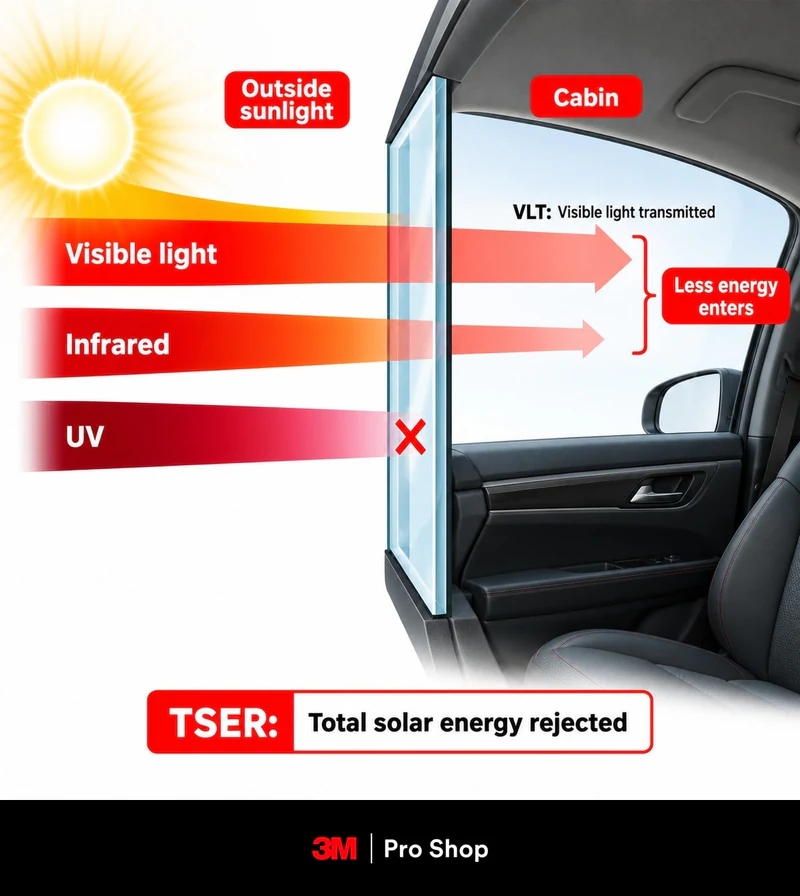
Every 3M tint shade is described with a few short figures. VLT tells you how dark the window looks, TSER tells you how much of the sun's total heat is kept out, and IRR and IRER tell you how much infrared heat, the part you feel on your skin, is blocked.
- VLT (visible light transmission). How much visible light passes through. Lower VLT means a darker window. JPJ rules use VLT.
- TSER (total solar energy rejected). The share of all solar energy, visible, infrared and UV, that the film and glass keep out. This is the best single figure for total heat.
- IRR (infrared rejection). How much infrared is blocked in a narrow test band, measured on the film alone. It is useful for comparing infrared performance, but it is not total heat.
- IRER (infrared energy rejection). The share of infrared energy rejected across a wider test range, from 780 to 2,500 nanometres, rather than the narrow band used for IRR. It gives a fuller picture of infrared heat than IRR.
- Glare reduction. How much bright light is cut. This decides how much you squint when the afternoon sun hits your side windows.
One common mistake is treating a TSER difference as a temperature. A film with 6 more TSER points does not mean the cabin is 6°C cooler. Cabin temperature depends on glass, car colour, parking and aircon, which is why a car can still feel hot after tint even with a good film.
VLT and TSER figures in this guide are 3M data measured on clear glass, and IRR is measured on the film alone. Your car's glass may be different, so these figures help you compare the films but do not promise the same readings on your car. Tinted glass still lets visible light through while the film keeps out some infrared heat and blocks UV, and total heat rejection is not the same thing as heat reflected off the window.
Similar shades can block different amounts of heat
The five pairs below are matched by shade code, not by exact darkness. In each one, Ceramic IR rejects 3 to 8 more TSER points and more than twice the IRR. XP 50 lets through 39% of visible light, while Ceramic IR 50 lets through 60%, so that pair is much less similar.
Darkest shades. XP 5 has 5% VLT, 55% TSER and 35% IRR. Ceramic IR 5 has 6% VLT, 63% TSER and 95% IRR. Similar darkness, with Ceramic IR rejecting 8 more TSER points and far more infrared.
Dark privacy shades. XP 15 has 13% VLT, 54% TSER and 37% IRR. Ceramic IR 15 has 19% VLT, 59% TSER and 90% IRR. The Ceramic IR shade is slightly lighter and still rejects more total energy.
Medium shades. XP 35 has 32% VLT, 48% TSER and 38% IRR. Ceramic IR 30 has 37% VLT, 55% TSER and 88% IRR. Again, Ceramic IR is a little lighter and rejects more.
Lighter shades. XP 50 has 39% VLT, 44% TSER and 30% IRR. Ceramic IR 50 has 60% VLT, 47% TSER and 83% IRR. The Ceramic IR shade is much lighter here, which matters for front side windows.
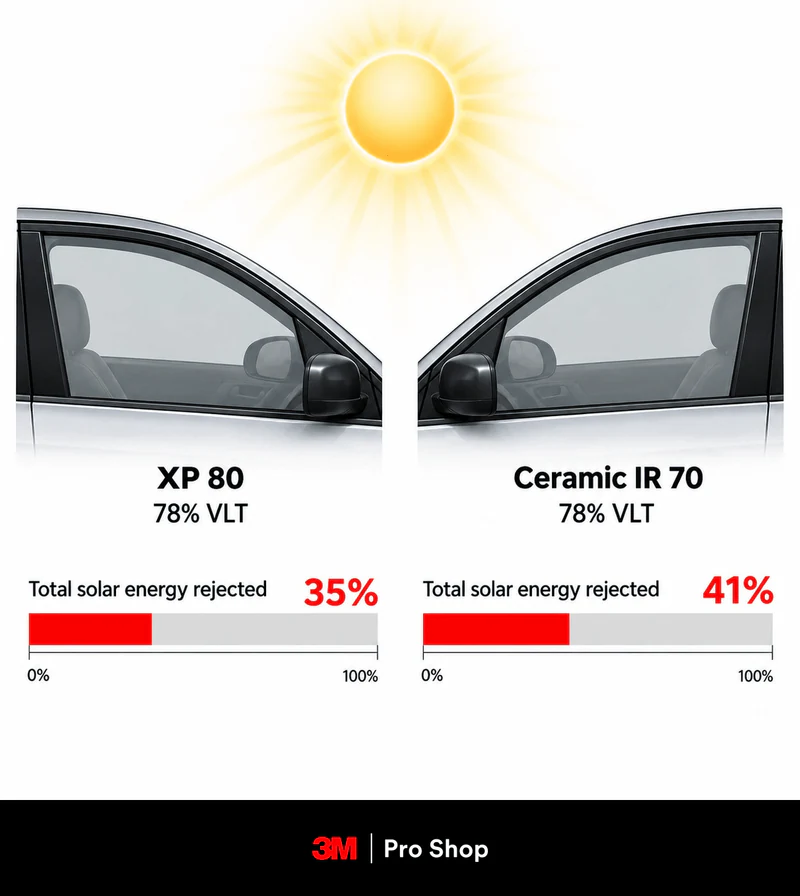
Lightest shades. XP 80 has 78% VLT, 35% TSER and 34% IRR. Ceramic IR 70 has 78% VLT, 41% TSER and 78% IRR. Same VLT, and Ceramic IR rejects 6 more TSER points. That works out to 6 divided by 35, or about 17% more total solar energy kept out. It is not a cabin temperature, so it does not mean the cabin will be 17% cooler.
IRER, the wider infrared figure, shows a smaller gap than IRR. XP sits between 44% and 49% IRER across its shades, and Ceramic IR sits between 58% and 63%. On the lightest pair, XP 80 is 47% and Ceramic IR 70 is 58%. So although the darkest pair shows 95% against 35% IRR, the IRER gap between matched pairs is only about 11 to 17 points. Ceramic IR still leads at every shade.
XP is slightly ahead on glare reduction, with up to 95% glare reduction on XP 5, against 93% on Ceramic IR 5. On medium shades, the two are close.
JPJ limits apply to glass plus film
JPJ requires at least 70% VLT on the windscreen and 50% on the front side windows, measured on the glass and film together. The rear side windows and rear windscreen of private cars have no minimum, which is why a light shade at the front and a darker one at the back is a common setup.
Because the reading covers glass and film together, the shade code is only a starting point. Your glass changes the final number, so JPJ-compliant window tint is confirmed by measuring it on your car.
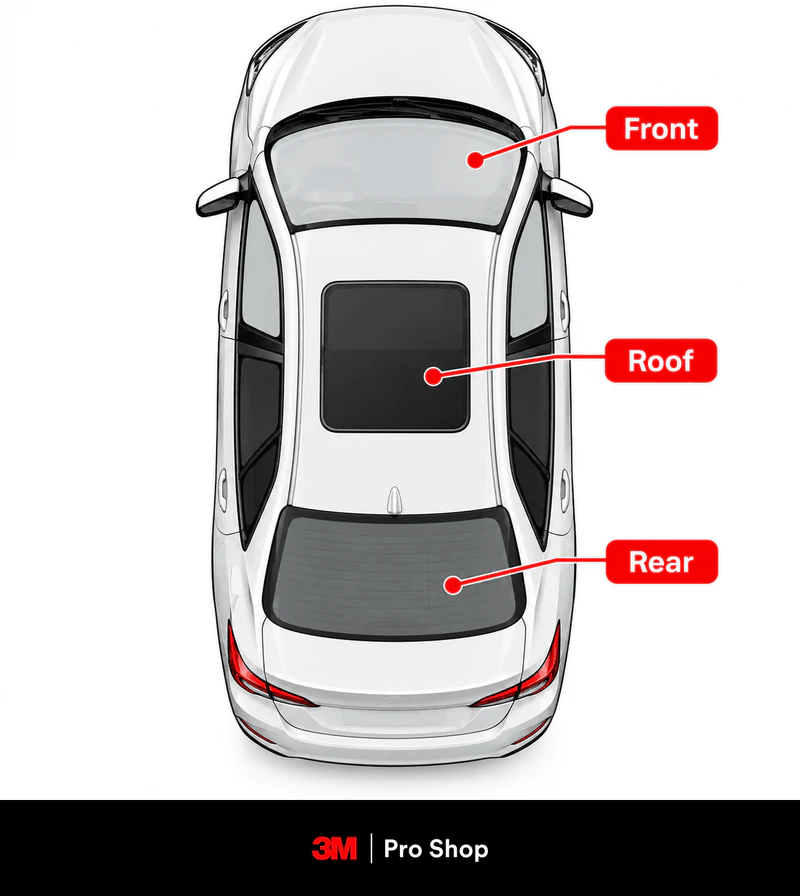
| Window | JPJ minimum VLT (glass plus film) | Example XP shade | Example Ceramic IR shade | JPJ note |
| Windscreen | 70% | XP 80: VLT 78%, TSER 35%, IRR 34% | Ceramic IR 70: VLT 78%, TSER 41%, IRR 78% | Lightest options. Factory glass lowers the total, so the installer measures before and after |
| Front side windows | 50% | XP 80: VLT 78%, TSER 35%, IRR 34% | Ceramic IR 50: VLT 60%, TSER 47%, IRR 83% | XP 50 at 39% VLT is below 50% on its own. Ceramic IR 50 needs measuring on your glass |
| Rear side windows | No minimum for private cars | XP 15: VLT 13%, TSER 54%, IRR 37% | Ceramic IR 15: VLT 19%, TSER 59%, IRR 90% | No JPJ minimum. Very dark shades can make night reversing harder |
| Rear windscreen | No minimum for private cars | XP 35: VLT 32%, TSER 48%, IRR 38% | Ceramic IR 30: VLT 37%, TSER 55%, IRR 88% | Lighter shades help reversing and mirror view at night |
| Sunroof or glass roof | Your installer can advise | XP 15: VLT 13%, TSER 54%, IRR 37% | Ceramic IR 15: VLT 19%, TSER 59%, IRR 90% | Large glass area, so darker shades are common for heat |
The front side windows are where the two ranges differ most. If you want a slightly darker look on the front side windows, Ceramic IR 50 is a mid-tone option at 60% VLT on clear glass, but whether it stays above 50% depends on your glass, as the example below shows. In the XP range, the next step lighter than XP 50 is XP 80. That gap is one reason some owners mix the two series.
Here is how the front side window maths works, using example figures only. Say your car's front side glass lets through 80% of light before any film goes on. Ceramic IR 50 is 60% VLT on clear glass, so the combined reading is roughly 60% x 80% = 48%. That is just under the 50% front side window limit. XP 80 on the same glass works out to about 78% x 80% = 62%, which clears it comfortably. Your own glass may read higher or lower than this example, which is why the installer measures it before suggesting a shade, and again after the film is on.
Night visibility changes your shade plan
A darker tint cuts more daytime glare, but it also makes unlit roadsides, pedestrians and your rear-view mirror harder to see at night, which is the main worry with window tint for night driving. With either series, lighter shades keep the night view clearer, while Ceramic IR still rejects more total solar energy at its lightest shade.
Picture reversing into a dim basement carpark after dinner. With Ceramic IR 5 on the rear windscreen, only 6% of visible light gets through, so the view in your rear-view mirror turns very dark and you lean on the reverse camera and side mirrors instead. A medium shade such as XP 35 at 32% VLT or Ceramic IR 30 at 37% VLT keeps that view brighter while still cutting a good share of heat.
If you drive mostly at night, it helps to sit in a car fitted with the shade you are considering before you decide. A dark rear windscreen may suit your daytime privacy preference but make the mirror view less useful in a dim carpark. You do not have to use the same darkness on every window.
You can mix the two series on one car. Some owners choose Ceramic IR on the windscreen and front sides, where shades must be light and infrared rejection helps most, and XP at the rear for privacy. It is worth seeing both films side by side on your glass first, because shades from different series may differ slightly in tone. On a sedan, a mixed plan from the table above could be Ceramic IR on the front side windows, if it measures legal on your glass, then XP 15 on the rear side windows and XP 35 on the rear windscreen.
A common plan is lighter glass at the front for visibility and JPJ rules, darker rear side windows for privacy, and a medium rear windscreen shade to keep the mirror view brighter. A glass roof may have a darker shade for heat. Each window gets its own shade, rather than one tint percentage for the whole car.
Clean fitting matters with either film
XP and Ceramic IR both need clean glass and careful fitting. A stronger heat rejection figure does not hide dust trapped under the film or an edge left lifting. The series you pick decides how much heat the film keeps out. How it is fitted decides how clear and tidy the glass looks.
The film is positioned on wet glass, then the installer squeezes the excess water out with a squeegee. Some moisture can remain while the tint dries, so early cloudiness does not by itself mean you have a bad tint job. A trapped hair or piece of dirt is different from moisture that can dry away.
Before installation, our team protects the interior and cleans the glass inside and outside. The film is cut for your car, checked for fit and applied wet. Those stages are the same whether you choose Ceramic IR at the front, XP at the rear or one series throughout, and paying for the pricier series does not change them.
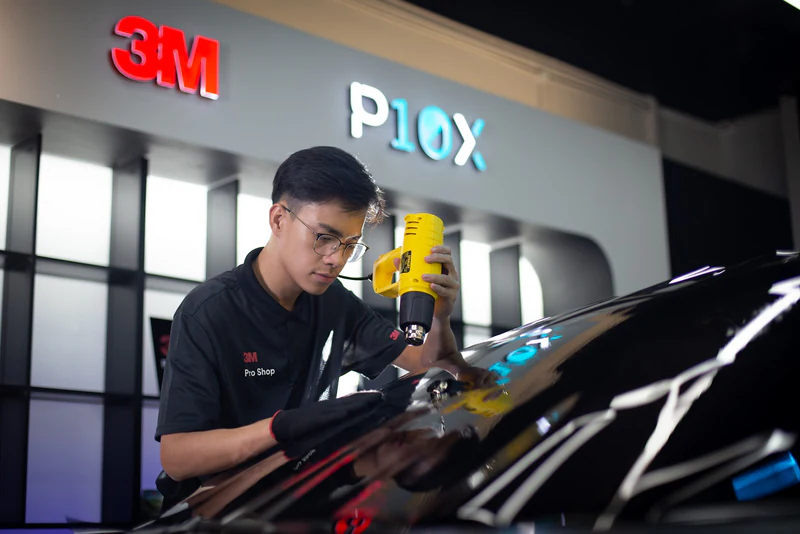
A windscreen curves, so film also needs to follow that shape without wrinkles. During preparation, the installer uses controlled heat to help shape the film to the glass. This is a job for the installer, not an aftercare step for you to repeat at home. Heating the tint yourself afterwards will not improve its heat rejection.
Finished glass needs a final check
When the tint is done, there are two things to check: how the glass looks, and how much visible light gets through. A smooth-looking windscreen does not prove that it meets the JPJ limit. The installer measures the glass and film together, while you can look over the finish before collecting your car.
At collection, you can ask which series and shade were fitted to each window, then compare them with the plan you agreed. This is especially useful if you mixed XP and Ceramic IR. A front-side shade and a rear shade can have different names, so a single series name does not describe every window on the car.
You can look through each window in daylight, both from inside and outside, rather than judging it only from a close-up phone picture. A mark in your normal line of sight matters more than a tiny speck you can only see up close. If something distracts you, you can show the installer the exact window and position.
From outside, the windscreen may reflect the workshop's signage. A reflection says little about the tint itself, so the view from the driver's seat is the better check. And because XP 80 and Ceramic IR 70 both have 78% VLT on clear glass, looking at them will not tell you which one keeps more heat out.
Which film suits your daily driving?
Ceramic IR usually suits drivers who want the most heat rejection at the light shades JPJ allows on the front side windows. XP usually suits drivers whose main goal is dark rear privacy at a lower price. You can also mix the two series on one car.
Ceramic IR is the stronger choice if you spend long hours in afternoon traffic, want a neutral colour and a lighter look, or have a large glass roof. XP's darker shades suit rear privacy, with XP 5 and XP 15 already rejecting 54% to 55% of total solar energy. XP also blocks 99.9% of UV and cuts strong glare on darker shades, if you are happy with lower infrared rejection in exchange for a lower price.
Cost also plays a part. 3M window tint price in Malaysia changes with the size of your car and the series you choose, and XP costs less than Ceramic IR on the same car. Some owners also look at 3M Crystalline Black, the flagship series, before settling on either.
XP or Ceramic IR: how to decide
The choice comes down to which window needs what. Ceramic IR does the most good on the windscreen and front side windows, where shades have to stay light, while XP is often enough at the rear, where darker shades are allowed.
The windscreen and front side windows come first, because JPJ limits decide how light they must be, and a good installer will measure your glass before suggesting a shade. After that, it is a matter of comparing shades of similar darkness, deciding how dark the rear can go for night driving, and deciding whether mixing the two series makes sense for your budget.
At 3M Pro Shop by P10X, we show both series on real glass so you can see the difference before choosing. You can compare both samples in person at any of our 3M Authorized Dealer locations.
Find out the best protection for your car
Visit a 3M Pro Shop and discover the cost-effective 3M Protective Film and Window Tint
Frequently Asked Questions
Which is cooler, 3M XP or Ceramic IR?
At matched shades, Ceramic IR rejects more total solar energy and much more infrared on 3M's clear-glass figures. How cool your cabin feels also depends on your glass, car colour, parking and aircon.
Is 3M XP good enough for Malaysian heat?
Yes, for many drivers. XP is a nano-ceramic film with up to 55% total solar energy rejected (TSER) and strong glare reduction. If infrared rejection at light front side window shades is your priority, Ceramic IR offers more.
Is a darker 3M XP shade cooler than a lighter Ceramic IR shade?
Not always. A darker film lets less visible light through, but that does not by itself tell you how much solar heat it rejects. Infrared makes up a large part of solar heat. XP 50 lets through 39% of visible light and rejects 44% of total solar energy. The lighter Ceramic IR 50 lets through 60% of visible light and rejects 47% of total solar energy.
Can I mix XP and Ceramic IR on one car?
Yes. Some owners choose Ceramic IR for the front and XP for the rear. It helps to see samples of both films together on your glass, so you can check that the tones match.
Will 3M XP or Ceramic IR affect my phone or GPS?
3M XP and Ceramic IR contain no metal, so neither film interferes with mobile or GPS signals.
Which 3M XP and Ceramic IR shades are legal on front side windows?
JPJ requires front side windows to let through at least 50% of visible light, measured on the glass and film together. Lighter shades such as Ceramic IR 50, Ceramic IR 70 or XP 80 are the usual starting points, and your installer should measure the result.