
Denza Z9GT PPF in Malaysia: Full-Body vs Front-End Coverage on a Flagship GT

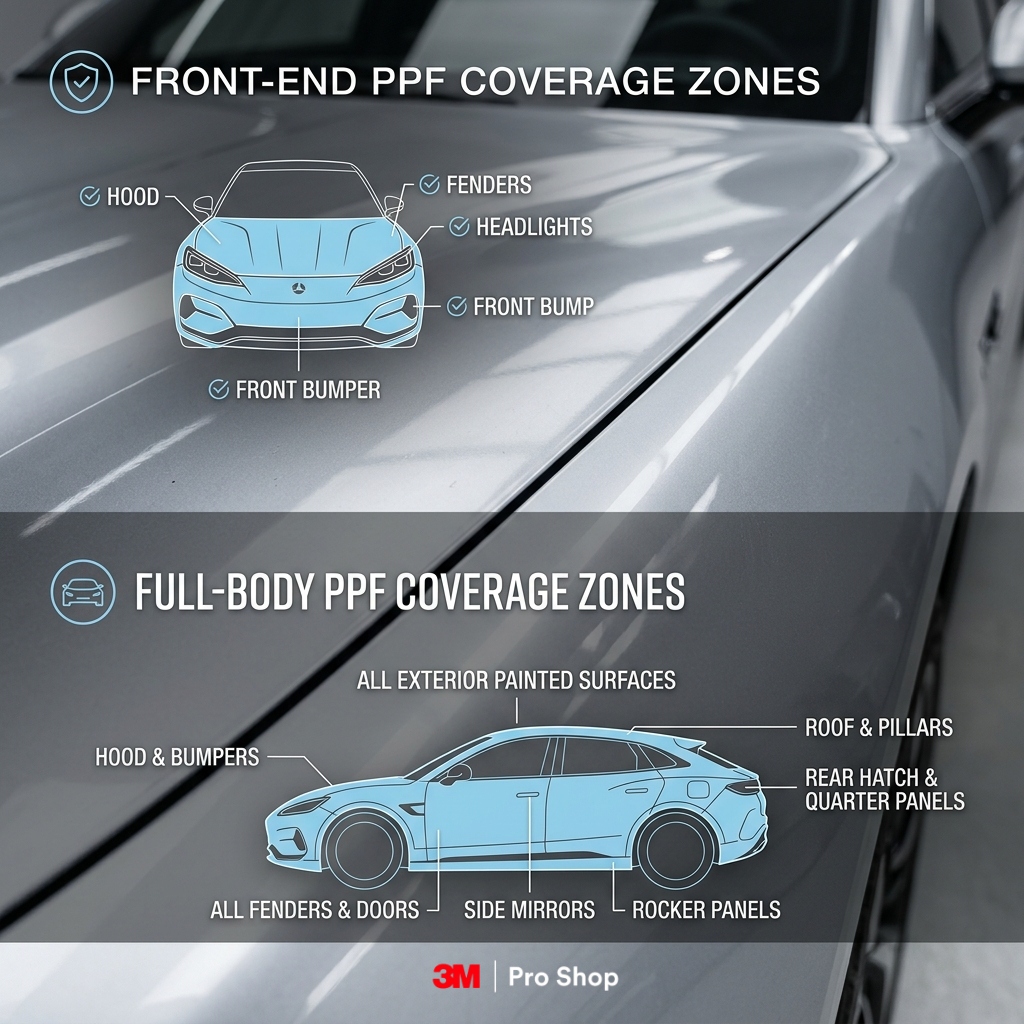
- A Series 150 front-end bundle covers the bonnet, front bumper, headlights and side mirrors, which is where the overwhelming majority of stone strikes land.
- Full-body adds the doors, rockers, rear arches, roof, rear quarters and boot lid, which matters most on a long hold and on Obsidian Black.
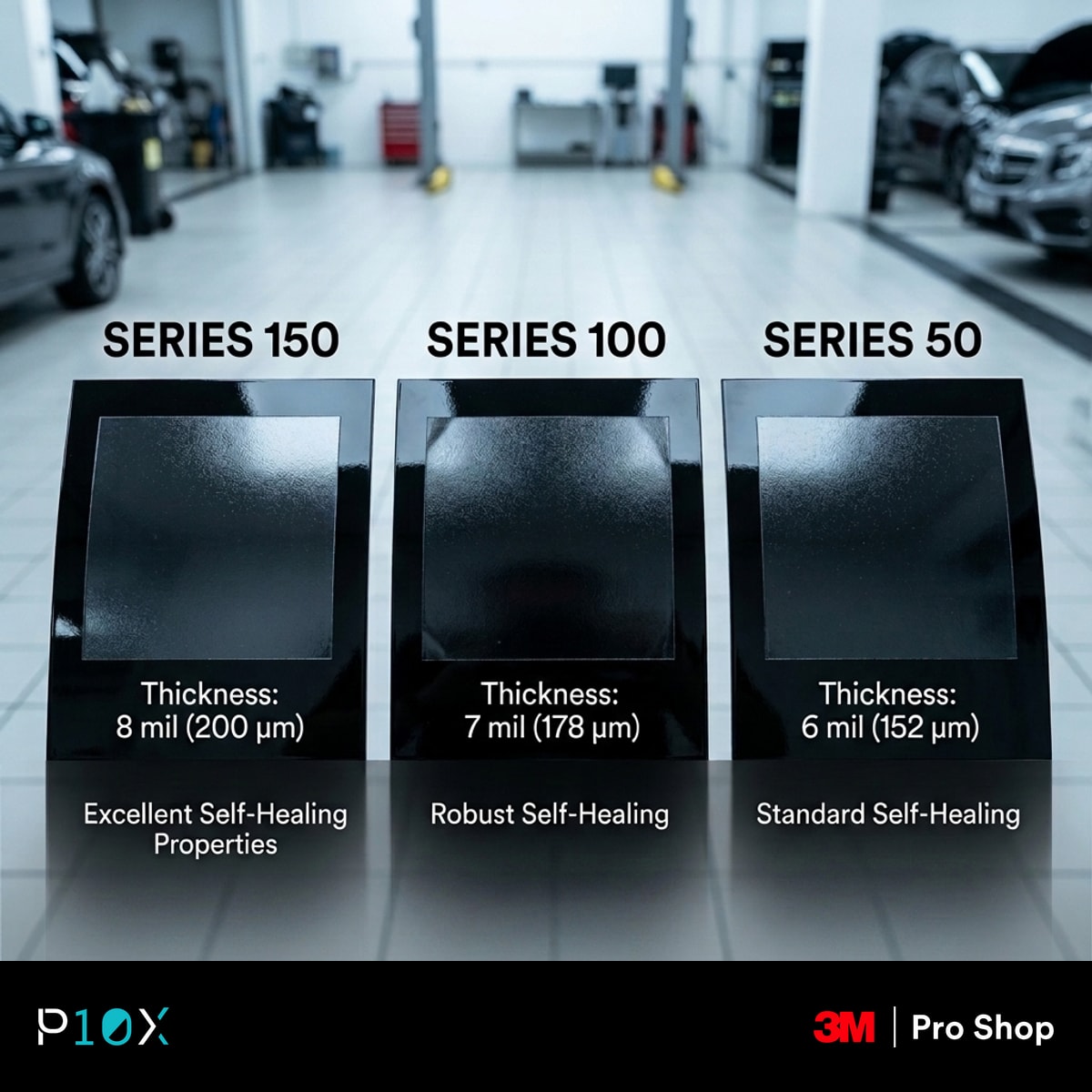
- Series 150 is 8 mil, Series 100 is 7.5 mil and Series 50 is 185 micron. All three are glossy, self-healing and warranty-backed once registered.
- If you are buying tint anyway, the combined PPF and tint package covers both jobs in one booking for less than buying the two services separately.
- Do not wash the car for 72 hours after installation, and hand wash after that.
Deciding on Denza Z9GT PPF is a coverage decision, and once you see how the coverage splits, the choice usually makes itself. A front-end package protects the four panels that actually take highway strikes: the full bonnet, the front bumper, the headlights and the side mirrors. Full-body carries the same film across every painted surface of this 5,180 mm shooting brake, doors, rockers, rear arches, roof and boot lid included. That is the whole argument, and the rest of this guide is about which side of it your ownership plan sits on. If you are speccing the glass at the same time, our Denza Z9GT window tint guide covers the three Crystalline Black shades this car needs across its four zones of glass, including the panoramic roof.
The context matters because the Z9GT is not an ordinary large EV. It arrived in Malaysia on 15 July 2026 as a fully imported flagship, and its panels are long, sweeping and difficult to refinish invisibly. Paint protection film is the only product that physically absorbs a stone strike before it reaches the clear coat, which is a different job from what a coating does. If you want the fundamentals first, our guide to 3M PPF benefits and costs in Malaysia covers the groundwork, and the PPF return on investment breakdown shows how the resale side of the sum works.
What follows is the panel-by-panel priority for protecting a Z9GT, the order those panels should be done in, the real difference between Series 150, 100 and 50, when the combined PPF and tint package makes sense, and the aftercare window that decides how long the film keeps looking invisible.
Front-End PPF Covers Four Panels, Full-Body Covers Every Painted Surface
Here is the split nobody puts in a quotation. A front-end package on the Z9GT is four items: the full bonnet, the front bumper, the headlights and the side mirrors. Add the four door cups and six line items have covered every surface that either meets road debris head-on or takes a fingernail every single day. Full-body carries the same film across the doors, the rockers, the rear arches, the roof, the rear quarters and the boot lid as well, which on a 5,180 mm body is several times the film area of the front end.
The ratio is what decides it. Those first four panels absorb the overwhelming majority of stone strikes on a Malaysian highway, so the front-end bundle removes most of the impact risk for a small fraction of a full-body scope. The panels it leaves bare are large in area but low in strike probability, which makes full-body a resale, colour and wash-haze decision far more than an impact decision.
Make it concrete. You collect the car in Subang Jaya on a Friday evening, run 200 km up the PLUS to Ipoh on the Sunday at 110 km/h behind weekend lorry traffic, and for those two hours every piece of grit thrown off the road meets the bonnet, the bumper, the headlights and the mirrors. Almost none of it meets the boot lid. Multiply that trip across five years of ownership and the question answers itself: for a long hold on a fully imported flagship, the case for full coverage is strong, while a two or three-year hold on a car doing mostly Klang Valley mileage is well served by the front end alone.
| Coverage | Panels included | Risk it removes | Best suited to |
|---|---|---|---|
| Front-end core | Bonnet, front bumper, headlights, side mirrors | Highest-frequency stone strike zone | A 2 to 3 year hold, mostly Klang Valley mileage |
| Front-end plus door cups | Above plus four door cups | Adds daily entry wear from nails and rings | Family cars and frequent passengers |
| Full-body | Every painted panel | Impact plus accumulated wash haze across the car | A 5 year hold, Obsidian Black, resale focus |
The Z9GT Creates Some of Its Own Paint Damage
Most PPF articles talk about the road as if the car were a passive victim. On a Z9GT that is not quite true. This is a 2,740 to 2,895 kg car making 1,210 Nm from three motors, reaching 100 km/h in 2.7 seconds. Torque like that, delivered instantly to all four wheels, picks up loose grit and flings it backwards along the body with far more energy than a conventional car ever generates from a standstill.
The bodystyle then decides where that grit lands. A shooting brake on a 3,125 mm wheelbase has unusually long rocker panels and long rear doors, and the airflow along a low, tapering roofline drags debris rearward rather than lifting it clear. That is why owners of long, fast, heavy EVs tend to find chips in two places the brochure never mentions, the leading edge of the rear doors and the rear arch just behind the rocker.
The carbon-ceramic brakes add a second, less obvious mechanism. Hard braking from GT speeds throws fine dust and particulate forward and outward across the lower body, and that dust is abrasive under a wash mitt. Film on the rockers and lower doors gives you a sacrificial layer between that grit and your paint. Our guide to which panels stone chips actually hit in Malaysia breaks the pattern down with the damage map.
The Order to Protect Z9GT Panels In, If You Are Doing It in Stages
Not everyone protects the whole car on day one, and staging the work is perfectly sensible as long as you stage it in the right order. The sequence is driven by impact probability first and repair cost second, and on this car those two things point in the same direction.
The bonnet and front bumper come first because they absorb almost everything the road throws forward, and on the Z9GT they are also very large single panels, which makes a partial repair almost impossible to hide. Headlights come next, and they are the most underrated item on the list. The signature light units on this car are complex assemblies, a chipped or hazed lens cannot be polished back the way paint can, and headlight PPF is inexpensive relative to what a replacement unit costs on a CBU flagship.
After that the priority moves to the A-pillars and mirrors, then the rockers and rear arches for the reasons above, then the boot lip and the door edges. Think about the practical version of this. You collect the car on a Friday, drive to Ipoh on the Sunday, and by the time you are back on the PLUS at Slim River you have already done the single highest-exposure trip of the month. The panels that matter are the ones facing forward on that trip.
| Priority | Panel or zone | Why it ranks here | Coverage note |
|---|---|---|---|
| 1 | Full bonnet | Largest forward-facing panel, invisible repair is not possible | Full panel only, never a partial |
| 2 | Front bumper | Takes the highest strike frequency at road level | Single piece, edges tucked |
| 3 | Headlights | Lens damage cannot be polished out, unit replacement is costly | Both lenses, full face |
| 4 | Side mirrors | Constant airflow exposure on both faces | Both caps, front and outer faces |
| 5 | Door cups | Fingernail and ring wear on every entry | All four handles |
| 6 | Rockers and rear arches | Long shooting-brake body drags debris rearward | Scoped per car after inspection |
| 7 | Roof, doors, rear quarters, boot | Low strike risk, high total area, full-body only | Full-body scope only |
Series 150, 100 and 50 Differ by Thickness, Not by Gloss
All three 3M PPF tiers are glossy and all three are self-healing, so the showroom demonstration looks identical across the range. What separates them is film thickness and warranty length, and on a car like this the thickness is the part that matters.
Series 150 is 8 mil thick, Series 100 is 7.5 mil, and Series 50 is 185 micron. All three carry a registered 3M warranty when a 3M Authorized Dealer installs them, so warranty cover is a tick on every row and thickness is the variable that actually changes the outcome. The half-mil difference between the top two tiers sounds trivial written down, but impact absorption is a function of the film mass standing between a stone and your clear coat.
For a Z9GT the recommendation is straightforward. If you are protecting the front end only, take Series 150, because the panels you are covering are precisely the ones being hit and the step up across a four-panel bundle is small. If you are going full-body and the total is the constraint, Series 100 across the whole car is a better outcome than Series 150 on half of it. Our 3M PPF series comparison covers the construction differences in more detail.
| Series | Tier | Thickness | Self-healing | Warranty registered | Best use |
|---|---|---|---|---|---|
| Series 150 Gloss | Premium | 8 mil | Yes | ✓ | Front-end bundles and long holds |
| Series 100 | Balanced | 7.5 mil | Yes | ✓ | Full-body on a fixed budget |
| Series 50 Gloss | Entry | 185 micron | Yes | ✓ | Entry-level full-body coverage |
The Combined PPF and Tint Package Beats Booking the Two Separately
Almost every Z9GT owner tints the car, so the combined packages are worth checking before you book anything. There are two. Package 1 pairs Series 100 PPF with the Crystalline-tier tint. Package 2 pairs Series 150 PPF with the Crystalline-tier tint. Both are single bookings, one car, one workshop slot, with the film on the paint and the film on the glass done by the same team in the same controlled bay.
This is also where a common misreading needs correcting. The large-vehicle adjustment in the package list attaches to those two combined packages only. It does not belong on a standalone full-car PPF quotation, so if a large-vehicle line appears on a PPF-only quote, ask which package it is being drawn from before you sign anything.
The practical gain runs two ways. Booked together, the two services come in under what they cost one at a time, and the difference is close to what a front-end bundle would have taken on its own. The second gain is time. A full-car PPF job on a 5,180 mm body plus a seven-piece tint job across four zones of glass is several days of workshop time, and running them in one continuous slot means the car is off the road once instead of twice, with no tint crew working around film edges that were laid a fortnight earlier. One note on terminology, the Crystalline tier in these packages is now the Crystalline Black CR BLK range, since the original Crystalline series became obsolete in Malaysia in December 2025.
| Route | Components | What it means on a Z9GT |
|---|---|---|
| Buy separately | Full-car Series 150, then X Large tint | Two bookings, two quotations, the highest total of the three routes |
| Package 1 | Series 100 PPF plus Crystalline-tier tint | Balanced tier, one booking, large-vehicle adjustment applies |
| Package 2 | Series 150 PPF plus Crystalline-tier tint | Premium 8 mil tier, one booking, large-vehicle adjustment applies |
| Standalone full-car PPF | PPF only, no tint | No large-vehicle adjustment belongs on this quotation |
Obsidian Black and Rime Gold Are Two Different PPF Conversations
The Z9GT launched in Malaysia in two colours, and they do not age the same way. Obsidian Black is the harder car to own well, because dark paint shows every swirl mark, every wash-induced micro-scratch and every stone chip as a bright white dot against a dark field.
On a black Z9GT the argument for full-body film is much stronger than the strike statistics alone would suggest, because the damage you are protecting against is not only impact. It is the accumulated haze from years of washing a very large, very dark car. The self-healing top layer means light marring in the film disappears with heat rather than staying in your paint permanently. Our guide to PPF on black cars covers this in depth, and the piece on new car swirl marks explains where most of them actually come from.
Rime Gold is more forgiving on swirls but less forgiving on chips, because a light metallic makes a dark chip stand out and colour-matching a light metallic on a repair is notoriously difficult. On a gold car the front-end bundle carries more weight than the full-body extension does. Either way, the film is glossy and optically clear, so neither colour changes appearance under it.

PPF and Ceramic Coating Solve Different Problems on This Car
This question comes up on every flagship, and the answer is not a preference. A ceramic coating is measured in microns and adds gloss, hydrophobic behaviour and chemical resistance. PPF is measured in mils and physically absorbs impact. A coating will not stop a stone from chipping your bonnet on the Karak, and film will not make the car easier to rinse.
The self-healing claim confuses a lot of buyers, because both products advertise it. In PPF the healing happens in a thick urethane layer that has real depth to recover into, which is why a light scuff genuinely vanishes with heat. In a coating the layer is a fraction of that thickness, so what heals is correspondingly shallower. Our comparison of self-healing PPF against self-healing coating sets the two mechanisms side by side, and the broader PPF versus ceramic coating versus wax piece covers the full picture.
For a Z9GT the sensible combination is film on the impact panels and coating over the top of it. That way the panels facing the road have physical protection, and the whole car, film and paint alike, gets the easy-clean surface. Given how large this car is to wash by hand, the easy-clean layer is not a vanity purchase.
The First 72 Hours Decide How Long the Film Looks Invisible
Fresh PPF needs time to finish adhering and to let installation moisture clear from under the film, and the rule is firm. Do not wash the car for 72 hours after installation. That includes rain-driven touch-ups, quick rinses and any pressure washing near an edge.
You may also see slight haziness or small water pockets in the first week or two. That is normal and it clears as the remaining moisture evaporates through the film. What is not normal is a lifting edge or a visible bubble that does not shrink, and both should go back to the installer rather than being pushed down at home.
After the initial window, hand washing is the preferred method, with a touchless wash as the fallback when hand washing is not practical. Avoid high-pressure jets aimed directly at film edges, which is the single most common way owners cause lifting on an otherwise perfect installation. Picture the temptation clearly, you collect the car on Thursday evening looking flawless, it rains on Friday, and by Saturday morning you want to rinse it. Waiting until Sunday is the whole discipline. Our PPF installation process guide covers what a proper job looks like from booking to handover.

Mistakes Owners Make Specifying PPF on a Flagship GT
The costly errors on this car are rarely about which brand of film. They are about scope, sequence and who does the work.
The most common is protecting the wrong things, usually a partial bonnet to save money. A partial bonnet puts a film edge across the middle of the largest panel on the car, and on a long GT bonnet that edge will eventually collect a visible line of dirt. Full bonnet or nothing. The second is skipping the headlights, which are the cheapest item on the priority list and the most expensive to replace. The third is accepting a large-vehicle adjustment on a standalone full-car PPF quotation, which the package list does not support, because that adjustment belongs to the combined PPF and tint packages only.
The fourth is the one that costs the most in the end, which is buying on price from an unauthorised installer. Genuine film, a warranty that is actually registered, and a technician who has wrapped a car this size before are not interchangeable with a lower number on a quote. Our comparison of an authorised dealer against a Facebook group vendor shows how that decision plays out. Booking with a 3M Authorized Dealer such as 3M Pro Shop by P10X keeps the film genuine and the warranty valid. Timing matters too, and the ideal booking is before delivery so the paint never sees an unprotected highway run, which is where our KL highway stone-chip map is useful for judging your own routes.
Choosing the Right Denza Z9GT PPF Coverage in Malaysia
The decision comes down to the split at the top. A Series 150 front-end bundle protects the bonnet, bumper, headlights and mirrors, a small share of a full-body scope covering the panels that take most of the damage. Full-body leaves nothing exposed. If you are buying tint as well, Package 2 does both jobs in one booking and comes in under buying the two services separately.
Match the answer to your ownership plan. A long hold on an Obsidian Black car argues for full-body Series 150, because the paint will be judged on swirl haze as much as on chips. A shorter hold, or a car that mostly does Klang Valley mileage, is well served by the front-end bundle in Series 150 with the rockers added later.
Whichever route you take, get it done before the first long highway run, insist on the full bonnet rather than a partial, and keep the car dry for the first 72 hours. A grand tourer like this only gets one set of factory paint.
Find out the best protection for your car
Visit a 3M Pro Shop and discover the cost-effective 3M Protective Film and Window Tint
Frequently asked questions
How much does PPF cost for a Denza Z9GT in Malaysia?
Quotations are given per car rather than published, and three things set the figure on a Z9GT: how much of the 5,180 mm body you cover, which series you choose between Series 150, Series 100 and Series 50, and whether you bundle the work with tint. Ask a 3M Authorized Dealer for a written quotation listing every panel, the series, and the warranty registration.
Is full-body PPF worth it on a Denza Z9GT?
It depends on how long you are keeping the car and which colour you bought. Full-body Series 150 leaves no panel exposed, which suits a five-year hold, especially in Obsidian Black where wash haze shows readily across a body this large. For a two or three-year hold, the front-end bundle removes most of the impact risk with a far smaller scope of work.
Does the large-vehicle adjustment apply to Denza Z9GT PPF?
Only to the combined packages. It attaches to Package 1 and Package 2, which bundle PPF with tint on a body as long as the 5,180 mm Z9GT. A standalone full-car PPF quotation is drawn from the series scope without it, so query any large-vehicle line that appears on a PPF-only quote.
Which Denza Z9GT panels should I protect first?
Full bonnet, then front bumper, then headlights, then side mirrors. After those, add the door cups, then the rockers and rear arches, which matter more than usual on a 5,180 mm shooting brake with a 3,125 mm wheelbase because the long body drags debris rearward.
Which 3M PPF series should I choose for the Z9GT?
For a front-end bundle, take Series 150 at 8 mil, since the step up across four panels is small and those panels are the ones being struck. All three series are warranty-backed once registered by a 3M Authorized Dealer, so thickness is the real variable. For full-body work on a fixed budget, Series 100 at 7.5 mil across the entire car beats Series 150 on only half of it.
Should I get PPF or a ceramic coating for my Denza Z9GT?
Both, in that order. PPF is measured in mils and physically absorbs stone strikes, while a coating is measured in microns and adds gloss and easy cleaning without stopping a chip. Film on the impact panels with a coating over the whole car is the sensible specification on a GT this size.
How soon can I wash a Denza Z9GT after PPF installation?
Wait 72 hours before any washing, including quick rinses. After that, hand washing is preferred, with a touchless wash as the fallback. Keep high-pressure jets away from film edges, which is the most common cause of lifting.
Does PPF void the Denza warranty?
No. The film is applied over the existing paint without altering any vehicle component, so it does not affect the manufacturer warranty. Using a 3M Authorized Dealer also keeps the film warranty properly registered.
Author

Kelvin Cheen
Kelvin is an Automotive Solutions Consultant and Branch Manager at 3M Pro Shop. With 4+ years of field experience in premium vehicle surface protection, Kelvin specializes in flagship 3M technologies, including 3M Crystalline Black optical film and Ceramic IR tints, 3M Paint Protection Film (PPF), etc. His focus is on delivering transparent, engineering-backed advice to car and EV owners, cutting through sales upsells to ensure customers choose the exact thermal rejection and paint protection tailored to their driving needs.
Experience the future of window tinting
Visit a 3M Pro Shop and discover the revolutionary Crystalline CR BLK film