
PPF for stone chips in Malaysia: what to protect first
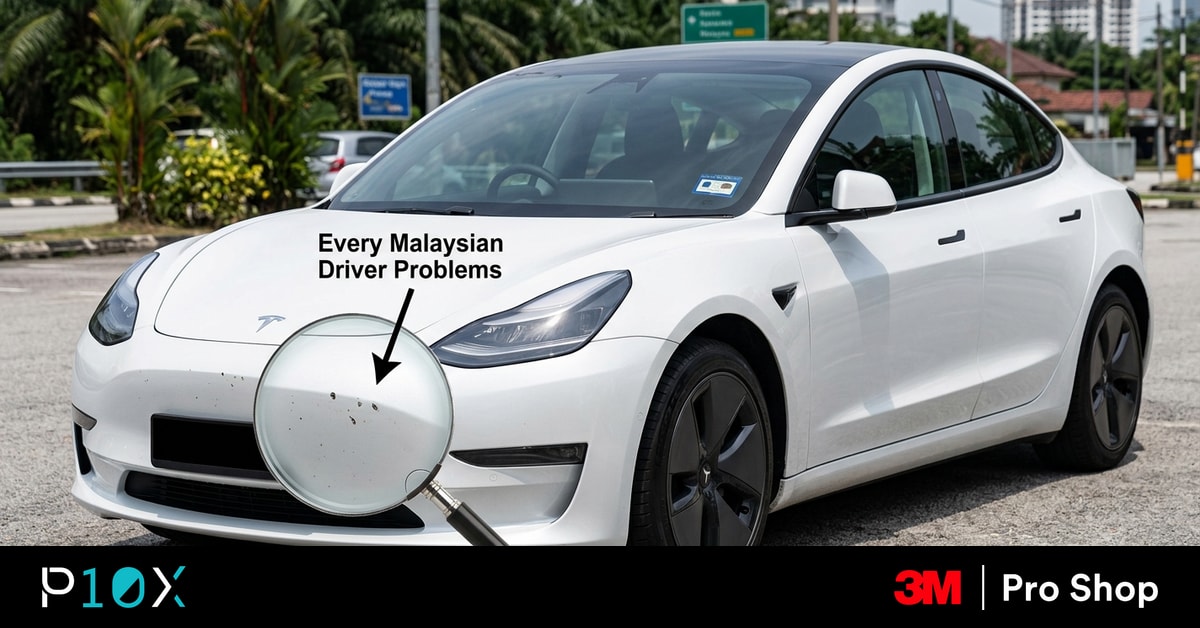
- Stone chips on Malaysian highways cut through paint in three layers, and tropical humidity turns a small chip into rust within months.
- Around 80% of chip damage lands on the front bumper, bonnet leading edge, headlights, and side mirrors, so these four panels are where smart PPF spend starts.
- 3M Paint Protection Film is a 7.5 to 8 mil TPU film that absorbs impact, self-heals minor scratches, and resists UV yellowing in Malaysian heat.
- An Essentials Pack runs about RM 3,000 to RM 4,000, Full Front about RM 5,500 to RM 11,000, and Full Car about RM 11,000 to RM 24,000 depending on series and vehicle size at a 3M Pro Shop.
- Touch up existing chips before installing PPF, and only book a 3M Authorized Dealer to keep the manufacturer warranty intact.
Choosing PPF for stone chips in Malaysia is less about wrapping the whole car on day one and more about knowing which panels actually take the hits on PLUS, Karak, and NKVE. Most Klang Valley drivers do not have RM 15,000 to RM 24,000 sitting in the budget for a full-car 3M PPF wrap. Most also do not need it. What you need is a clear, panel-by-panel plan so the money you spend protects the parts that get chipped first, in the right order.
This guide is built for new-car owners around KL, PJ, Subang, Cheras, and Kajang who drive expressways often, park in open condo lots or mall basements, and want their paint to still look factory-fresh three to five years down the road. We will walk through which panels chip first on Malaysian roads, how 3M Paint Protection Film actually works, what each tier of coverage costs, and the mistakes that cost owners thousands when they get this wrong.
For the wider picture on 3M PPF in Malaysia, including warranties and longevity, you can also read 3M Paint Protection Film in Malaysia: Benefits, Cost and Longevity.
What Stone Chips Actually Do to Malaysian Car Paint
A stone chip is a tiny impact crater where gravel or road debris strikes paint at speed, usually between 1 and 5 millimetres wide. The damage cuts down through three paint layers in order: the clearcoat first, then the colour basecoat, and finally the primer that protects bare metal. Once the primer breaks, water reaches the metal panel and rust starts forming, often within weeks in Malaysian humidity.
Malaysian conditions speed this up. Our average humidity sits above 80 percent year-round, monsoon rain delivers acidic runoff onto exposed metal, and the heat cycle between a 60-degree dashboard and a 30-degree shaded carpark makes the steel underneath expand and contract daily. A chip that would stay cosmetic in a dry climate becomes a rust spot in three to six months on a Malaysian car parked outdoors.
The visible damage is small. The hidden cost is bigger. A single chip on a metallic bonnet that reaches primer can require a full panel respray to colour-match correctly, because spot touch-up rarely blends on three-stage pearl finishes.
Why Bonnet and Bumper Chips Hit Malaysian Drivers Hardest
Bonnet and bumper chips hit Malaysian drivers the hardest because these two panels carry around 80 percent of the chips a car will ever take, sit in the most expensive part of the car to repaint, and almost never get covered by a standard motor insurance claim. A full bonnet respray at a body shop in Klang Valley typically runs from around RM 800 to RM 2,500 depending on body shop, paint type, and panel size, and metallic or pearl finishes almost never match the factory shade perfectly.
The everyday damage sources are very Malaysian. PLUS Highway between Tapah and Bidor regularly has loose gravel from repair patches. Karak Highway has long stretches of resurfacing where lorries kick up fresh aggregate. NKVE and KESAS truck lanes carry construction debris from quarries and cement plants. Even off the highway, condominium carparks with crushed-rock filler and uneven Klang Valley roads catch your front bumper at low speed. For a route-by-route view of where chips concentrate around Klang Valley, see the KL highway stone-chip map.
Insurance does not help here. Many comprehensive motor policies in Malaysia exclude cosmetic stone-chip damage from claims, so always check your specific policy wording before assuming insurance will cover paint touch-ups. For most owners, prevention is the only affordable strategy. For more on what insurance will and will not cover after paint damage, see Can You Claim PPF Replacement After an Accident in Malaysia?.
If you also want a wider read on resale value and ROI of PPF, Is PPF Worth the Investment for Malaysian Car Owners? Expert Insights and ROI lays out the maths.
How PPF Stops a Stone Chip Before It Reaches Paint
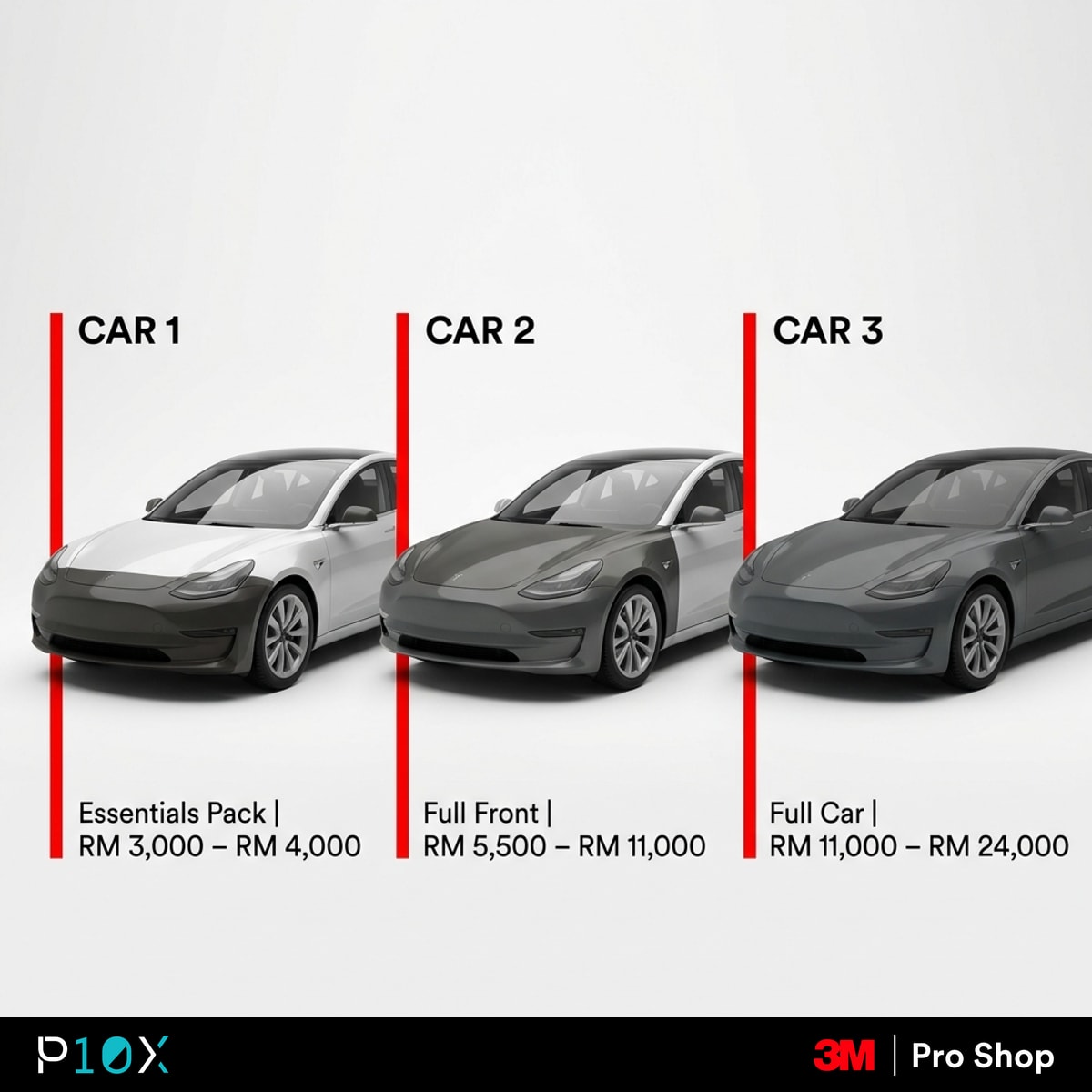
PPF stops a stone chip by absorbing the impact across three engineered layers stacked on top of your paint, so the gravel never reaches the clearcoat. 3M Paint Protection Film is built from thermoplastic polyurethane (TPU), a flexible plastic film typically 7.5 to 8 mil thick. One mil is one-thousandth of an inch, roughly 25 microns. That cushion either deflects debris or absorbs the energy harmlessly.

Top Layer: Self-Healing TPU Clearcoat
The top is a clear, slightly elastic layer engineered to absorb micro-scratches and minor swirls — the same kind of damage that shows up on glossy black cars after a few months of car-park use, covered in detail in New Car Swirl Marks in Malaysia. Heat from sunlight or warm water makes the layer relax back into shape. In Malaysian conditions, a dashboard easily hits 55 to 60 degrees Celsius by mid-morning, which is enough to trigger light scratches on the bonnet to disappear without intervention. This is what is meant by self-healing PPF. For a deeper comparison between self-healing PPF and self-healing coatings, read Self-Healing PPF vs Self-Healing Coating: Why Coating Alone Falls Short.
Middle Layer: Impact-Absorbing TPU Body
The middle is the thickest layer and does the real work against stone chips. It is a tough but flexible TPU that deforms slightly under impact and spreads the energy over a wider area instead of letting it punch through to paint. 3M Series 150 Gloss is the thickest at around 8 mil, Series 100 sits at around 7.5 mil, and Series 50 is around 185 microns. The thicker the middle layer, the more impact energy it can absorb at highway speed.
Bottom Layer: Pressure-Sensitive Adhesive
The bottom is a clear adhesive designed to bond firmly to factory clearcoat without yellowing or leaving residue when removed. 3M uses an adhesive that allows the installer to reposition the film during installation, which is what makes clean edge-wrapping on curved panels possible.
Be honest about scope. PPF reduces chip damage. It does not make the car indestructible. A large piece of debris at 110 km/h, sharp metal kicked up from a lorry, or a heavy stone striking a panel edge can still cause a minor dent or a deep cut that goes through all three film layers. PPF turns most chips into nothing and turns severe impacts into film damage that costs less to replace than a respray.
The 8 Panels That Need 3M PPF First in Malaysia
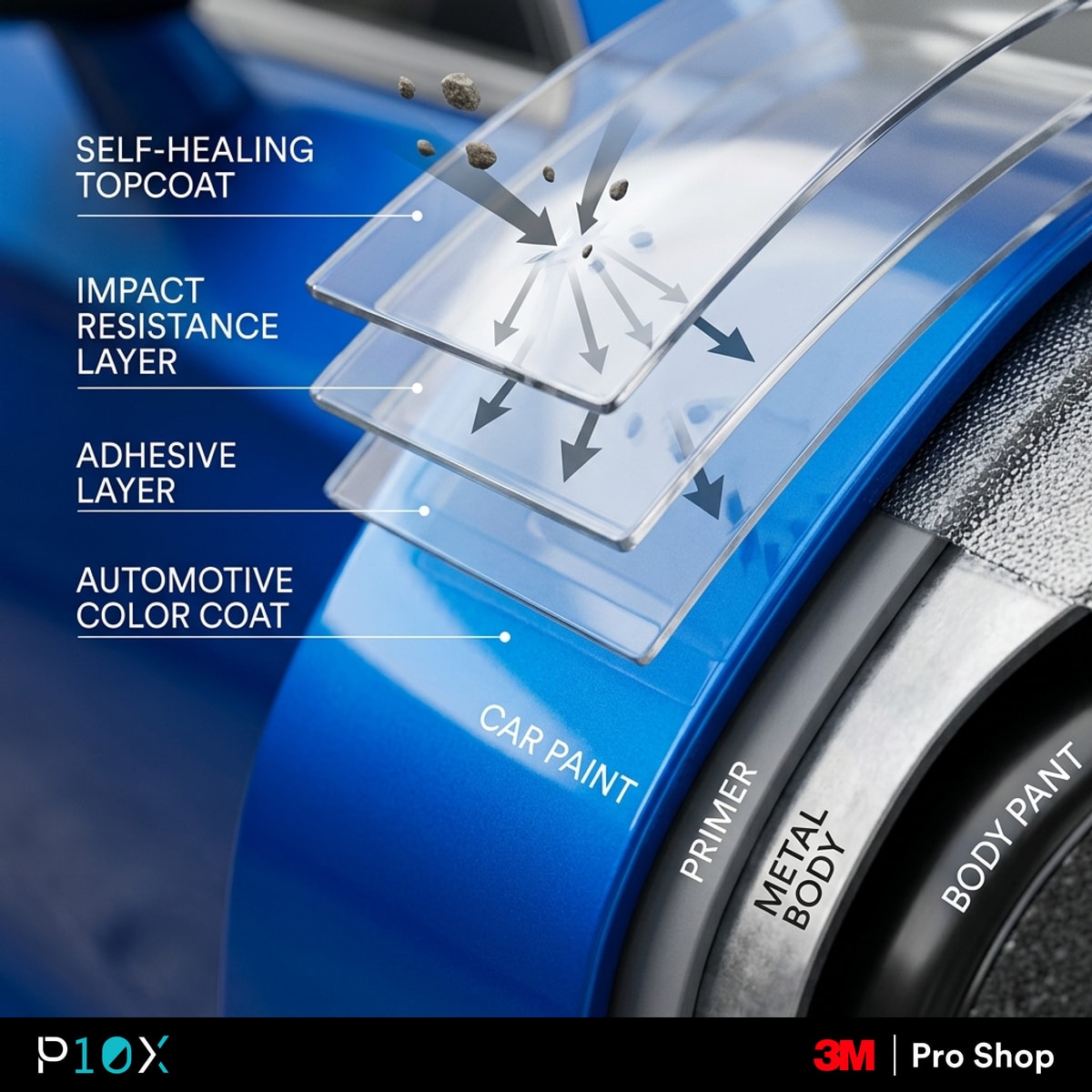
Based on where chips actually land on Malaysian cars, the order is front bumper, bonnet leading edge, full bonnet, headlights, side mirrors, fenders, A-pillars, then rocker panels and lower doors. The first three or four account for around 80 percent of all chip damage you will see on a five-year-old daily-driven car in Klang Valley.
Priority 1: Front Bumper Takes Most Highway Debris
The front bumper sits closest to the road, takes the brunt of stone spray from cars ahead, and is the cheapest panel to damage but the most expensive to respray cleanly because it includes intricate grille work and sensors. Ala-carte at a 3M Pro Shop, a full bumper wrap is around RM 2,250 across Series 50, 100, and 150 for medium vehicles. If you only ever PPF one panel, make it this one.
Priority 2: Bonnet Leading Edge Catches First Hits
The first 30 to 40 centimetres of the bonnet, right behind the bumper, takes the second-most chips. These are the small chips you see appear on a brand-new car after one PLUS round trip to Penang. A leading-edge strip of PPF is often sold as part of an Essentials Pack and protects the most visible part of the bonnet without paying for full coverage.
Priority 3: Full Bonnet Catches Long-Range Chips
Beyond the leading edge, the rest of the bonnet still catches chips from longer-range debris and tyre spray from lorries. Full-bonnet PPF closes the gap and gives you a single, seamless protected surface. Ala-carte pricing at a 3M Pro Shop runs around RM 1,250 for Series 50, RM 1,650 for Series 100, and RM 2,050 for Series 150 on medium vehicles.
Priority 4: Headlights Need Cover for Chips and Yellowing
Modern LED and projector headlights are clear plastic, not glass. They crack from sharp impacts, stress-fracture from chips, and yellow over time from UV. PPF cut to fit the headlight blocks both stone-chip stress cracks and slows down the yellowing. At a 3M Pro Shop, headlight PPF is around RM 500 to RM 600 (confirm per-pair vs per-side with the branch at booking). For a deeper look at protecting headlight clusters specifically, read PPF for Car Headlights in Malaysia.
Priority 5: Side Mirrors Catch Door-Edge Chips
Side mirrors stick out into the airflow and pick up chips from passing traffic and from rain-driven gravel on KESAS truck lanes. Replacing a damaged auto-folding mirror with cameras and indicators can run RM 1,500 to RM 3,000. Mirror PPF at around RM 350 is cheap insurance.
Priority 6: Fenders Take Tyre Spray and Side Impact
Front fenders catch fine gravel kicked up by your own front tyres and chips thrown by cars in the next lane. EV owners and continental sedan owners should pay extra attention here because fender repaints on metallic finishes are notoriously hard to colour-match. Black and dark metallic paint is the hardest of all to colour-match — see PPF for Black Cars in Malaysia for finish-specific guidance.
Priority 7: A-Pillars Catch Cross-Traffic Debris
A-pillars on either side of the windscreen take occasional chips from cross-traffic gravel, especially on multi-lane highways like ELITE and SPRINT. Damage here is rare but stands out because the pillar sits in your direct line of sight.
Priority 8: Rockers and Lower Doors Take Tyre-Kicked Gravel
Rocker panels and the lower 20 centimetres of doors catch gravel kicked up by your rear tyres and by lorries on the next lane. This is the lowest-priority zone for paint preservation but matters for cars with low ride height. EV owners with flat front fascias and lower ground clearance should think about rocker coverage earlier than most. For a real-world EV example, read 3M PPF for the 2026 MG S5 EV CKD in Malaysia. For drivers of compact EVs like the Perodua QV-E, Protecting Your Perodua QV-E: PPF and Window Tint Guide walks through the same logic on a smaller body.
Partial vs Full Front vs Full Car PPF in Malaysia
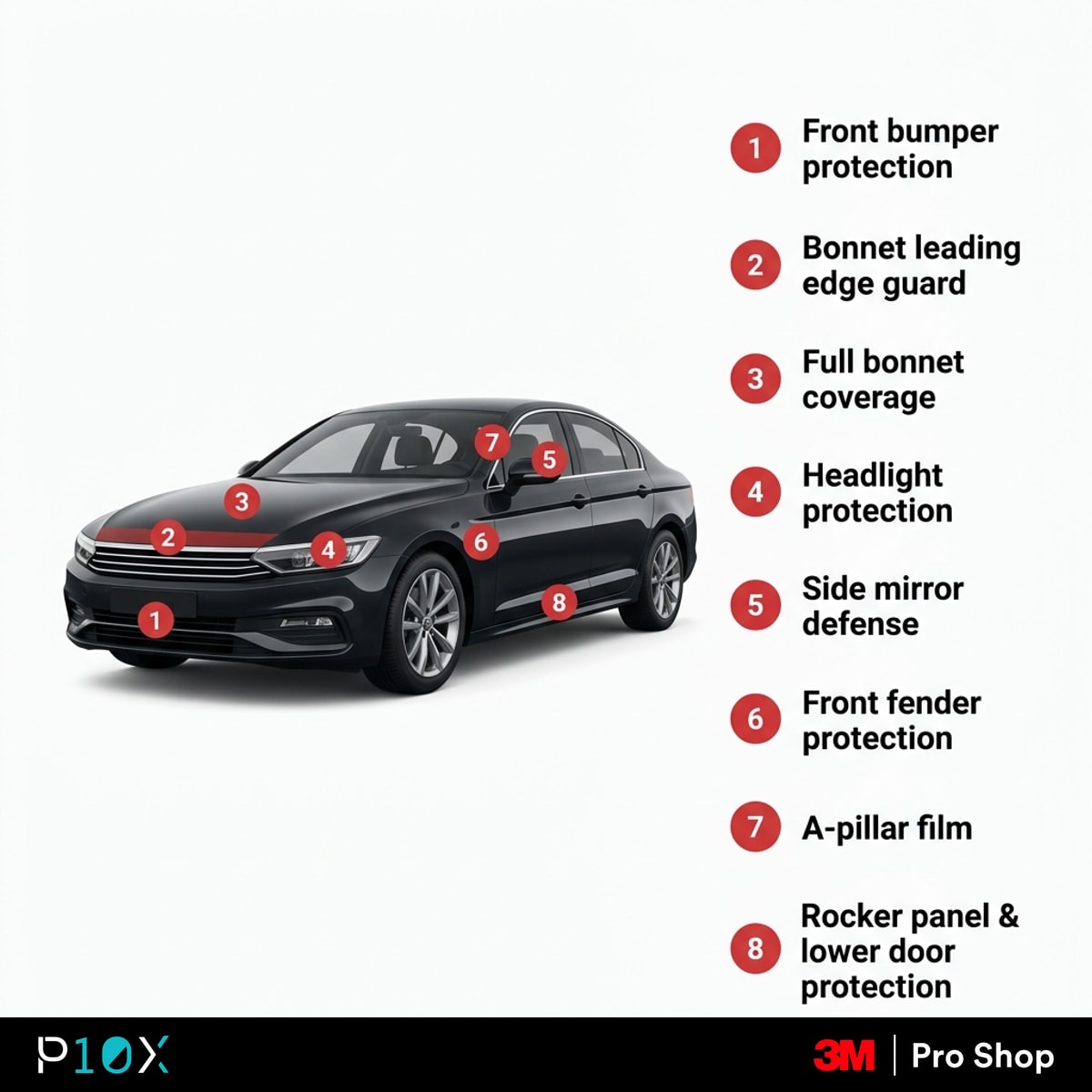
For most Malaysian drivers, Essentials coverage at around RM 3,000 to RM 4,000 covers 70 to 80 percent of real-world chip risk. Full Front at RM 5,500 to RM 11,000 is the right step up for new continental and EV owners. Full Car at RM 11,000 to RM 24,000 is for long-keep cars, supercars, or pristine concours owners. Pricing varies by vehicle size at a 3M Pro Shop branch.
| Coverage Tier | Panels Included | Indicative 3M Pro Shop RM Range | Best For |
|---|---|---|---|
| Essentials Pack | Bumper, bonnet leading edge, headlights, side mirrors | RM 3,000 to RM 4,000 (Series 100 or 150 ala-carte) | Budget-conscious daily drivers, used cars, light highway use |
| Full Front | Full bumper, full bonnet, fenders, headlights, mirrors | RM 5,500 to RM 7,000 (Series 50), RM 6,500 to RM 9,000 (Series 100), RM 8,000 to RM 11,000 (Series 150) | New continental sedans, EVs, weekly long-distance drivers |
| Full Car | Every painted panel including doors, rockers, roof, pillars | RM 11,000 to RM 15,500 (Series 50), RM 15,000 to RM 19,000 (Series 100), RM 19,000 to RM 24,000 (Series 150) | Long-keep cars, supercars, pristine resale plans |
EV owners deserve a special note here. Heavier kerb weight, lower ride height, and flat front fascias mean EVs catch more bumper and rocker spray than equivalent petrol cars. New EV owners on PLUS or NKVE should default to Full Front coverage at minimum, with mirror and lower-door PPF added for cars that regularly cruise next to lorries.
For a detailed series-by-series breakdown of Series 50, 100, and 150, read Comparing 3M PPF Series in Malaysia: Which One Fits Your Car and Budget.
Answer yes or no for each question. The more yeses, the higher the tier you should plan for.
- Is your car under 12 months old?
- Do you drive PLUS, Karak, or NKVE more than twice a week?
- Is your car parked outdoors at home or in open mall lots?
- Is your car a metallic or pearl colour that is hard to colour-match?
- Do you plan to keep this car for more than five years?
- 0 to 1 yes: Essentials Pack is enough.
- 2 to 3 yes: Full Front is the safer pick.
- 4 to 5 yes: Full Car coverage is worth the spend.
Common Mistakes Malaysians Make Choosing Stone-Chip PPF
The five most expensive mistakes are skipping the bonnet leading edge, buying thin film for highway use, installing PPF over existing chips, choosing an unverified installer, and confusing ceramic coating with PPF. All five are avoidable.
Mistake 1: Skipping the Bonnet Leading Edge
Going for full-bonnet PPF without bumper coverage, or vice versa, leaves the highest-chip zone exposed. If you can only afford one piece, prioritise the bumper. If you can stretch to two, add the bonnet leading edge. A PPF set that skips either of these two panels is poor value for highway drivers.
Mistake 2: Buying Thin Film for Highway Use
Some cheap PPF in the market is only 6 mil thick. 3M PPF starts at around 185 microns (about 7.3 mil) for Series 50, rises to 7.5 mil for Series 100, and tops out at 8 mil for Series 150. Thinner film absorbs less impact, yellows faster in Malaysian UV, and tears at panel edges. Series numbers and film thickness matter more than the brand stickers on the front desk.
Mistake 3: Installing PPF Over Existing Chips
If your car already has visible chips, PPF will seal them in. The chip stays underneath the film and continues to rust because moisture and oxygen are already trapped at the metal layer. The fix is paint touch-up first, then PPF on top of fresh, fully cured paint. A reputable installer will inspect the panels before quoting. For more on inspecting and redoing PPF the safe way, read Bad Past PPF Installation in Malaysia: How to Inspect and Plan a Safe Redo.
Mistake 4: Picking an FB-Group Installer With No Brand Warranty
Facebook Marketplace and group-buy PPF deals often look like half-price wins. They are not. Non-authorized installers cannot issue the 3M warranty, cannot guarantee genuine 3M film, and often use inferior adhesive that lifts at the edges within months. The right move is to book at a 3M Authorized Dealer such as 3M Pro Shop by P10X, which carries the manufacturer warranty and uses brand-trained installers. See PPF Installation in Malaysia: Why Certified 3M Pro Shop Installers Make the Difference for the full picture.
Mistake 5: Confusing Ceramic Coating With PPF
Ceramic coating is a thin glass-like layer that adds gloss, hydrophobic behaviour, and minor scratch resistance. It does not stop stone chips. Some owners buy a coating thinking it replaces PPF and then come back disappointed after their first highway trip. Coating and PPF solve different problems and often work best together.
How to Plan 3M PPF Coverage on a Malaysian Budget
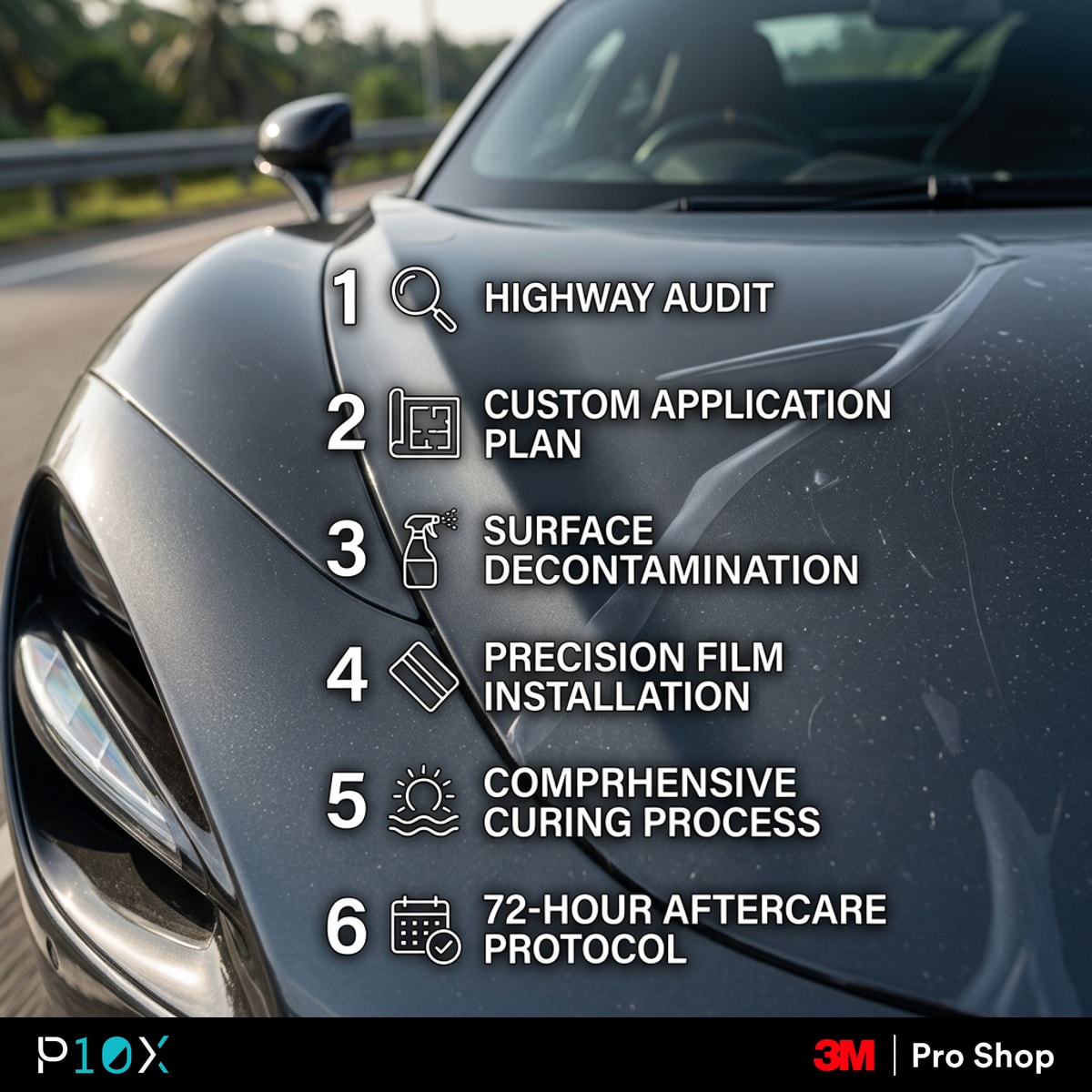
Plan PPF in six steps so the money you spend lines up with the chip risk on your specific car and routes. Audit your driving, inspect existing damage, pick a tier, pick a series, book a certified installer, then plan aftercare.
Step 1: Audit Your Weekly Highway Mileage
Count how many times a week you drive PLUS, NKVE, KESAS, Karak, MEX, SPRINT, DUKE, or ELITE. Daily commuters and weekly balik-kampung drivers need at least Essentials coverage. Drivers who barely leave the city can stay with a smaller front-only patch.
Step 2: Inspect Existing Chips and Touch Up First
Walk around your car in bright daylight and mark any chips on bumper, bonnet, and fenders with a removable sticker. Have a body shop touch up the paint and let it cure for at least seven to ten days before booking PPF.
Step 3: Pick Coverage Tier by Car Age and Parking
If your car is under 12 months old and parked outdoors at home or in open mall lots, lean towards Full Front. If your car is older, already has minor chips, and is parked in a covered carpark, Essentials is enough. For used-car buyers planning PPF on a vehicle with some history, read PPF for Used Cars in Malaysia.
Step 4: Choose 3M Series 50, 100, or 150
Pick by budget and finish needs. Series 50 is entry invisible armour for chip protection. Series 100 is the balanced everyday tier. Series 150 is the premium tier with the lowest orange peel, highest clarity, and a hydrophobic finish that sheds water cleanly during monsoon. If your car has a factory matte finish, ask the installer about matte PPF options instead of gloss series.
Step 5: Book a 3M Authorized Dealer
Book installation at 3M Pro Shop by P10X (3M's highest dealer tier in Malaysia) or your nearest 3M Authorized Dealer. Across our branches in Taman Equine, Kepong, and Bandar Sunway, the most common first-PPF requests we see are bumper-plus-bonnet-edge packages on cars under six months old, which lines up exactly with the priority order in this guide. You can compare locations and book a walkaround at 3mproshop.com.my/locations. Ask to see the dealer certification and confirm the warranty terms in writing at the time of booking.
Step 6: Plan Your 72-Hour Aftercare
Do not wash the car for 72 hours after installation so the adhesive fully cures. After that, hand wash with neutral car shampoo, skip brush-style automated car washes, and remove tree sap or bird droppings as soon as you see them using warm soapy water. For long-term film care, read PPF Aftercare in Malaysia: How to Keep Your 3M PPF Looking New.
If you are unsure where to start, look at your last three months of driving. The bumper, bonnet leading edge, headlights, and side mirrors are almost always the right first investment for a Malaysian car owner. From there, scale up to Full Front if you drive long highway hours or own a new continental or EV. The simplest next step is to book a panel-by-panel walkaround with a 3M Authorized Dealer and ask the installer to quote both an Essentials and a Full Front option so you can compare on paper before deciding.
Find out the best protection for your car
Visit a 3M Pro Shop and discover the cost-effective 3M Protective Film and Window Tint
FAQ: PPF for Stone Chips in Malaysia
Does PPF really protect against stone chips?
Yes. PPF for stone chips in Malaysia works by absorbing impact through a 7.5 to 8 mil TPU film (the 3M Series 100 and 150 standard) that prevents gravel from reaching the paint underneath. It does not make the car indestructible. Large debris at high speed can still cause minor damage, but day-to-day chips are stopped at the film.
What areas of the car should you PPF first?
Start with the front bumper, the leading edge of the bonnet, the headlights, and the side mirrors. These four areas catch roughly 80 percent of all stone-chip damage on a daily-driven Malaysian car.
Is partial front PPF worth it in Malaysia?
For most Malaysian drivers, yes. An Essentials Pack at around RM 3,000 to RM 4,000 covers the highest-risk panels at a fraction of the cost of full-car coverage. If your weekly mileage includes long stretches on PLUS, Karak, or NKVE, step up to Full Front for the full bonnet and fenders.
How thick should PPF be for stone chips?
For highway-grade stone-chip protection, look for film thickness of around 7.3 mil (185 microns) or higher. 3M Series 50 starts at around 185 microns as the entry tier, Series 100 sits at around 7.5 mil, and Series 150 is around 8 mil. Anything thinner than 6 mil is not engineered for serious chip protection on Malaysian expressways.
Can PPF be applied over existing stone chips?
Not directly. Film over an open chip will trap moisture and rust the metal underneath. The right sequence is paint touch-up first, allow the new paint to cure for at least seven to ten days, then install PPF over the freshly repaired surface.
How long does PPF last in Malaysia's hot weather?
Quality 3M PPF is engineered to resist UV yellowing, cracking, and adhesive failure in tropical conditions. Real-world life depends on parking, washing habits, and care. Warranty terms can vary between three and five years across product bulletins, so confirm the exact warranty period with the 3M Pro Shop branch you book with before installation.
How much does PPF cost in Malaysia for the front only?
For medium vehicles at a 3M Pro Shop, an Essentials Pack runs roughly RM 3,000 to RM 4,000. Full Front runs RM 5,500 to RM 11,000 depending on whether you choose Series 50, 100, or 150. Final pricing varies by vehicle size, body shape, and current promotions.
Author

Fabian
He is passionate about revolutionizing the car protection services industry by bringing innovation and transparency to a traditionally opaque and often misunderstood field. His mission is to educate end users on the true benefits and importance of car protection, aiming to replace outdated practices with honest, customer-focused solutions. With a fresh approach to car tinting, paint protection film (PPF), and detailing services, he is committed to delivering a superior customer experience that sets a new standard in the market. He welcomes discussions about the future of the automotive industry and is eager to connect with like-minded professionals who share his vision for innovation, integrity, and excellence.
Experience the future of window tinting
Visit a 3M Pro Shop and discover the revolutionary Crystalline CR BLK film