
KL Highway Stone Chips: A Klang Valley Map of Where Paint Chips Actually Happen

- KL highway stone chips concentrate on 6 named Klang Valley stretches: Karak, PLUS/NKVE Sg Buloh to Bukit Lanjan, MEX to Putrajaya, ELITE Subang to Bukit Jelutong, DUKE/Jalan Tun Razak and the East Coast Expressway on weekends.
- Speed and following distance matter more than route. A 3-second gap behind a cement lorry protects paint more than expensive PPF on its own.
- Bumper, bonnet edge, headlights and side mirrors chip first on every Klang Valley profile. These are the Tier 1 PPF priorities for any car under two years old.
- 3M PPF Series 50, 100 and 150 differ in thickness and stain resistance. Karak regulars lean Series 150. Daily NKVE-PLUS commuters do well with Series 100 on the front. City-only drivers can stop at Tier 1.
- Comprehensive motor insurance in Malaysia generally does not cover cosmetic stone-chip respray. Check your own policy wording before booking any work.
Introduction
Stone chips on KL highways are not random. The damage concentrates on specific stretches of Karak, PLUS, NKVE, MEX, ELITE and DUKE, where lorry density, granite cuttings and construction debris turn loose gravel into paint-cutting projectiles. If you drive a continental sedan, a new EV or any car under two years old around Klang Valley, you have probably already noticed your first chip on the bumper or bonnet edge.
This guide maps where those chips actually happen, why some highways are worse than others, and which panels to protect first with 3M Paint Protection Film (PPF). The goal is simple. Help you make one decision, calmly, with real Malaysian context. If you want the full PPF primer first, see 3M Paint Protection Film in Malaysia: Benefits, Cost and Longevity.
What Makes KL Highways Chip Paint More Than City Streets
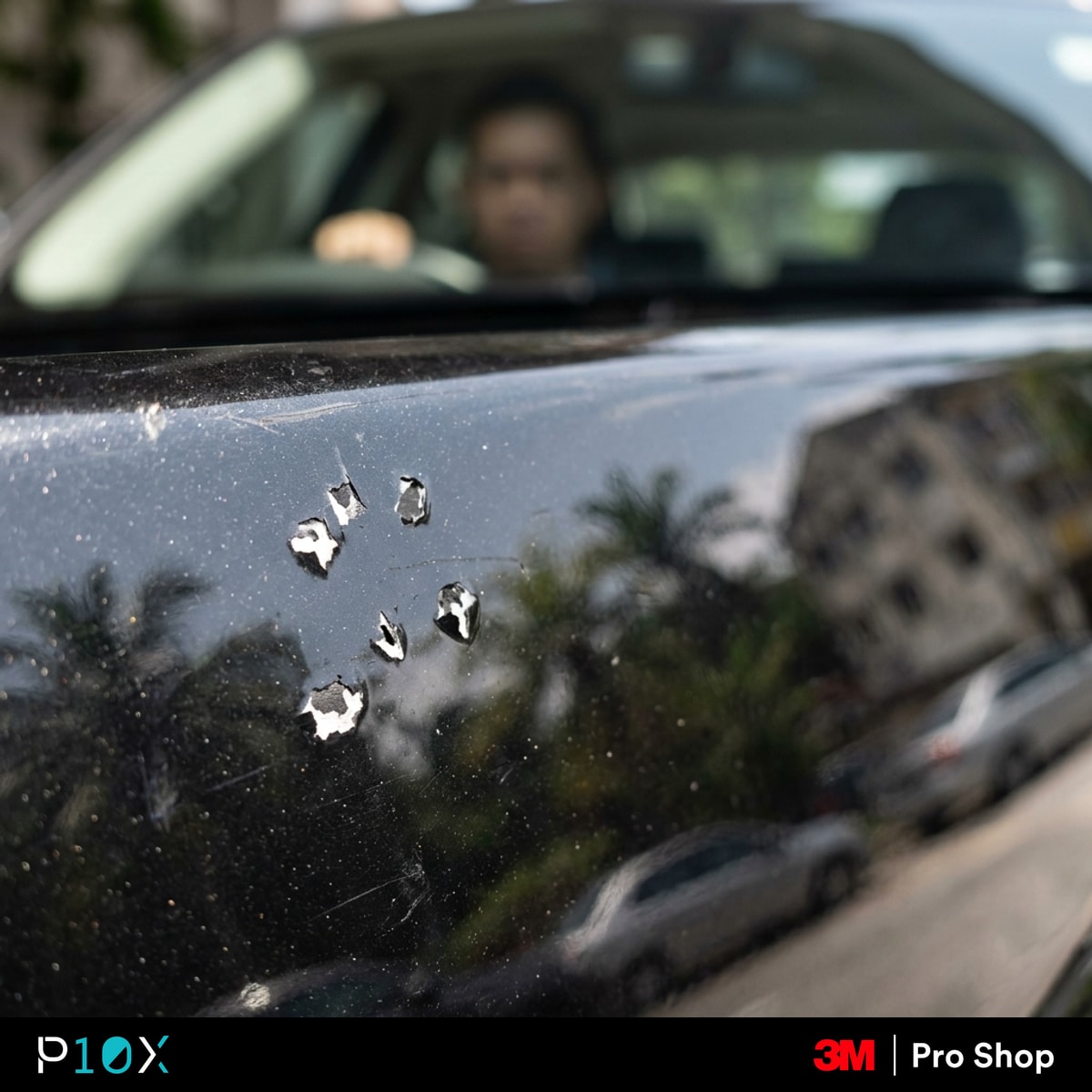
A stone chip is a 1 to 5 mm impact crater caused by gravel kicked up by tyres at speed. On Klang Valley highways, lorries at 90 km/h and cars at 110 km/h turn loose aggregate into projectiles that cut through the clearcoat, basecoat and primer of your car. Once bare metal is exposed, the chip can begin to rust within months in our 80%+ humidity.
City streets, even Federal Highway in stop-go traffic, rarely produce the same kind of damage. Three things change on a highway. Vehicle speeds are higher, so the same loose pebble carries far more impact energy. Lorries carry quarry stone, sand, gravel and cement debris that flicks off their tyres. Cuttings through hill sections, especially Karak, shed granite spall onto the road surface. The combination is what makes a daily PLUS or Karak driver see chips much sooner than a Bangsar-to-KLCC commuter who never leaves the city grid.
Why Klang Valley Drivers See Chips Faster Than City Drivers
Klang Valley humidity sits above 80% most of the year. Bonnet and dashboard surfaces cycle between roughly 22°C in the morning and 60°C under noon sun. Bare metal exposed by even a small chip rusts faster here than in drier climates, and the rim of the chip can lift the surrounding clearcoat after a few months.
The cost of one chip is not trivial. A panel respray in Klang Valley runs roughly RM 800 to RM 2,500 depending on colour. Metallic, pearl and black factory finishes are harder to match, so even a small touch-up often becomes a full panel respray. Continental brands and OEM-spec colours push that bill higher. If you are shopping for a used car already wearing film, see Bought a Used Car With PPF before paying for a redo.
Comprehensive motor insurance in Malaysia generally excludes cosmetic chip damage, so read your own policy wording carefully. For the deeper cost-benefit math, see Is PPF Worth the Investment for Malaysian Car Owners? and Can You Claim PPF Replacement After an Accident in Malaysia? for the insurance-claim reality.
How Speed and Following Distance Triple Chip Risk on PLUS
Stone-impact damage is a function of velocity, angle and temperature. Doubling your speed roughly quadruples the kinetic energy of the impact, which is why a chip from a stationary pebble feels harmless and the same pebble at 110 km/h cuts paint. Front-of-car panels chip more than the rear because most debris is thrown by the vehicles ahead of you, not behind you. The single biggest variable you actually control is the gap to the vehicle in front.
Factor 1: Speed Multiplies Impact Energy Squared
Impact energy rises with the square of relative velocity. The pebble itself does not change. Your closing speed against it does. Easing off from 130 to 110 km/h is not a small change in chip risk. It is a meaningful drop in impact energy at the panel.
Factor 2: Following Distance Determines Debris Reach
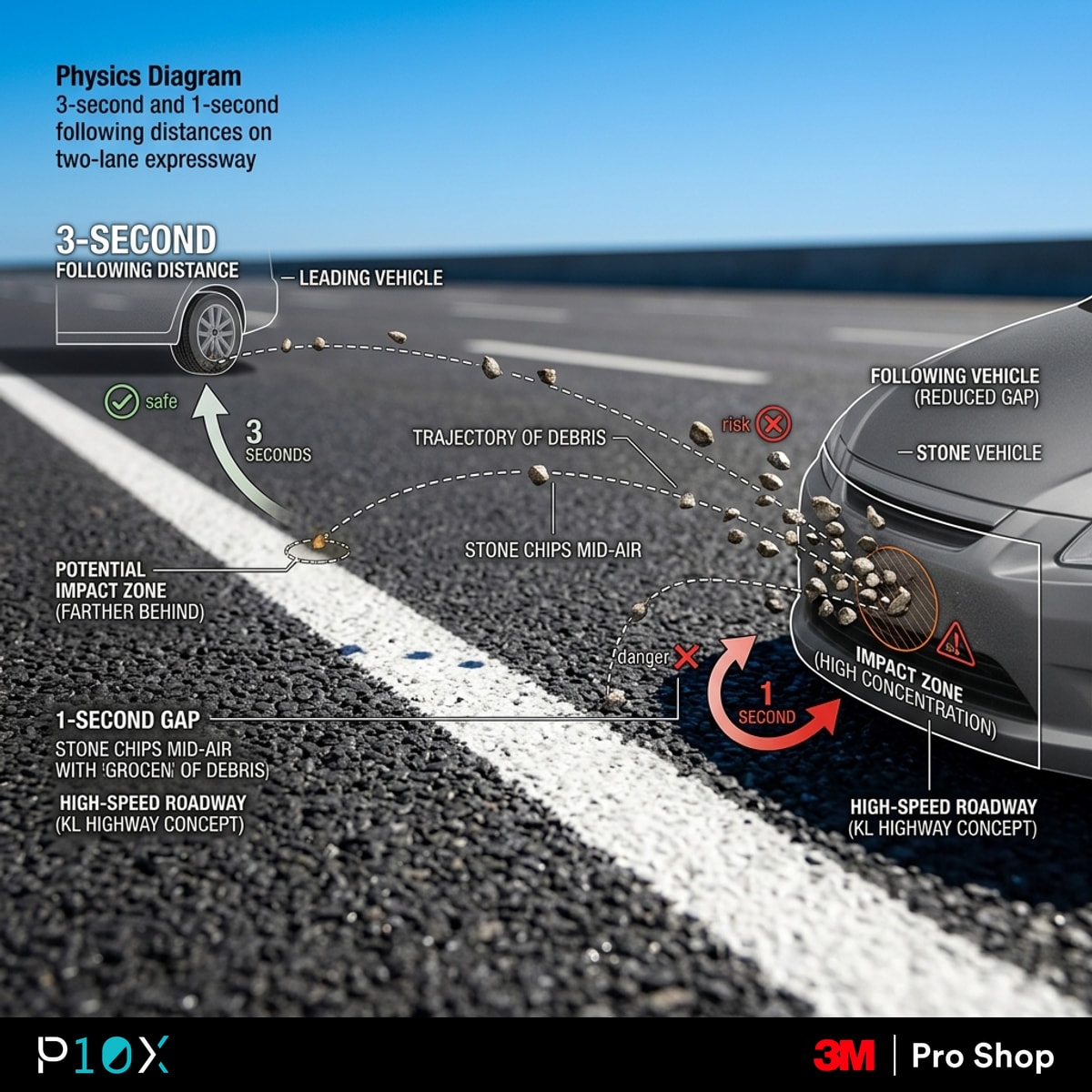
A 3-second following gap is the windshield and PPF installer consensus minimum. At highway speed, 3 seconds is roughly 90 metres of buffer, which is the distance most flicked debris loses energy before reaching your bumper. A 1-second gap puts you well inside the spray zone of the vehicle in front.
Factor 3: Lane Position Decides Cross-Lane Spray Exposure
Cement mixers, tippers and gravel trucks shed loose stones from their tyres and cargo edges. If you must overtake one, pass quickly and do not linger in the lane next to it. Sitting in its spray zone for 30 km of Karak is what causes the worst chip clusters we see at the shop.
6 Klang Valley Stone-Chip Zones Ranked by Damage Density
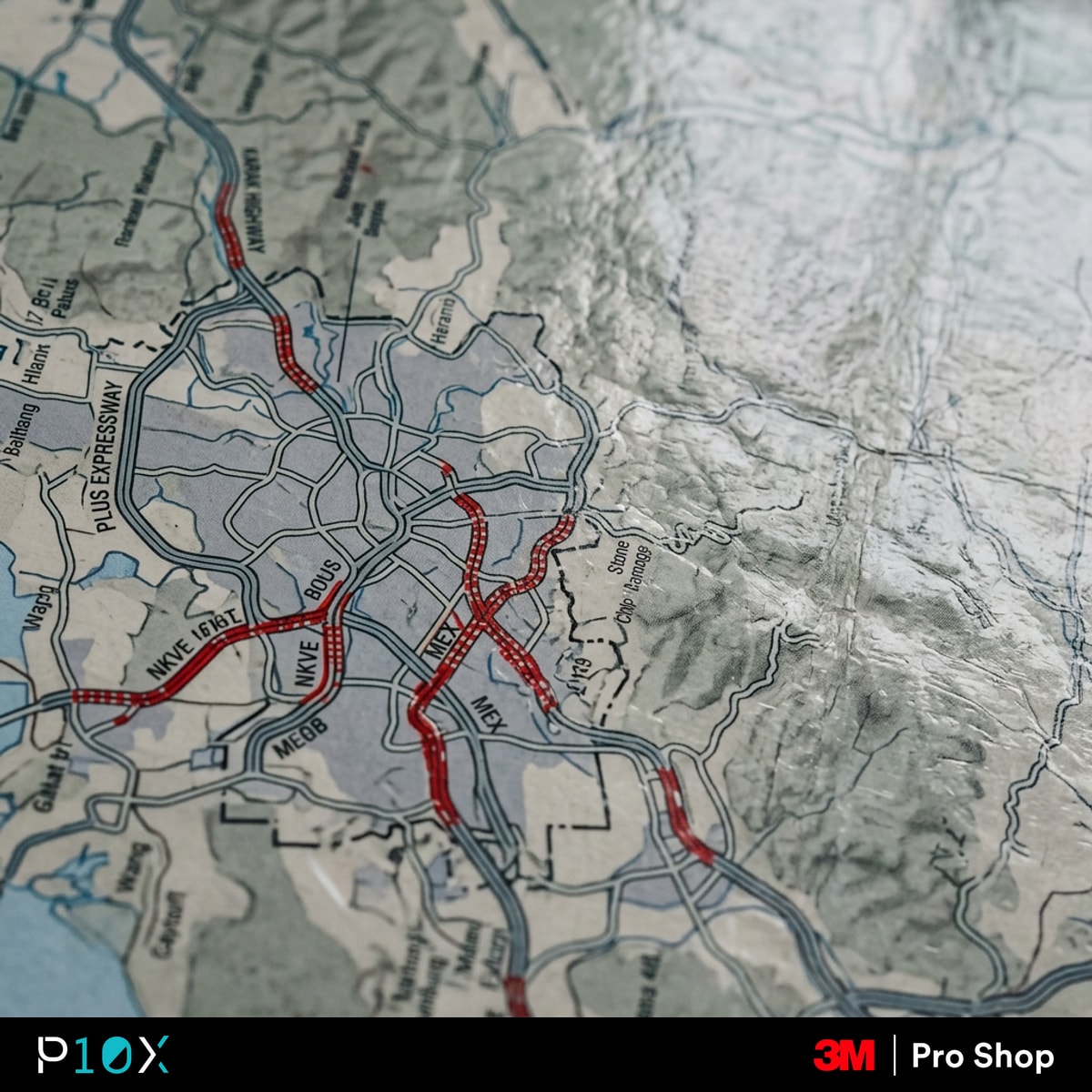
These six Klang Valley stretches are where customers most often arrive at the shop with fresh chips on the bumper, bonnet or headlights. The ranking is qualitative, based on what comes through the workshop bay over the years, not a statistical audit.
| Zone | Worst stretch | Primary cause | Panels most affected | PPF priority |
|---|---|---|---|---|
| 1. Karak Highway | KM30 to KM60 hill cuttings | Granite spall, cement lorries | Bumper, bonnet edge, headlights | Tier 2 or 3 |
| 2. PLUS / NKVE | Sg Buloh to Bukit Lanjan | Widening works, construction debris | Bumper, fenders | Tier 2 |
| 3. MEX to Putrajaya | Quarry interchange zones | Quarry and site gravel | Bumper, side mirrors | Tier 1 or 2 |
| 4. ELITE | Subang to Bukit Jelutong | Lorry density, cross-lane spray | Bumper, rocker, door cups | Tier 1 or 2 |
| 5. DUKE / Jalan Tun Razak | Urban interchange ramps | Resurfacing debris | Bumper, headlights | Tier 1 |
| 6. East Coast Expressway | Weekend balik-kampung stretches | Sand, patch repairs | Bumper, rocker | Tier 1 or 2 |
Zone 1: Karak Highway (Granite Spall and Cement Lorry Aggregate)
The Karak Highway KM30 to KM60 hill-cutting stretch is the most chip-dense road in our records. Granite spall shears off the Titiwangsa Range cuttings when it rains, and cement and quarry lorries headed to Bentong and Genting throw aggregate from their cargo edges. Bonnet edges, headlights and the lower bumper take the heaviest hits. Avoid the right lane behind cement lorries, especially on wet days.
Zone 2: PLUS / NKVE Sg Buloh to Bukit Lanjan (Widening and Construction)
PLUS Sungai Buloh to Bukit Lanjan has been under widening and resurfacing works on and off for years. Construction edges shed concrete and asphalt fragments, and lorry traffic into the Sungai Buloh industrial zones adds aggregate spray. Front fenders catch a lot of side-throw debris on this stretch, not just bumpers.
Zone 3: MEX to Putrajaya (Quarry and Construction-Site Gravel)
MEX is shorter than Karak but punches above its weight because of quarry traffic, Cyberjaya construction sites and the Putrajaya interchange resurfacing cycle. Bumper damage dominates here. Side mirrors also catch flicked pebbles during toll-plaza acceleration.
Zone 4: ELITE Subang to Bukit Jelutong (Lorry Density and Cross-Lane Spray)
ELITE between Subang Airport and Bukit Jelutong has consistent lorry traffic feeding Klang Port. Cross-lane spray, the debris thrown by lorries two lanes over, is more common here than on quieter expressways. Rocker panels and door cups, often ignored, take a steady beating.
New EVs feel this stretch more than equivalent ICE cars. Heavier kerb weight and lower ride height push the front fascia closer to the debris arc, and flat EV bumpers catch more side-throw than a sloped sedan nose. If you drive an MG S5 EV, an iCaur 03 or a Perodua eMO/QV-E on ELITE or NKVE daily, prioritise bumper, fender and rocker PPF early, not just the bonnet.
Zone 5: DUKE and Jalan Tun Razak (Urban Resurfacing Debris)
DUKE and the Jalan Tun Razak elevated section is technically urban, but speeds and resurfacing cycles produce highway-style chip damage. Bumpers and headlights catch the most debris near interchange ramps where stop-go merging happens at 80 km/h.
Zone 6: East Coast Expressway Weekends (Sand, Beach Runoff, Patch Repairs)
Friday-evening balik-kampung drives and Sunday returns concentrate damage on the East Coast Expressway. Beach-side sand runoff, patch repairs and the long exposure time of the trip add up. Bumper and rocker panels need protection here even though chip density per kilometre is lower than Karak.
Karak Highway vs PLUS: Which Damages Paint More
Karak damages paint more per kilometre, but PLUS damages paint more per trip. Karak's narrow lanes, granite cuttings and cement-lorry density concentrate damage into about 30 km of hill stretch. PLUS is far longer, better maintained in widened sections and has cleaner lorry segregation, but you spend more time on it on every drive, so cumulative exposure can match or exceed Karak.
| Dimension | Karak Highway | PLUS (Klang Valley stretch) |
|---|---|---|
| Lorry density | High (cement, quarry) | Medium to high (mixed cargo) |
| Surface condition | Variable, granite spall in hill cuttings | Better maintained in widened sections |
| Construction frequency | Lower, but landslip patchwork | Higher in Sg Buloh to Bukit Lanjan |
| Speed limit | 90 km/h, often slower on bends | 110 km/h |
| Chip risk per 100 km | High | Medium |
| Chip risk per trip | Medium | Medium to high (longer drive) |
If you take Karak once a month, the per-trip risk is manageable with a Tier 1 or Tier 2 PPF on the front. If you commute NKVE-PLUS daily, the cumulative exposure justifies Tier 2 or higher. For the full PPF series differences in thickness and warranty, see Comparing 3M PPF Series in Malaysia: Which One Fits Your Car and Budget?.
5 Mistakes Drivers Make on Karak, PLUS and NKVE
These are the five most common chip-causing habits we see at the shop, ordered from worst to most overlooked. The first two are about how you drive on the highway. The next two are about the film itself. The fifth is about who installs it. Fixing any one of them measurably cuts your chip count over a year of Klang Valley driving.
Mistake 1: Tailgating Cement Lorries at 110 km/h
The number-one cause of dense chip clusters on Karak and ELITE. Drop back to a 3-second gap or overtake cleanly. Do not sit in the spray zone.
Mistake 2: Skipping Bonnet Edge PPF Before Karak Trips
Bonnet edges catch direct stone impacts on hill stretches because debris bounces upward off the bumper and the road surface. Even partial PPF on the bonnet edge and front bumper covers the most chip-prone area on any car. A ceramic coating alone will not stop a stone chip on Karak. Only PPF absorbs the impact energy. For the practical difference, see Self-Healing PPF vs Self-Healing Coating.
Mistake 3: Using Brush Automatic Washes After PPF Install
Brush-style automatic washes can lift the edges of fresh PPF and scratch the surface over time. They are also the leading cause of swirl marks on new cars in KL. Hand wash with neutral shampoo or use a verified touchless wash. See PPF Aftercare in Malaysia: How to Keep Your 3M Paint Protection Film Looking New for the full aftercare routine.
Mistake 4: Choosing Thin Film for Highway Use
3M PPF Series 50 sits around 185 microns. Series 100 is roughly 7.5 mil including adhesive. 3M PPF Series 150 is roughly 8 mil including adhesive. Higher thickness absorbs more impact energy before any damage reaches the paint. If Karak is in your monthly rotation, do not pick the thinnest option just to save a few hundred ringgit on the front bumper.
Mistake 5: Booking a Non-Authorized PPF Installer Off Facebook
Cheap quotes from FB-group vendors often fail on edges within months because of poor surface prep, incorrect cutting templates or substandard film. Choose a 3M Authorized Dealer such as 3M Pro Shop by P10X, where the film carries the official e-warranty and the install follows verified 3M training. For why this matters in practice, see PPF Installation in Malaysia: Why Certified 3M Pro Shop Installers Make the Difference. If a previous installer has already left the film lifting at the edges, see Bad Past PPF Installation in Malaysia: How to Inspect and Plan a Safe Redo before paying for another job.
Tier 1 to Tier 3 Panel Coverage by Highway Profile
This section maps your driving profile to a sensible PPF tier. It does not replace the full panel-priority order for any car. For the panel-by-panel sequence on bumpers, bonnets, A-pillars and beyond, see Highway Stone Chips in Malaysia: Which Panels Need PPF First (KL Driver Guide).
Tier 1: Bumper, Bonnet Edge, Headlights, Mirrors (RM 3,000 to RM 4,000)
Covers the panels that chip first on every Klang Valley route. A sensible starting point for any new car under two years old, including those driven mostly in the city with occasional highway trips.

Tier 2: Full Front and Fenders (RM 5,500 to RM 11,000)
Covers everything in Tier 1 plus full bonnet and front fenders. Recommended for daily NKVE-PLUS, ELITE or MEX commuters, and for continental cars where paint match is harder.
Tier 3: Full Car for Karak Regulars and Supercars (RM 11,000 to RM 24,000)
Full car coverage in 3M PPF Series 50, 100 or 150 depending on budget. Sensible for Karak weekend regulars, supercars, EVs with low ride height and owners who plan to keep the car five years or more. If your car is finished in factory matte or you want a matte look over gloss, see Matte PPF on a Glossy Car before choosing a film series.
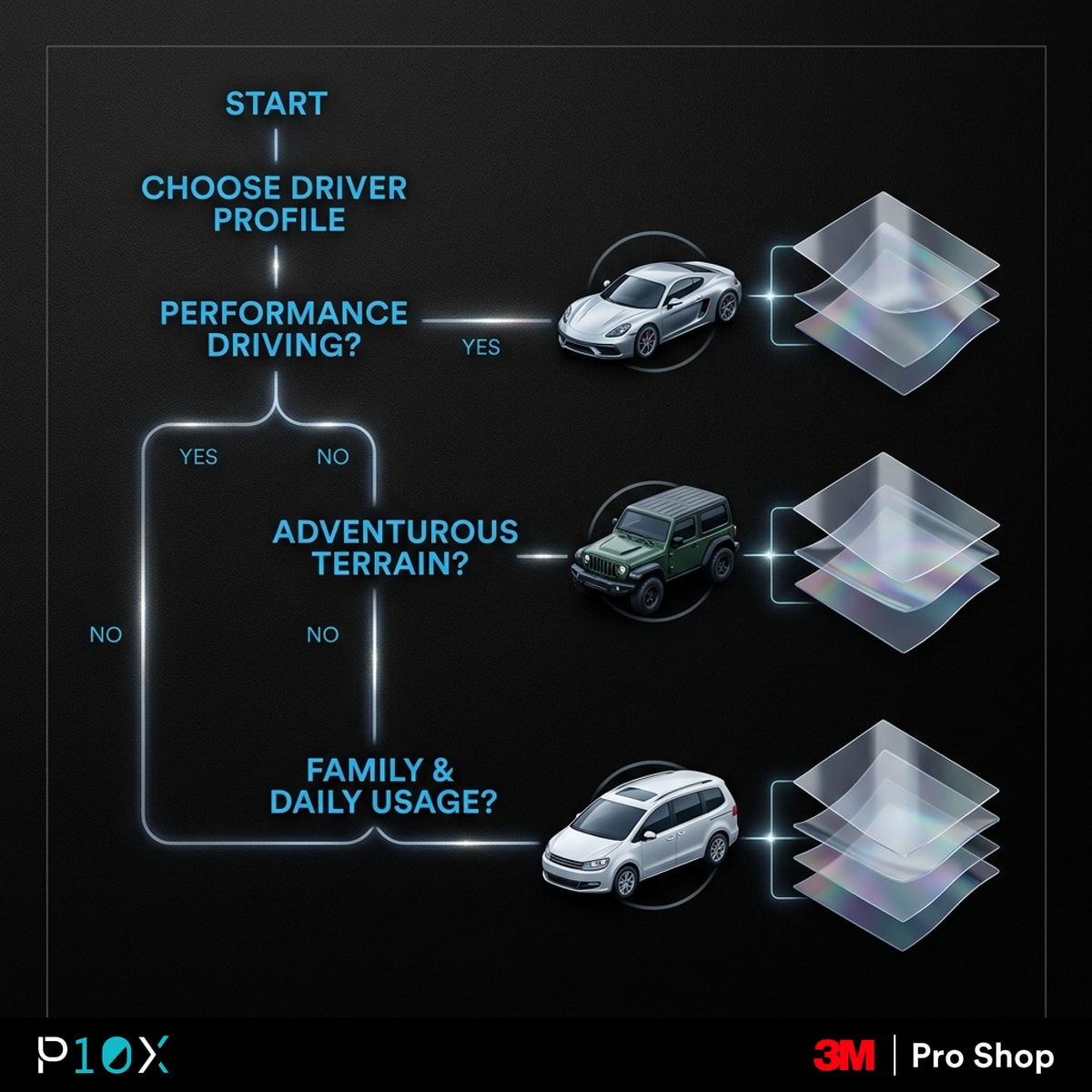
| Driver profile | Weekly highway use | Recommended tier | Recommended 3M PPF series |
|---|---|---|---|
| KL city only | 0 to 1 trip | Tier 1 | Series 50 or 100 |
| Occasional balik-kampung | 2 to 3 trips/month | Tier 1 or 2 | Series 100 |
| Weekly Karak | 4+ trips/month | Tier 2 or 3 | Series 100 or 150 |
| Daily NKVE-PLUS commuter | 5+ trips/week | Tier 2 | Series 100 |
| New EV owner | Variable, heavier kerb weight | Tier 1 or 2 | Series 100 or 150 |
| Supercar or daily continental | Any | Tier 3 | Series 150 |
For EV-specific notes on bumper and rocker coverage, see 3M PPF for the 2026 MG S5 EV CKD in Malaysia. When you are ready to book, walk in to 3M Pro Shop by P10X (or your nearest 3M Authorized Dealer) for a panel-by-panel inspection and a written quote. Find the closest 3M Pro Shop outlet in Klang Valley. Confirm the warranty period in writing at the time of booking, since film series warranties can vary across product bulletins.
5 Pre-Trip Habits That Cut Highway Chip Risk
Before you leave KL on Karak, PLUS or the East Coast Expressway:
- Check tyre treads for embedded gravel and pick them out at the petrol station.
- Plan a 3-second following gap and stick to it, even when traffic tries to push you in tighter.
- Avoid the right lane behind cement and quarry lorries.
- Do a quick walk-around inspection so you know what is fresh damage versus old.
- Hand wash within 48 hours of getting back to flush out embedded grit before it sets.
The cheapest paint protection you can do today is simply maintaining your distance from lorries. Everything else, PPF included, layers on top of that habit. If you already have visible chips and want to know whether to touch up first or PPF over fresh paint, walk in for an inspection rather than guessing.
Find out the best protection for your car
Visit a 3M Pro Shop and discover the cost-effective 3M Protective Film and Window Tint
FAQ: Karak, PLUS and NKVE Paint Protection
Does PPF protect against highway stone chips?
Yes. PPF is the most reliable single upgrade against everyday chip damage. The film absorbs impact energy from small gravel and self-heals minor scuffs with heat. PPF does not stop severe debris like loose bricks or large rocks. Treat it as armour against everyday Karak and PLUS chips, not as indestructible coating.
Which Malaysian highway has the most stone chips?
In Klang Valley, Karak Highway (especially the KM30 to KM60 hill cuttings) is the chip-densest road we see at the shop, mainly because of granite spall and cement-lorry traffic. PLUS Sungai Buloh to Bukit Lanjan ranks high too, but more from construction debris than granite.
Is Karak Highway dangerous for car paint?
Karak is hard on paint, not because it is poorly maintained, but because the road cuts through granite hills and carries heavy quarry and cement lorries. Drive at the speed limit, keep a 3-second gap behind lorries, and PPF the front bumper and bonnet edge if you take it monthly.
Should I avoid following lorries on the highway?
Yes, especially cement, tipper and quarry lorries. They shed loose aggregate from their tyres and cargo edges. Maintain a 3-second gap, overtake cleanly when safe, and do not linger in the lane next to them on Karak or ELITE.
How much PPF do I need for highway driving in Malaysia?
A Tier 1 front-end PPF (bumper, bonnet edge, headlights and mirrors) at RM 3,000 to RM 4,000 covers most highway chip damage for a typical Klang Valley driver. Daily PLUS or weekly Karak drivers should consider Tier 2 full front and fenders for RM 5,500 to RM 11,000. Supercars and Karak regulars should look at Tier 3 full-car coverage.
Can stone chips crack my windscreen?
Yes. A larger stone striking the windscreen at highway speed can chip or crack the glass. PPF does not cover windscreens. If your windscreen takes a hit, get it inspected quickly before the chip spreads into a full crack.
How fast can a stone chip rust a Malaysian car?
In Klang Valley humidity, rust can begin at the chip edge within a few months once bare metal is exposed. The earlier you cover or touch up a chip, the less likely you are to need a full panel respray later.
Author

Fabian
He is passionate about revolutionizing the car protection services industry by bringing innovation and transparency to a traditionally opaque and often misunderstood field. His mission is to educate end users on the true benefits and importance of car protection, aiming to replace outdated practices with honest, customer-focused solutions. With a fresh approach to car tinting, paint protection film (PPF), and detailing services, he is committed to delivering a superior customer experience that sets a new standard in the market. He welcomes discussions about the future of the automotive industry and is eager to connect with like-minded professionals who share his vision for innovation, integrity, and excellence.
Experience the future of window tinting
Visit a 3M Pro Shop and discover the revolutionary Crystalline CR BLK film