
How 3M Crystalline Works: 200 Nano Layers Thinner Than a Post-it (And Why It's Not "Sputtered")
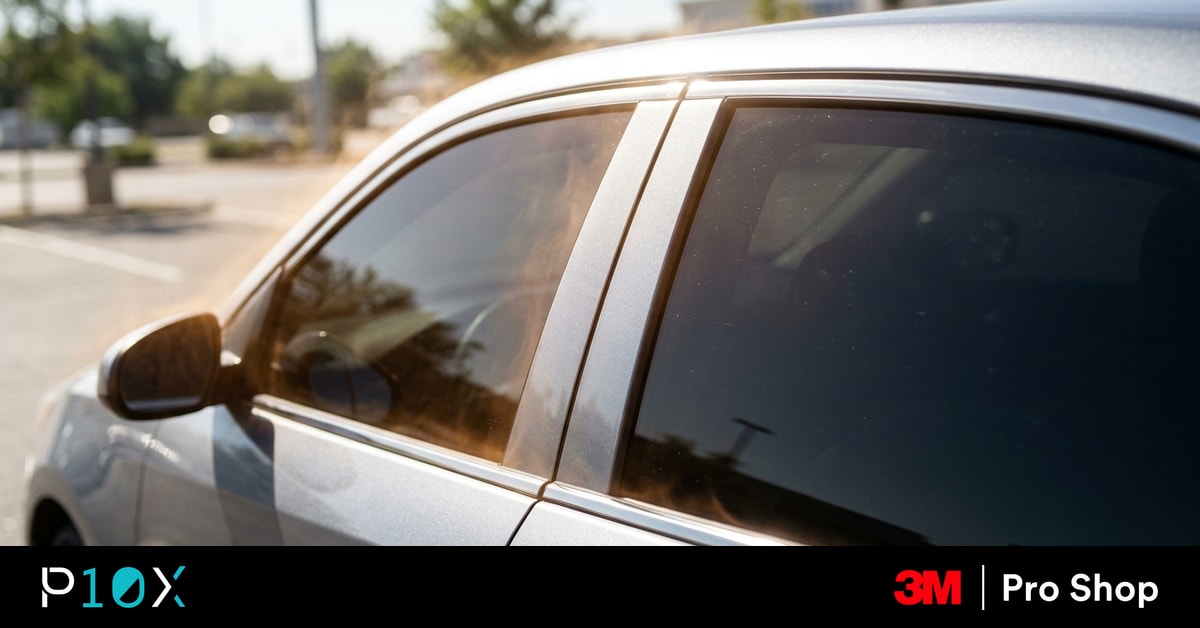
- 3M Crystalline is built on Multilayer Optical Film (MOF), a stack of around 200 ultra-thin polyester layers in a film thinner than a Post-it Note.
- It rejects heat through optical thin-film interference, the same physics behind butterfly wing colour and anti-reflective lens coatings, not through metal layers or simple absorption.
- The current Malaysia range is the Crystalline Black Series (CR BLK). It rejects up to 68% of total solar energy, 95 to 98% of infrared, and 99.9% of UVA and UVB, even at lighter shades.
- Because there is no metal layer, CR BLK does not block Touch 'n Go RFID, GPS, mobile data, or 5G signal.
- In Malaysia, the original Crystalline range is obsolete from December 2025 and CR BLK has replaced it. Full-car prices at 3M Pro Shop start at RM 3,800.
If you have ever asked how 3M Crystalline works on a Malaysian car under our open-sky heat, the short answer is physics, not metal. 3M Crystalline is built on Multilayer Optical Film (MOF), a stack of around 200 ultra-thin polyester layers, co-extruded into a single film thinner than a Post-it Note. Each layer is tuned to reflect a specific wavelength of infrared light away from your cabin, while letting visible light through cleanly. That is why your view stays clear, your phone signal still works, and your Touch 'n Go RFID still beeps at the toll.
This is also why a Crystalline tint can look light to the eye yet reject more heat than a much darker dyed film. The film does not rely on dye or metal. It uses the same kind of optical trick as anti-reflective camera lenses and butterfly wings, not the kind used in normal window tint.
This guide walks through what 3M Crystalline actually is in Malaysia in 2026, why heat rejection matters here, how the 200-layer stack works step by step, how it compares with sputtered, ceramic and dyed films, and what to expect on shades, pricing and warranty at a 3M Authorized Dealer.
What Is 3M Crystalline and Why It Matters in Malaysia
3M Crystalline is the brand name for 3M's flagship Multilayer Optical Film window tint range. In Malaysia, the original Crystalline Series is obsolete from December 2025, and the Crystalline Black Series (CR BLK) has taken over as the current Crystalline offer. CR BLK uses the same MOF platform of around 200 nano-layers, now paired with ceramic nano-technology for a deeper, more uniform black look without losing the underlying heat-rejection physics.
It matters in Malaysia for three reasons. First, our heat is constant and the sun load on a parked car in Klang Valley is intense year-round. Second, JPJ rules on visible light transmission for the windscreen and front windows mean drivers cannot simply choose the darkest film. Third, our daily driving relies on signal-sensitive devices that metal-based tints can interfere with, including Touch 'n Go RFID, mobile data, GPS, and increasingly 5G.
A Crystalline or CR BLK tint addresses all three at the same time. It rejects up to 68% of total solar energy (TSER), blocks 99.9% of UVA and UVB, and reaches 95 to 98% infrared rejection in the 900 to 1,000 nm band where you feel heat the most. Because it is non-metallized, it does this without blocking the signals your car and phone depend on. For a broader view of why this combination works for local drivers, see this overview on why 3M window tinting suits Malaysian conditions.
Why Heat Rejection Matters for Malaysian Drivers
Heat rejection is not a luxury in this climate. It is the difference between stepping into a 50°C dashboard or a 35°C one after a few hours under the open sun, every single working day.
Three things suffer when a car bakes daily. The first is your air-conditioning system, which has to work harder and longer to bring the cabin down, raising fuel use on petrol cars and pulling more power on EVs. The second is your interior. UV and infrared energy slowly fade dashboards, crack leather, and yellow the plastics around door cards. The third is your skin. UVA and UVB exposure through clear or low-grade tinted glass is a real long-term risk on a daily KL commute.
For EV owners, a strong heat-rejecting film keeps the cabin cooler when parked, which reduces the battery energy needed to cool the car before you drive. If you are driving a Proton eMAS 7 in Malaysian heat, the link between cabin temperature and usable range is direct. The same logic applies to Tesla, BYD Atto 3, and the upcoming Perodua QV-E.
This is the practical case for a film that rejects more heat per shade. A driver who chooses CR BLK 70 on the front windscreen still hits JPJ-compliant visible light levels, while gaining the same MOF heat-rejection physics as the darker CR BLK 15 on the rear.
Inside the 200-Layer Optical Stack of Crystalline
Crystalline works by selectively reflecting specific bands of infrared light using a process called thin-film interference. Instead of absorbing heat (like dyed film) or bouncing it back with a metal coating (like sputtered film), the MOF stack uses about 200 ultra-thin polymer layers to interfere with the light waves themselves. Each layer is precisely tuned by thickness so that it targets a different slice of the infrared spectrum.
The same physics is behind the colour of a butterfly wing, the bloom on a soap bubble, and the coating on a quality camera lens. It is not paint and it is not metal. It is light bending against itself.
Stacking 200 nano-layers of polyester
The base of Crystalline is a stack of around 200 layers of optical polyester, co-extruded together into a single film thinner than a Post-it Note. Each layer is only a fraction of a wavelength thick. The mechanical precision of the stack is what makes the optical trick work, and it is also why so few manufacturers in the world can produce film at this level.
Tuning each layer to a specific IR wavelength
Layers are not identical. They are designed so that each one is matched to a target band of infrared light. By stacking many tuned layers across the IR spectrum, the film covers a wide range of heat wavelengths instead of just one narrow slice. This is why CR BLK can hit 95 to 98% rejection in the 900 to 1,000 nm range where solar heat is strongest.
Reflecting infrared via thin-film interference
When an IR wave hits a tuned layer, part of it reflects off the top surface and part travels into the next layer. The reflected waves cancel each other on the cabin side, so the heat bounces back out of the glass. Multiplied across 200 layers, the effect is large enough to reject the majority of incoming infrared without darkening the cabin.
Letting visible light pass through cleanly
The same stack is tuned to be transparent in the visible range. Visible light passes through with very little scatter, which is why Crystalline keeps a clear view at higher VLT shades. The driver gets a film that looks closer to factory glass than to a heavy tint, while still doing the heat-rejection work in the background.
Adding ceramic nano-tech for CR BLK depth
In the current CR BLK Series, 3M pairs the MOF stack with a ceramic nano-technology layer. The MOF still does the wavelength-selective heat work. The ceramic layer adds a deeper black appearance and a more uniform tone across shades. There is still no metal in the construction, so signal performance is preserved.

5 Types of Window Film Compared by Mechanism
Most arguments about window tint in Malaysia happen because people are comparing films that work in completely different ways. Once the mechanism is clear, the price and performance differences make sense.
The five main types of automotive window film, sorted by heat-rejection mechanism, are dyed film, single-layer sputtered, multi-layer sputtered, nano-ceramic, and Multilayer Optical Film (MOF).
| Film type | Layers | Material | Heat-rejection mechanism | Signal friendly |
|---|---|---|---|---|
| Dyed film | 1 | Dyed polyester | Light absorption | Yes |
| Single-layer sputtered | 1 metallic | Metal coating | Metal reflection | No |
| Multi-layer sputtered | Multiple metallic | Stacked metal layers | Stacked metal reflection | No |
| Nano-ceramic | 1 to a few | Ceramic nano-particles | Ceramic absorption | Yes |
| 3M Crystalline (MOF) | ~200 | Optical polyester (plus ceramic nano-tech in CR BLK) | Thin-film interference | Yes |
Dyed film: absorption only
A dye layer absorbs visible light and a small share of solar energy. Heat builds up in the film itself and re-radiates back into the cabin. It darkens the window but does little against infrared. Cheapest tier, shortest lifespan, prone to purple fade.
Single-layer sputtered: metal reflection
A thin metallic coating reflects light and infrared. Strong heat rejection at install, but the metal layer can interfere with mobile, GPS and RFID signals, and tends to corrode in tropical humidity.
Multi-layer sputtered: stacked metal reflection
Several metallic layers, each tuned differently, are stacked together. This is where the common misconception starts. People assume Crystalline must be the premium version of this approach. It is not. Multi-layer sputtered films are still metal-based and still carry signal-interference and oxidation risks.
Nano-ceramic: ceramic-particle absorption
Microscopic ceramic particles absorb and dissipate infrared energy without using metal. Signal-friendly and durable. Heat rejection is strong, but typically caps below what a well-designed MOF stack can deliver at the same visible light level.
3M Crystalline MOF: optical interference
The only mass-market automotive tint using Multilayer Optical Film. Heat is rejected by wavelength-selective thin-film interference across around 200 layers, with no metal and no dye doing the primary heat work. In CR BLK, a ceramic nano-tech layer is added for appearance, not as the heat-rejection mechanism.
If you want to dig deeper into how Crystalline stacks up against other premium brands sold locally, see this 3M Crystalline tint comparison for Malaysian conditions.

3M Crystalline vs Ceramic IR and Other Premium Tints
Inside the 3M range itself, the three tiers most Malaysian drivers compare are Crystalline (now CR BLK), Ceramic IR, and XP.
| Spec | CR BLK (Crystalline) | Ceramic IR | XP |
|---|---|---|---|
| Total Solar Energy Rejected (TSER) | Up to 68% | Up to 63% | Up to 55% |
| Infrared Rejection (IRR) | 95 to 98% | Up to 95% | Up to 38% |
| UV Rejection | 99.9% | 99.9% | 99.9% |
| Glare Reduction | Up to 81% | Up to 93% | Up to 95% |
| Signal friendly | Yes (non-metallized) | Yes | Yes |
| Tier | Premium flagship | Performance | Essential |
CR BLK leads on infrared rejection and on heat rejection per shade, which is why it is the only one in the range that can deliver high heat rejection at a light shade like CR BLK 70 or CR BLK 80. Ceramic IR is the strong middle tier with nano-ceramic absorption and up to 95% IR rejection. XP is the affordable entry into 3M tint, focused more on glare and privacy than on raw infrared rejection.
The price gap reflects a real technology gap, not markup. CR BLK uses a manufacturing process that very few competitors in the world can replicate. For a full breakdown of where the cost goes, see the 3M window tint price guide for Malaysia.
Common Misconceptions About 3M Crystalline
Five myths come up repeatedly when Malaysian buyers compare Crystalline against other films. Each one is worth correcting clearly.
Myth: Crystalline is sputtered film
Crystalline and CR BLK are Multilayer Optical Film, not sputtered metal film. The 'many layers' wording sometimes used in marketing creates the confusion, but the construction is fundamentally different. MOF uses optical interference. Sputtered uses metallic reflection.
Myth: Lighter tint cannot reject heat
Because Crystalline rejects heat by wavelength rather than by darkness, a light CR BLK 70 still hits around 65% TSER and 95 to 98% IR rejection. The driver gets factory-clear visibility on the front while staying JPJ-compliant.
Myth: Any 3M shop can install it
CR BLK installation difficulty is in the same class as multi-layer sputtered film. Very few outlets in Malaysia have the skill, the clean-room environment, and the official 3M Authorized Dealer status needed to install it correctly with full warranty. A poor install will undo the technology no matter how good the film is, leaving you with common car window tint problems like bubbles, dust specks, and peeling edges. The step-by-step guide to professional 3M car tint installation in Malaysia explains what a proper install actually involves.
Myth: Legacy Crystalline is still sold in Malaysia
The original Crystalline Series is obsolete in Malaysia from December 2025. CR BLK has fully replaced it as the current Crystalline offer, as covered in the 3M Crystalline CR BLK launch update for Malaysia. If a quote refers to legacy CR40 or CR70 from before this transition, ask the installer to clarify whether they are using current CR BLK stock.
Myth: Ceramic tints match Crystalline
Strong ceramic films, including 3M Ceramic IR, are excellent in their own tier. The MOF mechanism still has the edge on infrared rejection per shade and on heat rejection at lighter VLT. They are different tiers, not equivalents.

3M Crystalline Pricing, Shades, and Warranty in Malaysia
CR BLK is offered in eight shades, identified by their approximate VLT number, from CR BLK 15 (darkest) to CR BLK 80 (lightest). Heat rejection stays strong across the range because the MOF mechanism is wavelength-based rather than darkness-based.
Shade options (CR BLK 15 to 80)
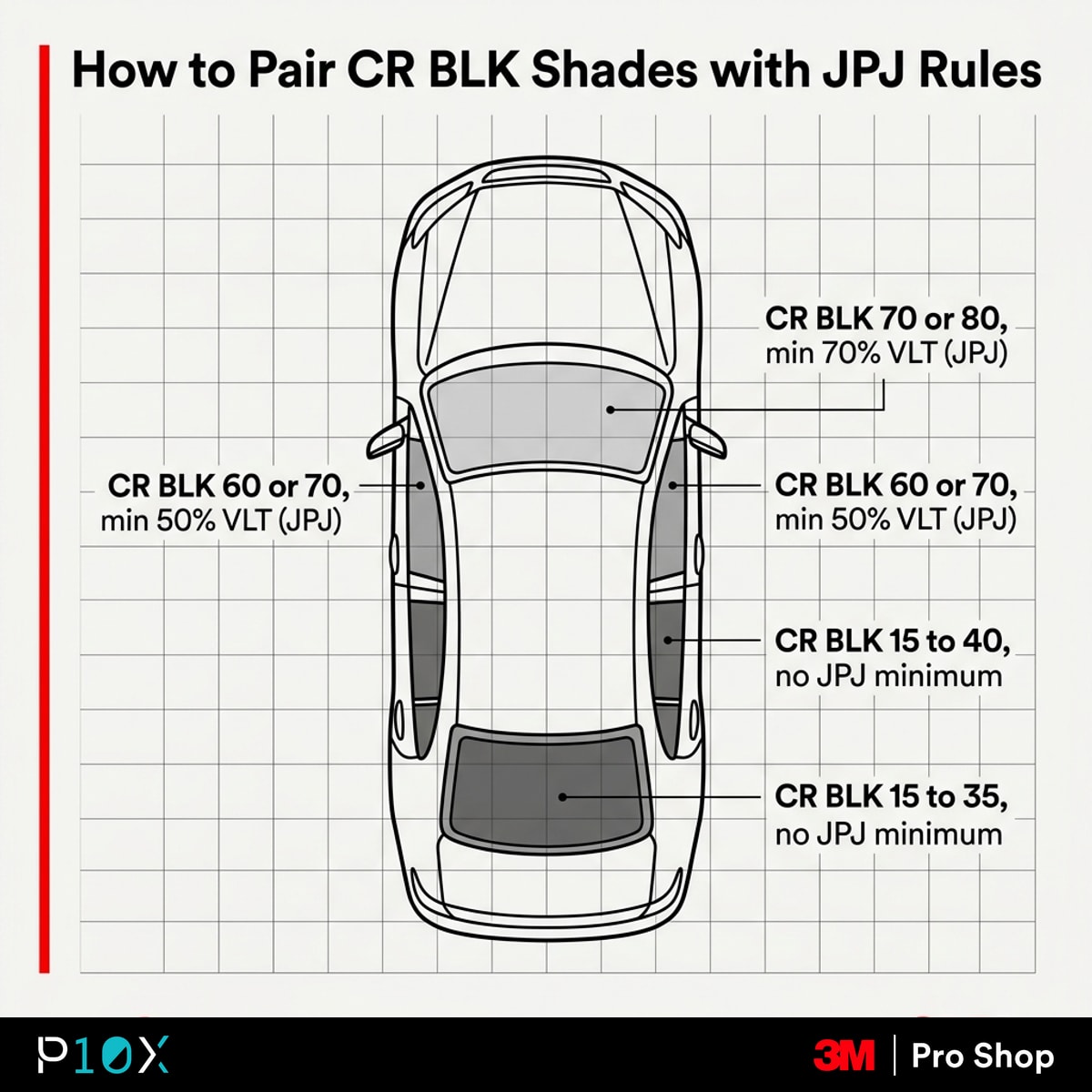
The shade naming follows VLT. CR BLK 15 is the darkest, suited for rear and rear-side glass where privacy and maximum heat rejection are wanted. CR BLK 70 and CR BLK 80 are the lightest, designed for windscreens and front side windows to comply with JPJ rules. For exact JPJ thresholds and how to pair them with shades, see this JPJ-compliant window tint guide for Malaysia.
Heat rejection by shade
| CR BLK shade | TSER | Suggested use |
|---|---|---|
| CR BLK 15 | 64% | Rear and rear-side, maximum privacy |
| CR BLK 30 | 66% | Rear and rear-side |
| CR BLK 35 | 67% | Rear and rear-side, balanced |
| CR BLK 40 | 67% | Rear, lighter look |
| CR BLK 50 | 68% | Peak heat rejection |
| CR BLK 60 | 67% | Front side, JPJ-friendly |
| CR BLK 70 | 65% | Windscreen and front side, JPJ-compliant |
| CR BLK 80 | 59% | Windscreen, near-clear look |
Peak heat rejection sits around CR BLK 50 at 68% TSER. Even at the lightest CR BLK 80, you still get 59% TSER and 99.9% UV protection.
Full-car pricing in RM
| Package size | 3M CR BLK full-car price |
|---|---|
| Standard car | RM 3,800 |
| Large car | RM 4,200 |
| X Large car | RM 4,500 |
Pricing covers the genuine CR BLK film, professional installation at a 3M Authorized Dealer, and the e-warranty record.
Limited lifetime warranty terms
CR BLK comes with a Limited Lifetime Warranty when installed by a 3M Authorized Dealer Installer. Exact local terms are confirmed by the dealer at the time of installation. The warranty only stays valid if the installer is officially authorized and the film is genuine CR BLK stock.
Authorized installation in Malaysia
The technology only delivers its full performance when the install is done correctly. 3M Pro Shop by P10X is the certified 3M reseller for Crystalline and CR BLK in Malaysia, with clean-room outlets across the Klang Valley. Every install uses genuine CR BLK stock, certified 3M Preferred Installers, and an official e-warranty record tied to your vehicle.

If you want to compare options for your own car, the practical next step is to verify the JPJ-compliant VLT for your windscreen and front windows, decide on the shade you want for the rear, and ask a 3M Authorized Dealer to walk you through the CR BLK spec sheet for that shade. A spec-based conversation, against the workshop's clean-room and warranty paperwork, will tell you more than any social-media review.
FAQs
How does 3M Crystalline window tint work?
Crystalline works through optical thin-film interference. Around 200 ultra-thin polyester layers are stacked together, each tuned to reflect a specific band of infrared light. Visible light passes through cleanly, while infrared is bounced back out of the glass. There is no metal layer doing the work, and in CR BLK a ceramic nano-tech layer is added for appearance, not for primary heat rejection.
Is 3M Crystalline metal or ceramic?
Neither, primarily. The core technology is Multilayer Optical Film, made from co-extruded optical polyester layers. In the current CR BLK Series, a ceramic nano-technology layer is added for a deeper black look. It is non-metallized either way, which is why it does not interfere with signals.
What is the difference between 3M Crystalline and Crystalline Black (CR BLK)?
Both use the same MOF platform of around 200 nano-layers. CR BLK adds ceramic nano-technology for a deeper, more uniform black tone and is the version currently sold in Malaysia. The original Crystalline Series is obsolete locally from December 2025.
Is 3M Crystalline still available in Malaysia?
Yes, but as the Crystalline Black (CR BLK) Series. The legacy Crystalline range is no longer offered. If a quote refers to legacy CR film stock, ask the dealer to confirm it is current CR BLK.
How long does 3M Crystalline tint last?
3M offers a Limited Lifetime Warranty on Crystalline and CR BLK when the film is installed by a 3M Authorized Dealer Installer. Exact local warranty wording is confirmed by the dealer at the time of installation.
Does 3M Crystalline block GPS or Touch 'n Go RFID signals?
No. Crystalline and CR BLK are non-metallized, so they do not interfere with Touch 'n Go RFID, GPS, mobile data, satellite radio, or 5G. This is one of the main practical advantages over metal-based films.
Is 3M Crystalline JPJ legal in Malaysia?
Yes, when the shade is chosen to meet JPJ rules. The windscreen must allow at least 70% visible light through and the front side windows at least 50%. The rear and rear-side windows have no JPJ minimum. CR BLK 70 or 80 for the front, paired with CR BLK 15 to 40 for the rear, is a common JPJ-compliant setup.
Is 3M Crystalline worth the price compared to Ceramic IR?
For drivers who want the highest heat rejection at the lightest possible shade, and who depend on a metal-free film for daily signal use, the price gap reflects a real technology gap. For drivers who are happy with a slightly darker film and slightly lower IR rejection, Ceramic IR remains a strong tier of the same brand.
Find out the best protection for your car
Visit a 3M Pro Shop and discover the cost-effective 3M Protective Film and Window Tint
Author

Fabian
He is passionate about revolutionizing the car protection services industry by bringing innovation and transparency to a traditionally opaque and often misunderstood field. His mission is to educate end users on the true benefits and importance of car protection, aiming to replace outdated practices with honest, customer-focused solutions. With a fresh approach to car tinting, paint protection film (PPF), and detailing services, he is committed to delivering a superior customer experience that sets a new standard in the market. He welcomes discussions about the future of the automotive industry and is eager to connect with like-minded professionals who share his vision for innovation, integrity, and excellence.
Experience the future of window tinting
Visit a 3M Pro Shop and discover the revolutionary Crystalline CR BLK film