✧ Key Takeaways
- Car glass provides some UV protection, but windscreens and side windows do not necessarily provide the same amount.
- Glass usually blocks UVB well. UVA protection varies with the glazing and any film applied to it.
- A study of 29 older cars found much more variation in side-window UVA protection than in windscreens. It does not give the specification of your car.
- Dark tint, a cool cabin and glasses that darken in sunlight do not measure the glass’s UV protection.
Car glass provides some UV protection, but a closed window does not mean every type of ultraviolet radiation is blocked equally. Windscreens commonly offer strong UVA protection, while side-window protection can vary. You need information about the actual glass and any film on it to know more.
Different types of car tint can change what passes through a window, but the existing glass matters too. When comparing 3M window film, neither the shade nor the car’s appearance tells you its UV rejection.
For someone who spends long periods driving, the useful question is not simply “does the car have UV protection?” It is which windows provide it, which kind of UV is being discussed, and what evidence supports the claim.
Glass does not block all UV equally
Ultraviolet radiation includes UVA and UVB. Both matter for sun protection, but they do not pass through every material in the same way. The Skin Cancer Foundation’s sun-protection guidance explains that ordinary glass blocks UVB well while allowing UVA to pass through. Vehicle glazing can add protection beyond that basic description.
This means “glass blocks UV” is an incomplete answer. It can be true that a window blocks much of one part of the ultraviolet spectrum while still allowing more of another part through. When someone quotes a percentage, the type of UV and the test conditions are part of what the figure means.
The Skin Cancer Foundation describes UVB as mainly associated with sunburn, while UVA contributes to skin ageing and skin-cancer risk. UVA can also cause sunburn, but not getting burnt does not prove that no UVA passed through a window. How your skin looks or feels after one journey is not a measurement of the glass’s UV rejection. It is also not a reason to dismiss medical advice or assume that a closed window provides complete sun protection.
| What you notice | What it does not establish |
| The window looks dark | Its UVA rejection percentage |
| The cabin feels cool | How much UV passes through the glass |
| You did not get sunburnt | That the glass blocked all UVA |
Visible light is a different measurement again. A clear window can provide useful UV protection without making the view dark. A dark window can reduce visible light without its appearance proving a particular UVA rating. Do not treat darkness as a protective scale that applies equally to every kind of radiation.
For a product claim, look for documentation explaining what was measured. For a personal medical concern, ask a qualified healthcare professional. A film installer can explain a film’s stated properties, but should not turn a UV figure into a diagnosis or a promise that a health condition will be prevented.
Windscreens and side windows can differ
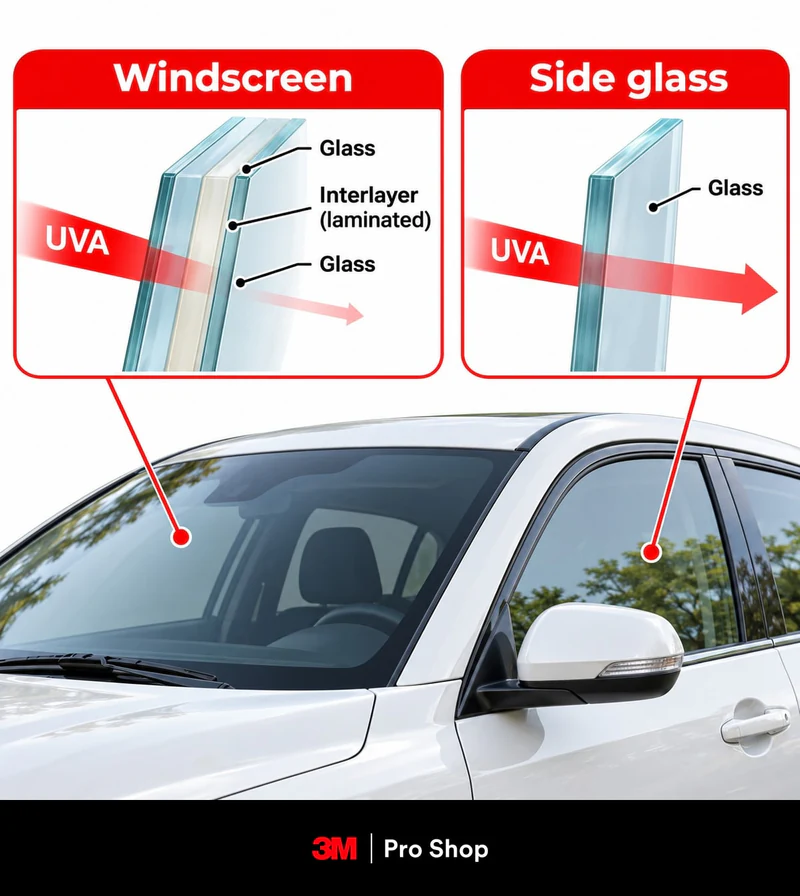
Windscreens commonly use laminated glass, with a layer between sheets of glass. That construction helps explain why the windscreen and a side window can behave differently. However, not every side window has the same construction, and you should not assume every pane in one car is identical.
The Skin Cancer Foundation says windscreens are treated to protect drivers from most UVA, while side, rear and sunroof glazing usually do not offer the same protection. That is useful general guidance. It is not a substitute for the manufacturer’s information about a particular vehicle, model year and market specification.
Some cars use laminated glazing beyond the windscreen. Other cars may have tinted or coated glass with different stated properties. A brochure mentioning privacy glass does not automatically provide a UVA-transmission figure. Ask what the vehicle manufacturer actually confirms instead of filling the gap with an assumption.
If a windscreen or side window has been replaced, the original sales brochure may no longer describe it. The replacement record can help identify its construction. That matters because a laminated windscreen and a side pane can provide different UVA protection.
What the 29-car study found
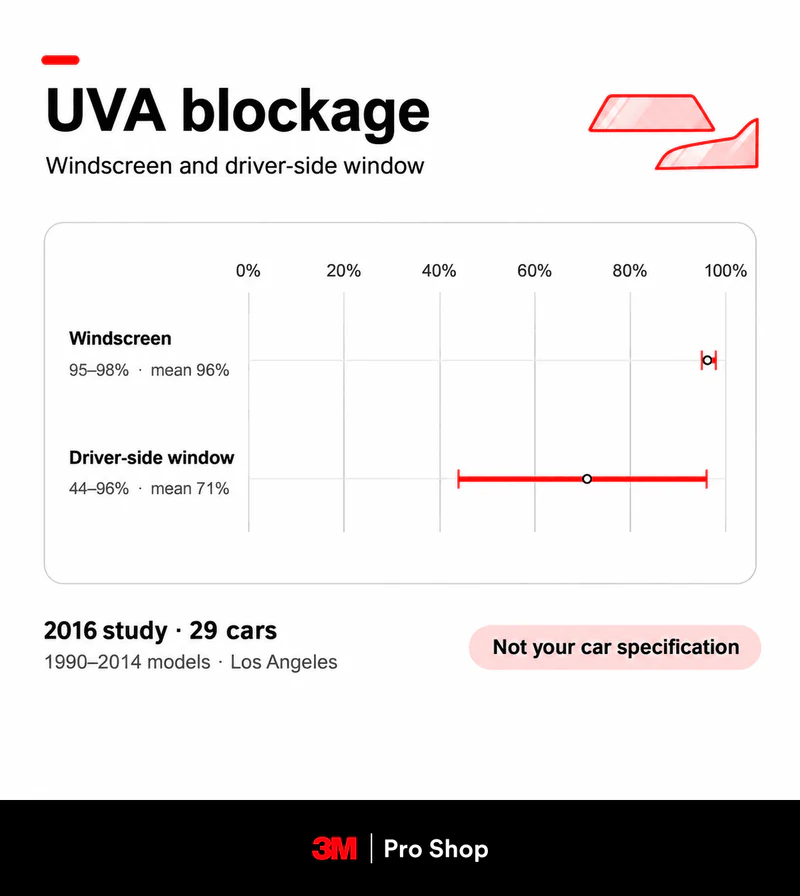
A 2016 study in JAMA Ophthalmology measured UVA protection in 29 cars from 15 manufacturers. The vehicles were from model years 1990 to 2014 and were assessed at dealerships in Los Angeles. Researchers compared UVA outside the car with readings behind the windscreen and the driver’s side window.
The average windscreen UVA blockage was 96%, with results ranging from 95% to 98%. Side-window blockage averaged 71%, with a much wider range of 44% to 96%. Only four of the 29 cars had side-window blockage above 90%.
The important finding is the variation. Windscreens in this sample consistently blocked a high proportion of UVA. Side windows were much less consistent. A side window being closed was therefore not enough to tell the researchers how much UVA protection it provided.
| Part measured | Average UVA blockage | Range in this study |
| Front windscreen | 96% | 95% to 98% |
| Driver’s side window | 71% | 44% to 96% |
These figures describe the 29 cars in the study, not every car. The two averages differ by 25 percentage points. That does not mean every side window blocks 25% less UVA than its windscreen, or tell you the health risk for an individual driver.
Why that average is not your rating
A small study can show why a question deserves attention without answering it for every modern car. These vehicles were older models tested in another country. The results cannot establish the UVA protection of a current Malaysian-market model, a particular variant or a pane that has since been replaced. A 71% study average is not your car’s UVA rating.
There is also a difference between a material measurement and a person’s total exposure. A reading through one closed pane does not account for every window, whether a window is open, where someone sits, how long they travel or their time outdoors. The study should not be stretched into a personal exposure calculator.
The reported ranges are also more informative than the averages alone. A 44% to 96% side-window range includes very different results, even though each car contributes to the same 71% average. Choosing the average as a default for an unidentified car hides that variation. It is a reason to seek information about the actual glass, not a reason to assume every side window needs the same treatment.
The finding points to a useful question: what does the manufacturer say about your car’s glass? If no figure is published, the protection remains uncertain. A precise-looking number copied from another vehicle cannot fill that gap.
Window tint can reduce UV through treated glass
An appropriate UV-protective film can reduce the ultraviolet radiation passing through the treated glazing. That is an additional material on the glass, not proof that the original glass had no protection. It is also a property to check for the exact film, rather than assume from the word “premium”.
Crystalline Black is one current 3M option, not a UV rating for every film.
Current 3M Crystalline Black product information describes high UVA and UVB rejection. For any percentage quoted, check which film and test conditions it describes. A result for film applied to test glass does not tell you how much UV your untreated factory glass blocks.
The benefits of 3M window tinting include controlling sunlight, but UV rejection is only one property to compare. The current ranges are Crystalline Black, Ceramic IR and XP. Your quote should identify the range and shade proposed for each window.
Film only affects the glazing it covers. It cannot provide the same barrier when that window is lowered, and treating one pane does not establish the protection of the remaining windows. A realistic explanation should make that limitation clear without suggesting you need every window treated regardless of the car’s existing glass.
UV rejection is not heat rejection
You can feel warm behind a window that blocks a high proportion of UV. Sunlight includes more than ultraviolet radiation, and a UV-rejection percentage does not describe the whole solar heat load. Feeling heat on an arm is therefore not a reliable way to measure how much UV passes through.
The reverse is also important. A cool-feeling cabin does not prove a particular UV rating. Shade, air conditioning and other conditions can change comfort without telling you the ultraviolet transmission of a specific pane. UV protection and comfort can both matter, but they need their own evidence.
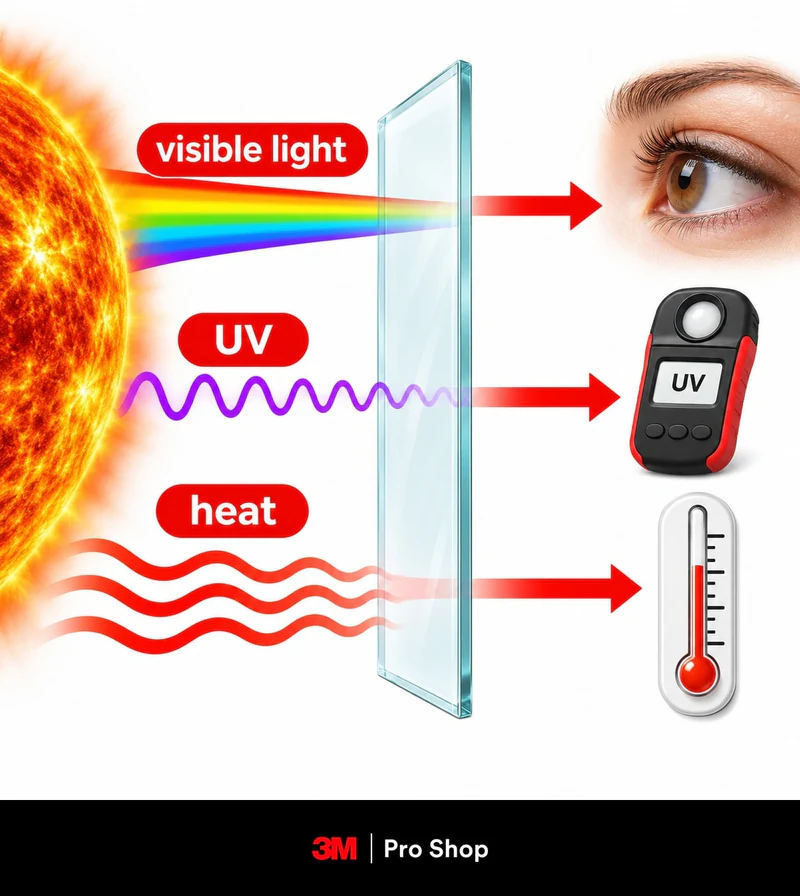
For heat control, total solar energy rejection (TSER) and infrared rejection (IRR) describe different measurements. Check which one is quoted and how it was measured. Neither figure tells you the UVA protection of the glass.
Keeping these questions separate makes a quotation easier to understand. Ask whether the film has the UV performance you need, then whether its shade and heat-related properties suit your driving. You do not need to accept a dark film solely because a salesperson has made darkness sound essential for UV protection.
Glasses that darken in sunlight are not a UV meter
Photochromic glasses are the kind that darken in sunlight. If they change inside a tinted car, it is understandable to question the film. But the change in the lenses is not a calibrated UV measurement. It does not give you a rejection percentage or tell you whether the glass, film or another condition caused it.
Do not use that observation alone to declare the tint defective. Equally, do not dismiss a concern simply because the film carries a high UV claim. Bring the product details and the observation to the installer, and ask what measurement or documentation would meaningfully address the question.
A mobile-phone camera, a hand held behind glass and the darkness of the view are also poor substitutes for appropriate testing. You can use them to describe what you notice, but not to calculate a medical risk or certify a film’s full UV performance.
Check the side windows and glass roof too
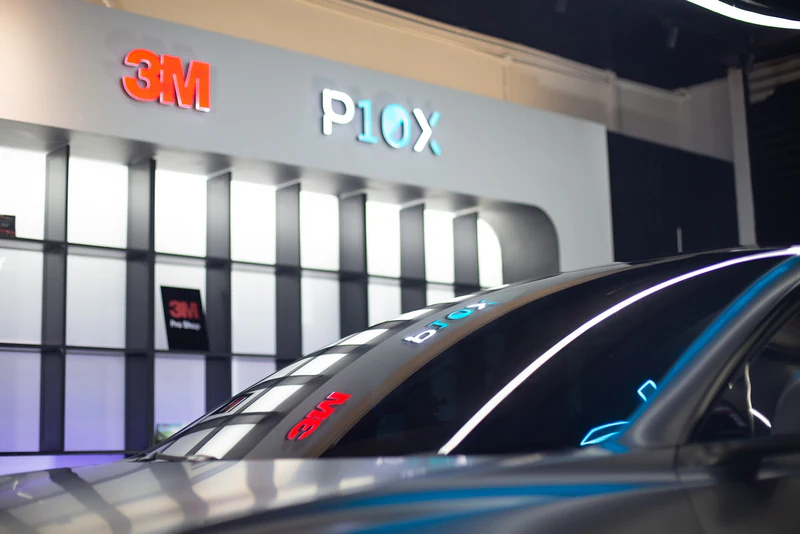
Start with the windows beside the people who use the car. For the driver, the windscreen is not the only glass that matters. For a rear passenger, the relevant side glass may be different again. A UV rating for the windscreen does not tell you how much UV the glass roof blocks.
Ask for the following information where available:
- The current glazing type and any manufacturer-stated UV properties.
- Whether an aftermarket film is already fitted.
- The exact film manufacturer, series and shade.
- The UV wavelengths and conditions covered by the stated performance.
- Which windows the proposed installation will cover.
You do not need to test the glass on every journey. Information for your car’s glass and the exact film is more useful than a general UV claim. If the car manufacturer does not publish a UV figure, an average from another vehicle cannot tell you your car’s rating.
Sun protection for children in the car involves more than choosing a film. Keep following suitable clothing, sunglasses and sunscreen advice from a recognised health authority. Window film is one part of protection, not a substitute for those measures.
Before film is fitted, have the installer check the glass for existing scratches or residue and record its condition. That inspection identifies visible issues; it does not measure UVA transmission.
What a UV meter can tell you
If you arrange a check, ask what the instrument is measuring before using the result. A meter designed for a particular wavelength range does not automatically describe the entire ultraviolet spectrum. The setup should also make clear whether it is measuring through the existing glass, film on glass or a separate sample.
A percentage needs a clear basis. “UV rejected” and “UV transmitted” describe opposite sides of the same measurement, so a small displayed number cannot be interpreted without knowing its label. Ask the person testing the glass to explain the result in ordinary words rather than rely on a photograph of the display.
| Reading label | What the number describes |
| UV transmitted | The UV passing through the tested sample within the instrument’s range |
| UV rejected | The UV kept out within the stated test conditions |
| No wavelength or sample information | An incomplete basis for interpreting the displayed number |
Precision also has limits. A reading rounded to a whole number should not become a claim that absolutely no ultraviolet radiation passes through. Keep the instrument’s scope and the product’s documented claim separate from a promise of total protection.
This is particularly important when comparing windows on the same car. A result for the windscreen cannot certify the rear side glass or roof. Record which pane was checked and what was already fitted to it. That gives you a useful answer about the tested glazing without extending it to the whole vehicle.
Choose protection without a medical promise
Car windows provide different levels of UV protection, and colour alone cannot tell you how much they block. Information about your car’s glass and the proposed film can help you decide which windows to treat and what protection to expect.
If you have a condition affected by sunlight or have been given specific medical advice, take that advice to the discussion. The film choice should fit that advice, not replace it. 3M states that its window films do not prevent skin cancer, even where a product blocks a high proportion of ultraviolet radiation.
At 3M Pro Shop by P10X, ask about the glass already in your car and the applicable information for the current 3M window-tint range. The right conversation begins with those facts, not a promise that a dark-looking car is completely protected from the sun.
Find out the best protection for your car
Visit a 3M Pro Shop and discover the cost-effective 3M Protective Film and Window Tint
Frequently Asked Questions
Do all car windows block the same amount of UV?
No. Windscreens and side windows can differ, and side-window protection can vary between vehicles. Check the specific glazing rather than assume every pane has the same rating.
Does clear glass block UV?
It can block some UV, especially UVB, without appearing dark. UVA protection depends on the glazing and any treatment or film. Clear appearance alone does not establish the percentage.
Does darker tint provide better UV protection?
Not automatically. Darkness concerns visible light. Use the exact film’s UV-performance information to assess UV rejection.
Can photochromic glasses prove tint has failed?
No. Glasses darkening inside a car do not tell you how much UV the glass and film block. The film’s documented UV performance or an appropriate measurement is needed to assess that claim.
Does strong UV rejection mean less heat?
A UV figure alone cannot answer the heat question. UV rejection, total solar energy rejection and infrared measurements describe different properties.
Does the 2016 UV study tell me my car’s protection?
No. The JAMA Ophthalmology study measured 29 cars from model years 1990 to 2014 in Los Angeles. Its averages do not give the UVA rating of a current Malaysian car.
Can window tint prevent skin cancer?
Window tint is not a guarantee against skin cancer. It can reduce UV passing through the covered glass, but it does not replace professional medical advice or other recommended sun protection.