✧ Key Takeaways
- Sputtering is a manufacturing process. Nano ceramic describes material used in a film.
- Neither label, by itself, tells you which named product rejects more solar heat.
- For a fair heat comparison, both films need similar light transmission and figures measured on the same glass using the same method.
- Check metal content and the exact equipment separately when signal compatibility matters.
Choosing between sputter and ceramic tint starts with one important distinction: sputtering describes how a thin coating is applied during manufacture, while ceramic describes a material used in the film. Neither word alone proves which product will keep you more comfortable, give you the clearer view or suit your car’s equipment.
A fair comparison of car tint types starts with the actual films. For 3M window tint, that means identifying the series and shade. The same principle applies to another maker’s product: a quote saying only “sputter” or “nano ceramic” leaves too much unanswered.
You do not need to understand a factory production line before buying tint. You do need to know what the film contains, which shade is being offered and whether its figures can be fairly compared with those in the other quote.
Sputter describes a process, ceramic a material
Sputtering is a way of putting a very thin coating onto a surface during manufacture. The word describes the process, not one universal ingredient list. The manufacturer still chooses the coating materials and the rest of the film’s construction to make a particular product.
Nano ceramic refers to the use of very small ceramic material in the film. It does not identify every layer, the complete manufacturing process or the final solar performance. Calling a product nano ceramic therefore does not tell you everything that would appear on its technical sheet.
The two labels are not a neat pair of opposites. A manufacturing process and a material description answer different questions. Some films combine several types of layers or treatments. You need the product documentation to know whether either description is complete.
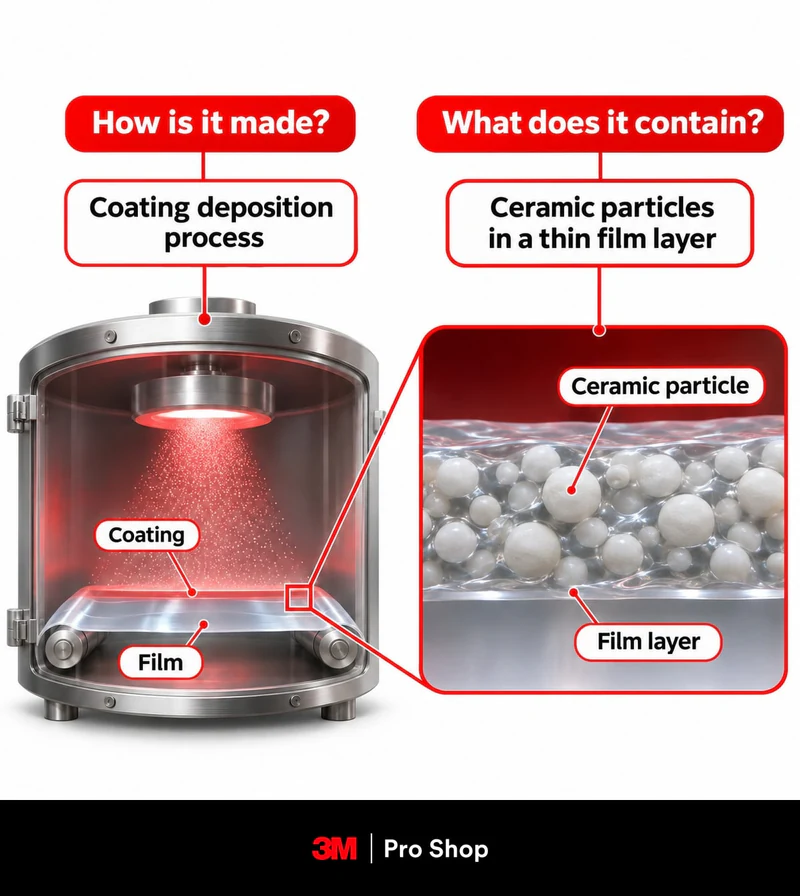
| Label on a quote | What it describes | What is still missing |
| Sputter | A coating-deposition process | The materials, finished construction and measured performance |
| Nano ceramic | A material-based description | The exact formulation, construction and measured performance |
| A named series and shade | An identifiable product | The applicable technical sheet and suitability for your glass |
A nano carbon ceramic film can combine materials too. A process such as sputtering describes how a coating is applied. A material name describes what it contains. Neither a longer label nor a simpler one tells you which finished film performs better.
Sputtering alone does not reveal the metal content
A seller may use “sputter” as shorthand for a metal-containing film, but the word itself does not tell you everything the film contains. Ask what the manufacturer says about the finished film. If the quotation relies on the manufacturing term, the seller should still be able to identify the product it refers to.
Sputtering can apply metal, alloy or oxide coatings to film bases. That describes the process’s capabilities, not the construction of an unnamed car tint. Some automotive films combine ceramic coatings with other treatments or deposited metals. This does not mean every ceramic film contains metal. The product’s full construction, rather than the process name, answers that question.
For your decision, the useful question is whether the specific product contains a metal layer and what the manufacturer confirms about compatibility. “Made by an advanced process” is not an answer to that question. Neither is a photograph of a shiny sample.
Both a correctly identified sputtered-metal film and a ceramic film can be genuine products. Construction tells you what a film contains, not whether it is fake. Suitability needs to be assessed for the actual product and car.
Match the visible-light level first
Visible light transmittance, or VLT, is the proportion of visible light that passes through the tested material. A higher VLT means a lighter result under those conditions. Before comparing heat figures, check whether the two films give you a reasonably similar level of visible light.
A very dark sample beside a much lighter sample does not isolate the effect of construction. You are changing the shade as well as the technology. If the darker film has a different heat figure, the result does not automatically show that its manufacturing method is better.
Ask which shade is actually proposed for each window. A series-wide maximum may describe a shade you are not buying. It is more useful to see the relevant row in a technical sheet than the largest number printed across the top of a brochure.
Film-only VLT and VLT measured through film on glass are different measurements. Your car’s existing glass affects the finished result, so a film code cannot guarantee the same reading on every vehicle.
| Figure on the sheet | What it describes | What to check |
| Film-only VLT | Light passing through the film alone | Not a reading for the finished car window |
| Film-on-glass VLT | Light passing through film applied to the stated test glass | Whether the glass matches the other test |
| A series maximum | The highest stated figure in that range | Whether it applies to the shade being quoted |
A comparison at a similar VLT is not the entire buying decision, but it removes an obvious source of confusion. You can then ask what each named product does at a light level you would genuinely consider using.
Read the heat figures properly
Total solar energy rejection, or TSER, describes the percentage of total solar energy rejected by the tested glazing. It is a useful starting point when comparing solar performance. The glass, film shade and test method still need to match closely enough for the figures to mean what you think they mean.
Infrared rejection, often shown as IRR, covers a specified part of the infrared spectrum. Different measurement ranges and methods can produce figures that should not be ranked as if they came from the same test. A large IRR percentage is not a complete description of all solar heat entering through the glass.
IRR and infrared energy rejection (IRER) are not interchangeable. In 3M’s documentation, IRER covers a broader infrared range and accounts for energy absorbed and reradiated through the glass. Check the column heading and measurement conditions before comparing percentages.
A fair comparison should make these points visible:
- The exact series and shade for both films.
- Whether the figures use the same kind of test glass.
- Whether visible-light transmission is similar.
- The name and wavelength range of each infrared measurement.
- Whether the data describe film alone or film applied to glass.
Where a sheet has several infrared columns, write the full measurement name beside the number you are comparing. Dropping that heading when transferring figures to a quotation can hide the difference between IRR and IRER.
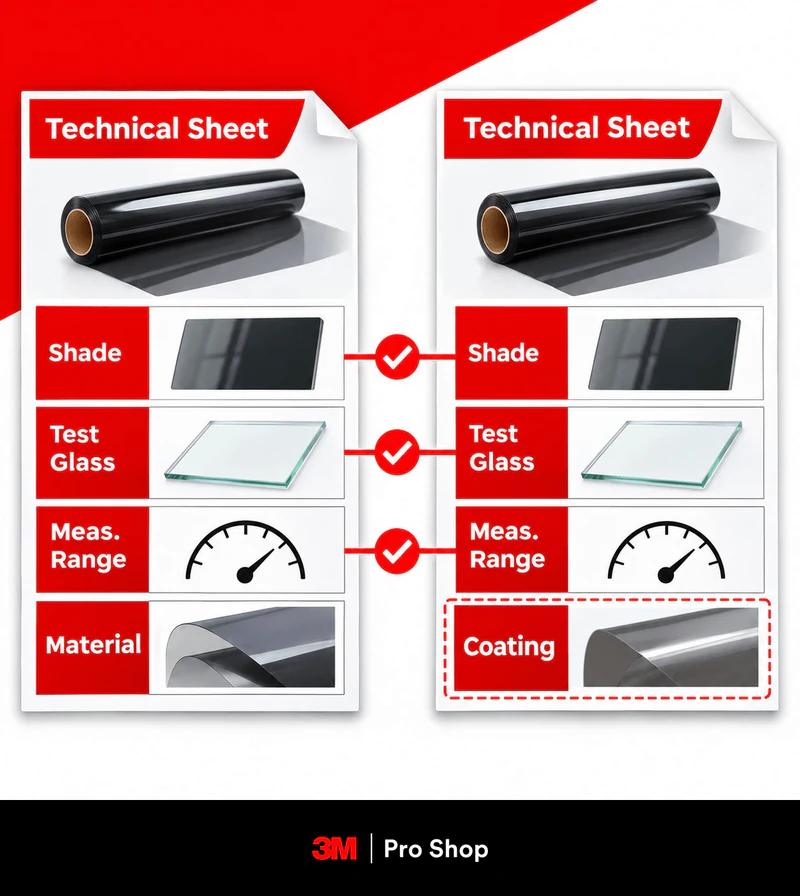
Without those details, the heat figures cannot be compared fairly. You can still assess the samples and installation work, but unmatched percentages do not show which film rejects more heat.
A heat lamp answers a narrower question
A heat-lamp demonstration can show how the selected samples behave under that lamp in that setup. It can be useful to feel a difference. However, the lamp, distance, sample glass, exposure time and measurement method all affect what is being demonstrated.
Ask what the test is intended to show and which published figure supports it. If someone says it proves every sputter film is better than every ceramic film, the conclusion goes beyond what two samples under a lamp can establish. The same caution applies when the category names are reversed.
A lamp demonstration does not tell you how much cooler your cabin will be, which air-conditioning setting you will need or how much EV range you might gain. Those outcomes need their own measurements. For the films on your quotes, the specifications give you a firmer basis for comparison than an unsupported saving.
Check metal content and signals separately
Metal-containing film can affect some radio signals, but this is not a reason to assume every sputtered product disables the car’s equipment. The construction, device, antenna location and conditions matter. Equally, the word ceramic should not be treated as a guarantee that every system will work in every installation.
A pre-installation glass and switch inspection can record existing damage and identify parts that need protection from water during fitting. It is not a test of radio reception.
With metallic window tint, compatibility depends on the actual film and equipment, not just the category name. Ask what the manufacturer confirms for the product being quoted and the devices you rely on.
Be specific about the function. A film’s radio-compatibility statement does not replace the vehicle manufacturer’s fitting instructions for cameras, sensors or displays.
- A phone connection needs to be checked as a phone connection.
- A navigation receiver needs its own reception check.
- A windscreen camera needs a suitable view through the glass as well.
If equipment is already behaving poorly, have it checked before assuming new film will fix it. If you are choosing film before installation, describe your equipment in advance. That gives the installer an opportunity to assess the actual configuration rather than make a blanket promise based on the material name.
Visibility is more than a ceramic label
A ceramic film does not automatically make every dark shade suitable for driving at night. A sputtered construction does not automatically make every sample too reflective. What you see depends on the exact film, its shade, the existing glass and the lighting conditions.
View a relevant sample through glass rather than judge only a loose piece held against a bright light. Ask about reflections from inside as well as appearance from outside. Your view of dim surroundings matters more than whether the sample looks impressive in a brightly lit showroom.
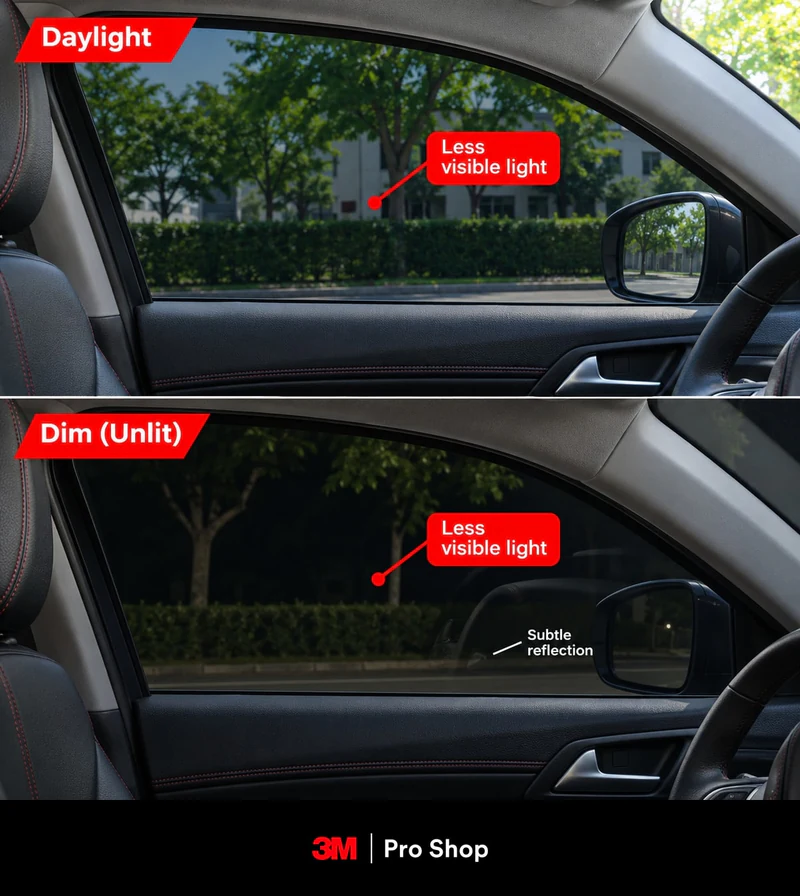
Do not confuse reducing daytime glare with improving all night-time visibility. Less visible light passing through can also make a dark scene harder to see. A salesperson should explain that trade-off instead of suggesting one material removes it completely.
JPJ compliance needs to be checked on the finished glass against the requirements for your vehicle. A technology label, a familiar shade number or a suitable result on another car does not prove compliance on yours.
Where current 3M films fit
3M Crystalline Black, identified as CR BLK, is a non-metallised multilayer optical film with ceramic nanotechnology. It is not a sputtered-metal film. Its construction is a useful reminder that “metal versus ceramic” does not include every way of making a solar-control film.
Ceramic IR is a metal-free nano-ceramic range. XP is another current nano-ceramic range in Malaysia. Each has its own shades and specifications, so neither name represents the performance of all ceramic films.
When comparing Crystalline Black with Ceramic IR, use the figures for shades you would fit. That gives you a choice between identifiable products, rather than a claim that one technology word wins every comparison.
If the figures describe different shades or test glass, they cannot tell you which range rejects more heat. You can still compare how the samples look and check each film’s construction, but a heat comparison needs data measured on the same basis.
Make sure the sheet describes car film
A search for sputtered or ceramic window film can bring up building products as well as automotive film. The construction vocabulary may look familiar, but that does not make a film intended for an office window an appropriate recommendation for a car.
| Document | What it can help establish |
| General coating-process brochure | What a manufacturing process can do |
| Automotive product sheet | The stated properties of the named car film |
| Current local range information | Whether that exact product is offered in this market |
Eastman’s industrial Flexvue sputter-coating brochure lists aluminium and silver under metals, stainless steel under alloys, and tin oxide under oxides. Those are examples of what the process can apply, not a claim that any of those materials is in the tint on your quote. The brochure also covers uses outside cars, including displays and medical sensors. It helps explain the word “sputter”, but it cannot identify an unnamed automotive film. For that, the seller needs the finished product’s construction information, not a list of factory capabilities.
Use the documentation for the actual automotive product being quoted. A manufacturer’s general explanation can help define sputtering, but it does not establish the performance, fitting requirements or suitability of every film made with that process. Keep a process reference separate from the product sheet used for the buying decision.
Check the market and document version as well. A familiar series name in an old brochure or a foreign-market range does not prove that the same product is the current local offer. The film code on the quotation should connect to the applicable information, not merely to a document with a similar heading.
If the documents do not line up, ask the seller to resolve the mismatch before installation. That is a more useful response than choosing whichever sheet has the strongest headline. It also avoids carrying building-glass assumptions, another market’s legal rules or an obsolete product recommendation into your car’s comparison.
Compare two products, not two slogans
Before agreeing to an installation, you should be able to name both films and explain why the proposed shade suits each window. You should also know which figures are comparable and which equipment requirements need checking. If the quotation still contains only a technology label, request a more specific description.
Keep the purchase record consistent with that description. A product code discussed at the counter is less useful if the final record names only a broad shop package. Clear identification helps with later care, product questions and any discussion about what was installed.
At 3M Pro Shop by P10X, use the current 3M window-tint options to identify a real product for comparison. Your choice depends on those products and your car’s needs, not a universal claim that sputter or ceramic is better.
Find out the best protection for your car
Visit a 3M Pro Shop and discover the cost-effective 3M Protective Film and Window Tint
Frequently Asked Questions
Is sputter tint always metallic?
The process name alone does not tell you everything the film contains. Ask what was deposited and check the finished product’s manufacturer information, rather than assume every film uses the same materials.
Is nano ceramic a manufacturing process?
No. Nano ceramic describes material used in a film, not a way of making it. It does not identify every production step or every layer in the finished film.
Does higher IRR prove better heat rejection?
Not by itself. Check the wavelength range, test glass, shade and whether the figure measures film alone. Use matching measurements when comparing products.
Can sputtered tint affect GPS reception?
A metal-containing construction can affect some signals, but the product and device matter. Do not make a universal diagnosis from the manufacturing label alone.
Is Crystalline Black a sputtered-metal film?
No. Current 3M product information describes CR BLK as non-metallised multilayer optical film with ceramic nanotechnology.
Does ceramic tint guarantee good night visibility?
No. Shade, glass, reflections and lighting still matter. Check the relevant sample and finished-glass suitability rather than rely only on the ceramic label.