✧ Key Takeaways
- Nano carbon ceramic can describe a genuine hybrid construction. The label alone does not prove a film is fake or superior.
- “Nano” does not provide a heat-rejection rating or identify the exact product.
- Ask for the manufacturer, series and shade before comparing technical sheets.
- Check how much heat and UV each film rejects, how well you can see through it and whether it suits your car’s equipment.
A film sold as nano carbon ceramic tint is not automatically fake or better than a nano-ceramic alternative. Carbon and ceramic can be used together. To compare the films fairly, you still need to know which products are being offered, what they contain and how their performance was measured.
Comparing types of car tint starts with the manufacturer, series and shade. With 3M window tint, for example, Ceramic IR and XP are specific ranges, not a general name for every ceramic film. The same product detail is needed for a hybrid quote.
If one quote says “nano carbon ceramic” and another says “nano ceramic”, do not decide that one must be the genuine version and the other a substitute. First find out whether the two quotes identify real, documented products that can be fairly compared.
Carbon and ceramic can share a film
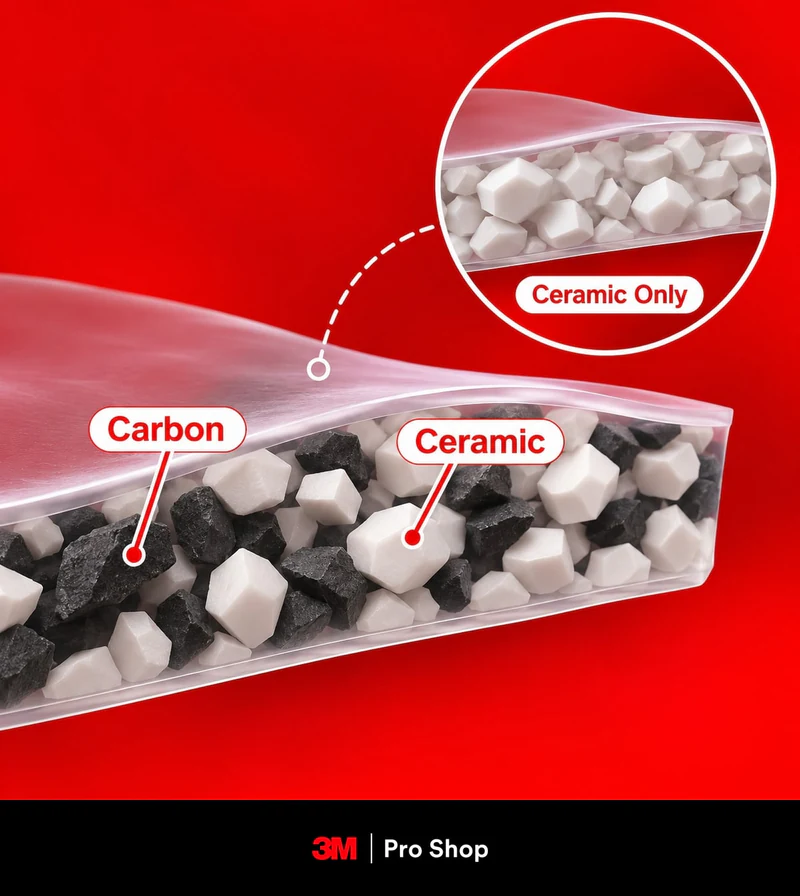
Carbon and ceramic are materials that can be used together in a film. A carbon-ceramic hybrid is therefore possible. That does not mean every seller using the phrase offers the same formulation, or that every hybrid will reject the same amount of solar heat.
A long label can still leave important questions unanswered. It does not tell you how much of each material is used, how the film is arranged, which shade is proposed or how the finished film performs on glass. Those details belong to the particular product, not the category name.
Nor does a short label necessarily leave something important out. A manufacturer may describe its product more simply while providing a clear technical sheet. More words on the quotation do not mean more useful evidence. The quality of the product information matters more than how technical the package sounds.
Calling one film “real nano ceramic” does not prove that a hybrid is fake. That claim needs evidence about the specific product. Naming both films and checking their product information gives you a fairer comparison.
Sputter versus ceramic tint needs a different distinction: sputtering is a process, while carbon and ceramic are materials. Carbon and ceramic can be used together in a hybrid, so the names do not form a simple scale from basic to best.
What the word nano leaves unanswered
“Nano” refers to a very small scale. On a quotation, it is not a unit of heat rejection, a visibility rating or proof of a complete manufacturing specification. You cannot read the word and work out how much total solar energy that particular film rejects.
The National Nanotechnology Coordination Office defines nanotechnology as working with matter at roughly 1 to 100 nanometres. A nanometre is one-billionth of a metre. That explains the scale behind the word, but it is not a measurement of the complete window film’s thickness.
Materials can behave differently at that scale, including in how they interact with light. That is why nanoscale technology can be useful, not a reason to treat it as empty marketing. It still takes product-specific testing to establish the finished film’s heat rejection or light transmission. A definition of nanotechnology cannot establish the particle size, coating thickness or measured performance of a product on your quote. Those details need evidence for that product.
The same word can appear in descriptions of products with different constructions and different measured properties. It does not make them interchangeable. If the salesperson relies on “nano” as the whole explanation, ask for the product’s actual solar and visible-light information.
A genuine film can still have a shade or heat rejection that does not suit your windows. A technical-sounding name does not resolve that choice.
Without product information for the exact series and shade, you cannot compare its performance fairly. That gap does not prove the film is counterfeit.
Identify the film before comparing it
Ask for the manufacturer, full series name and shade code. “Premium ceramic package” or “nano carbon upgrade” may be a shop’s sales description rather than the identity of the film. You need a name that can be matched to a manufacturer’s document.
Then ask whether the same film is proposed for every pane. Different windows may receive different shades or products. A quotation should make that clear rather than leave you assuming the headline product covers the whole car. This is especially important if the windscreen and side-window recommendations differ.
Useful identification details include:
- The manufacturer and full product-series name.
- The specific shade proposed for each window.
- The technical sheet that applies to those products.
- The product description that will appear on the installation record.
- The applicable local care and product terms.
These details identify what the shop is offering, but do not by themselves prove authenticity. A packaging mark or QR code is only useful if it is part of that manufacturer’s verification process. Check the manufacturer’s own instructions rather than assume one marking system applies to every genuine film.
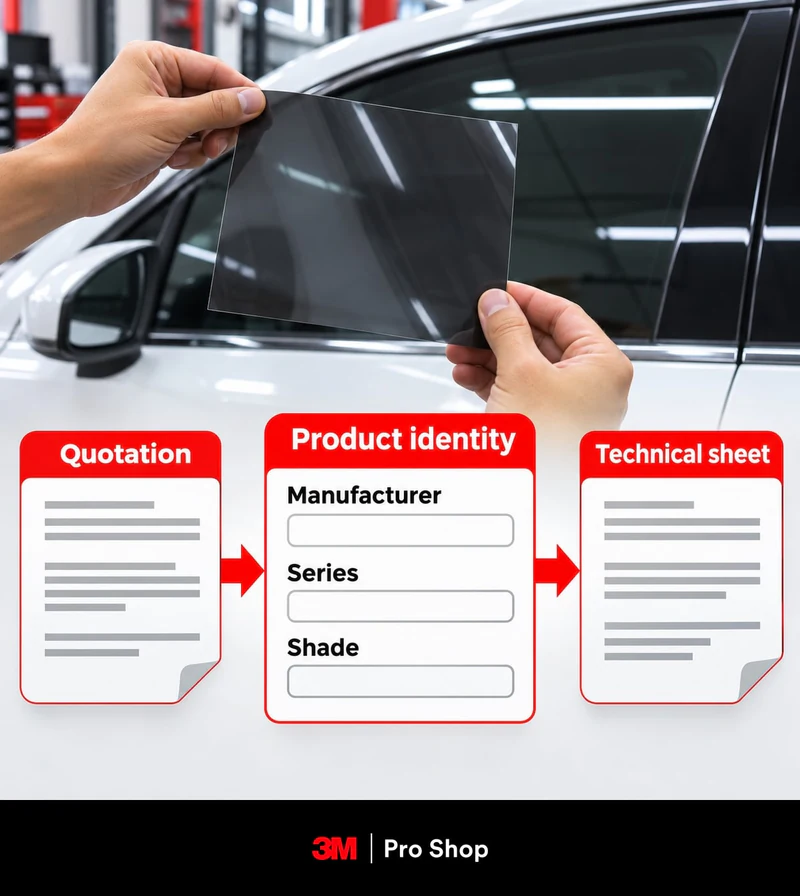
If the shop cannot name the film beyond the hybrid label, you cannot make a meaningful product-to-product comparison yet. Ask for a clearer quote before making the decision. A discount, a confident explanation or an impressive sample display does not supply the missing identity.
Compare the shade you would actually use
Visible light transmittance, or VLT, tells you how much visible light passes through the tested material. A higher percentage means a lighter result under those conditions. Before comparing heat claims, check that you are looking at reasonably similar visible-light levels.
Otherwise, a comparison may be changing both the material and the darkness at once. A dark hybrid film beside a much lighter ceramic film does not show what the materials alone contribute. It also does not tell you which is the more suitable shade for your windscreen or side glass.
Read the relevant row in each technical sheet, not only the series-wide headline. A large maximum can belong to a different shade from the one on your quotation. You are choosing the installed product, not buying the largest number available somewhere in the range.
Film-only VLT measures light passing through the film alone, not through your finished window. Your original glass affects the reading after fitting. The installer needs to assess the proposed film with the glass already in your car.
Meeting the legal limit does not tell you whether a shade suits your night driving. A sample can help you judge the view and reflections, but a material label cannot make a dim scene easier to see.
Heat numbers need matching conditions
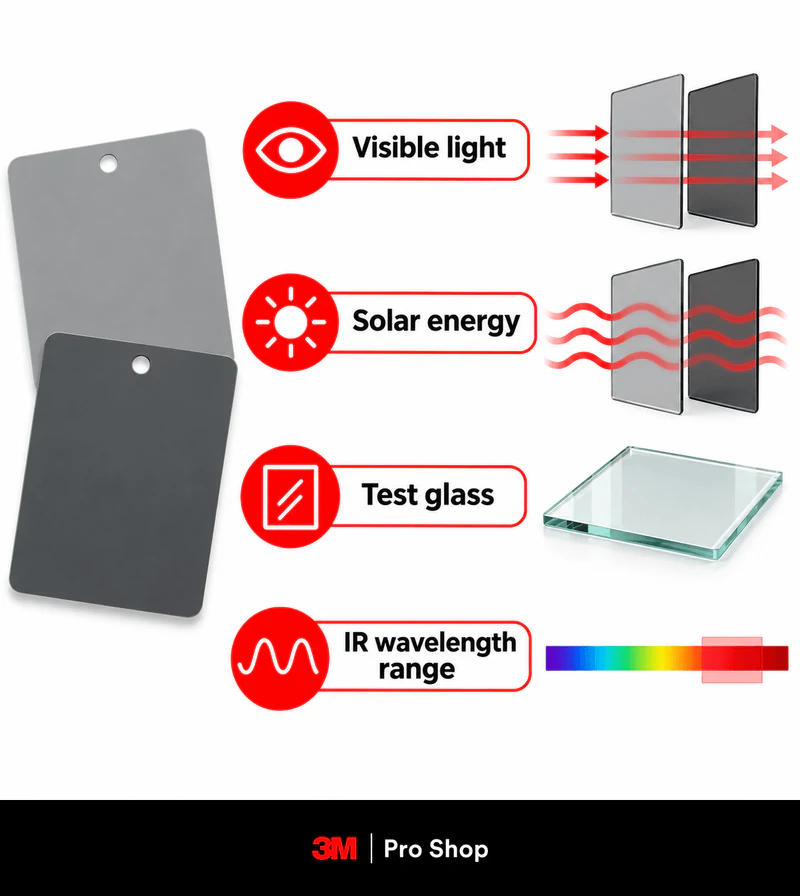
Total solar energy rejection, or TSER, describes how much total solar energy the tested glass-and-film combination rejects. It can help you compare heat rejection, but only when the figures use comparable shades, glass and test methods. Otherwise, the difference may come from the test conditions as well as the film.
Infrared rejection, or IRR, covers a stated wavelength range. One film’s percentage can be measured differently from another’s, so the bigger number is not automatically a fair winner. You need to know whether the figures describe the same part of the spectrum and the same type of sample.
Infrared energy rejection, or IRER, is a different measurement from IRR. In 3M’s technical information, IRER covers a wider infrared range and accounts for energy absorbed and reradiated through the glazing. Comparing IRER for one film with IRR for another does not show which film rejects more heat.
A fair TSER or IRR comparison uses matching measurements. Line up the shade, test glass and wavelength range on both sheets. If one infrared percentage has no explanation of how it was measured, it cannot establish which film rejects more heat.
| Question | Useful evidence | What is not enough |
| Which product rejects more solar energy? | Comparable TSER data at relevant shades | A longer material label |
| Which gives the lighter view? | Applicable VLT data and a relevant glass sample | “HD” or “clear vision” wording |
| What is its UV performance? | The product’s stated UV measurement | How dark it looks |
| Will it suit particular equipment? | Product and device-specific compatibility information | “Ceramic means everything works” |
Do not judge by a lamp alone
A shop demonstration can be useful when its limits are explained. You can see a sample, compare the view and feel how it behaves under the lamp being used. Those observations can help you ask better questions, but they do not replace a technical sheet.
For a heat demonstration, the lamp, distance, glass, exposure and measuring method all matter. A reading from that setup should not be presented as the exact temperature saving in your car. It also cannot prove that every hybrid beats every ceramic film, or the reverse.
The same limit applies to an ultraviolet meter. Ask which wavelengths it measures and what the displayed number represents. A single reading should not be stretched into evidence for every UVA and UVB claim. Glasses that darken in sunlight and a phone camera cannot measure the film’s UV rejection.
Claims about fading need specific evidence
A label alone does not establish how every film in that category will look after years of use. Claims such as “all carbon lasts longer” or “all ceramic changes colour” are too broad without product-specific evidence. A manufacturer’s claim about its own formulation should not be converted into a universal fact about its competitors.
Keep product characteristics separate from warranty promises. A statement about colour stability or resistance to a condition does not automatically mean that condition is covered. Read the applicable written local terms rather than assume the material name determines what support you will receive.
Before fitting a replacement, ask the installer to record the glass condition and any existing marks. That inspection is separate from proving why the old film changed colour.
| Claim being discussed | Evidence needed | What not to infer |
| Colour stability | Information for the exact product | All films in that material category age identically |
| Warranty coverage | The applicable written local terms | A durability claim automatically means coverage |
| A report of colour change | Identify the film and inspect the change | A controlled result for every hybrid film |
For the same reason, do not treat one owner’s experience with one unidentified film as a controlled category comparison. It may describe a genuine concern worth investigating, but it cannot establish the construction or long-term behaviour of every hybrid product sold in Malaysia.
If you are replacing an existing film because its appearance has changed, identify the current film and have the glass inspected. Do not let an unexplained fault turn the next purchase into a contest between two vague labels. Clear identification is useful both before the installation and later if a product question arises.
Where the current 3M range fits
Both XP and Ceramic IR use nano-ceramic technology, but they are separate product ranges with their own shades and specifications. Their figures need to be compared at the shades you would use, rather than treated as a single result for all ceramic film.
Crystalline Black differs from Ceramic IR in its construction. CR BLK uses non-metallised multilayer optical film with ceramic nanotechnology. That is more specific than calling it simply nano ceramic and does not establish how every other hybrid performs.
With two identified films, you can compare how much solar energy they reject at useful shades, how well you can see through them and whether they suit your equipment. Those answers are more useful than deciding whether one label must be the “real” version.
Does the report cover your film?
A test report can be useful, but first check what it tested. A document supporting one solar measurement does not necessarily verify every construction, durability or compatibility claim made at the counter. Read the product identity and the actual property being reported.
The same applies to the specimen. A report for a different series or shade may explain a manufacturer’s technology, but it does not automatically provide the figures for your proposed installation. Ask the shop to show how the named test product connects to the film on the quotation.
| Report detail | Question to resolve |
| Series and shade | Is it the film being quoted? |
| Reported property | Does it test the claim being made? |
| Glass and method | Can the result be compared with the other film? |
Check who the report names as the manufacturer as well as the film name. A shop may use its own package label, while the laboratory document identifies a different name or product code. Ask the seller to explain that connection. Similar-sounding names are not enough to show that the tested sample is the product being fitted.
A certificate is not a reason to ignore missing context. The glass, method and measurement range still matter when comparing its result with another sheet. Nor should a broad certification claim be turned into a guarantee that the film will produce a particular cabin temperature in every car.
Get the film name before accepting the quote
If the quotation still says only “nano carbon ceramic”, ask the shop to write down exactly what will be installed. You should not have to infer the manufacturer from the package name or guess which technical sheet applies. Clear identification is a reasonable part of choosing a product.
Once the products are identified, compare the relevant evidence and samples. If the data use different conditions, keep that limitation visible. You do not need to force a winner before the comparison is fair, and you do not need to call one product fake to explain why another is better documented.
At 3M Pro Shop by P10X, the current 3M window-tint range gives you named products to discuss. Start with the exact series, shade and your car’s glass, then choose on that basis rather than the number of technology words on a quotation.
Find out the best protection for your car
Visit a 3M Pro Shop and discover the cost-effective 3M Protective Film and Window Tint
Frequently Asked Questions
Is nano carbon ceramic tint fake?
Not automatically. Carbon and ceramic can be used together in a genuine product. Establish the manufacturer and exact product before making an authenticity claim.
Does nano guarantee stronger heat rejection?
No. The word is not a heat-performance rating. Compare the relevant measurements for the actual series and shade.
Can carbon and ceramic share one film?
Yes. A hybrid construction can use both. That does not mean every product carrying the hybrid label has the same formulation or performance.
How should I compare different IRR figures?
Check the wavelength range, shade, test glass and sample conditions. Do not assume the larger number wins if the measurements differ.
Is Crystalline Black simply nano-ceramic tint?
3M Crystalline Black uses non-metallised multilayer optical film with ceramic nanotechnology. Calling it only nano ceramic leaves out that layered construction. The label does not make it identical to other films described as ceramic.
What if the shop cannot name the film?
Ask for the manufacturer, series, shade and applicable technical sheet before deciding. Without knowing which film is being offered, you cannot compare it fairly with another product.