✧ Key Takeaways
- Metallic tint contains a metal layer that can affect some radio signals. It does not cause every reception problem.
- Darkness, a shiny surface and heat-rejection figures do not reliably identify the film’s construction.
- GPS reception, mobile reception and a camera’s view through the glass are different things to check.
- Identify the exact film and device before deciding to replace otherwise usable tint.
Metallic window tint can affect some signals reaching equipment inside your car, but weak reception alone does not prove the tint is at fault. The useful first step is to identify the film and the device that is struggling, rather than assume every dark window needs a different film.
Unlike metallic tint, current 3M window films include non-metallised constructions. Metal content is one difference between tint types, but keeping sunlight out and receiving a radio signal are separate questions.
If your reception changed after tinting, keep a note of what changed and where it happens. A clear description gives the installer or device technician something useful to investigate before anybody recommends removal.
What makes a tint metallic?
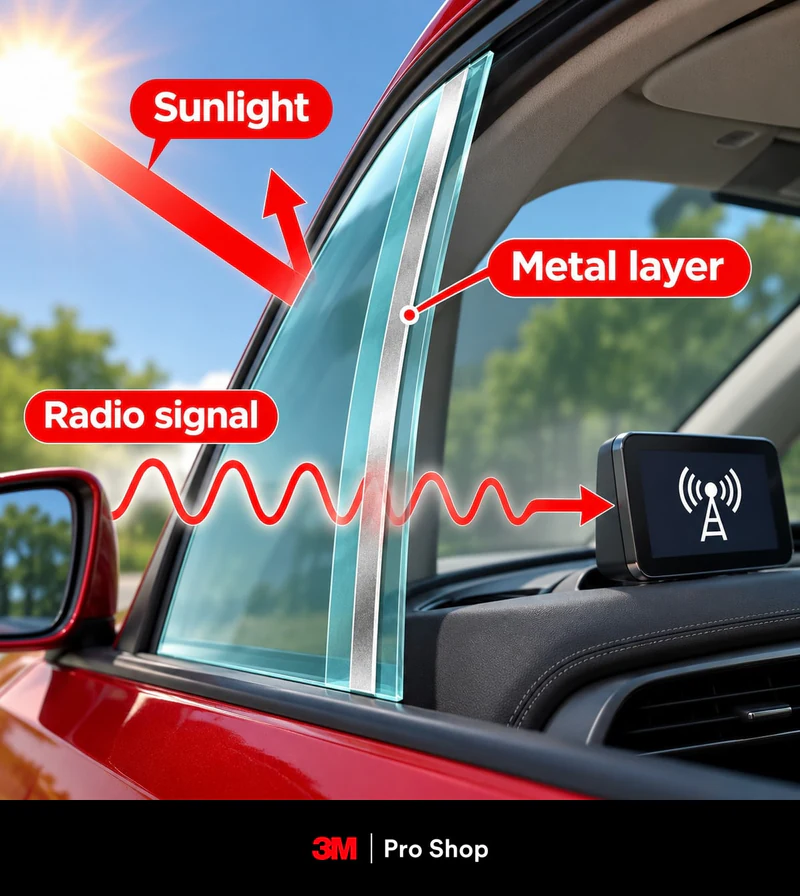
Metallic, or metallised, tint contains a thin metal layer that helps the product control sunlight. A shiny sample or a metallic colour name does not confirm that a film contains metal. For that, you need the manufacturer’s description of the film’s construction.
Sputtering and ceramic tint describe different things: sputtering is a way of depositing thin coatings during manufacture, while ceramic describes a material. For the signal question, what matters is what the finished film contains, not which manufacturing word appears on the quotation.
Metal content does not tell you whether a film is genuine or well made. A metallic product can be a suitable choice, while a ceramic label alone proves neither authenticity nor suitability. The manufacturer’s information needs to describe the product being offered and the equipment it will be used with.
| Description | What it tells you |
| Metallic | The film contains a metal layer |
| Sputtered | A coating was applied using a particular process |
| Ceramic | Ceramic material is used in the film |
| Genuine | Whether the film is authentic, not what material it uses |
There is also a difference between film applied later and a coating already built into the vehicle’s glass. If you do not know what was fitted before delivery, ask for the installation record. A visible film edge may suggest an applied film is present, but it does not reveal every layer inside it.
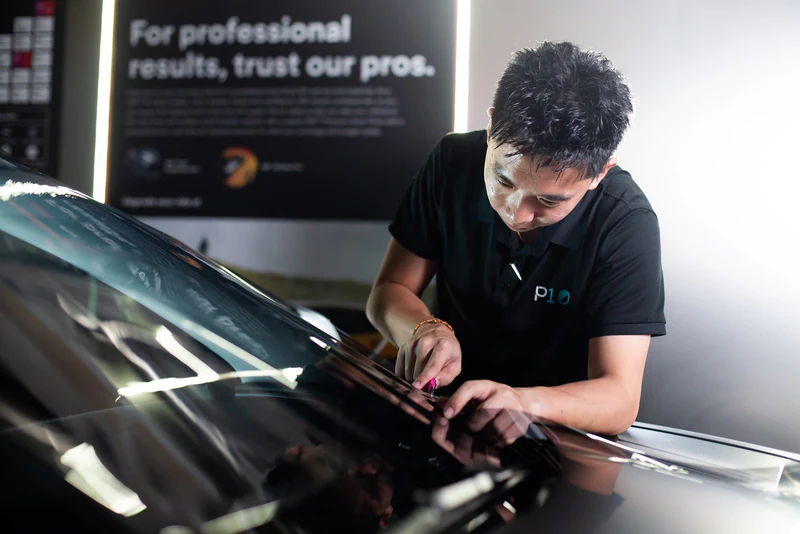
Removing an added film does not remove a coating built into the glass. If the vehicle specification mentions coated glazing, the device manufacturer’s instructions for that glass may help the installer assess it before recommending a film change. Reception can remain poor if the material affecting the signal is still in place.
Why metal can affect reception
A radio receiver needs enough of the relevant signal to reach its antenna. Garmin’s automotive GPS troubleshooting guidance identifies metal-containing windscreens and protective coatings as possible causes of poor satellite acquisition. Its DriveAssist 51 manual separately warns that heated, metallised windscreens can reduce traffic-receiver performance. These examples concern specific receivers and glass constructions. Check the device, glass and film combination before attributing a reception fault to aftermarket tint.
The result depends on the film, the frequency being used, where the antenna sits and the conditions around the car. A device receiving signals through treated glass is not in the same position as equipment using an antenna outside the cabin. This is why one owner’s experience cannot settle the question for a different car and installation.
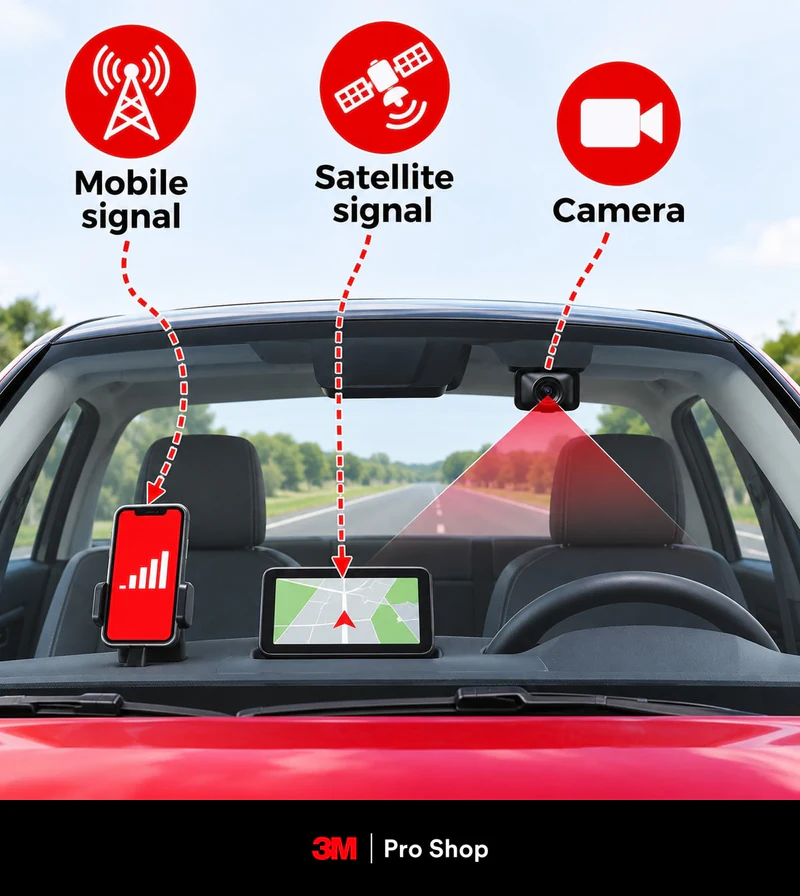
It is also why “my phone still works” is not a complete test of the whole car. Mobile reception and satellite positioning are different systems. A working phone call does not establish that a separate navigation receiver is getting the signal it needs. The opposite is also true: a navigation fault does not automatically mean mobile reception has been affected.
A key remote, an in-car navigation receiver and a windscreen camera do not all work in the same way. A camera needs a suitable view through the glass, while a radio receiver needs enough of its signal to reach the antenna. Sunlight control is a separate measurement again.
When does reception become unreliable?
A problem that starts after installation deserves attention, but timing alone is not a diagnosis. Begin by describing the symptom accurately. Is the phone losing its mobile connection, is the navigation position drifting, or is a separate device failing to respond? “Signal is bad” can mean several different things to the person trying to help.
Then note the circumstances while the car is safely parked. Does the problem happen only in a basement, near tall buildings, or in one particular location? Is the same device unreliable elsewhere? A problem that happens only in one place needs different checks from one that happens wherever you take the car.
Useful information to bring to the installer includes:
- The film’s manufacturer, series and shade, if known.
- The affected device and whether it is built into the car or fitted later.
- Whether the behaviour existed before installation.
- Where the device or its antenna is positioned.
- The places and conditions in which the fault repeats.
Keep these observations separate from conclusions. “The position marker drifts in this location” is useful information. “All ceramic films solve GPS problems” is an unsupported leap. Do not operate a phone or test equipment while driving. Have the installer or an appropriate technician carry out any controlled checks.
If more than one function seems affected, record them separately. A navigation app can show a position marker and also download map information. Describe whether the marker moves incorrectly, the map fails to load, or both. That description does not diagnose the fault, but it avoids treating two different symptoms as one reception problem.
A technician may need to compare several conditions before finding the cause. Other possibilities include the device itself, its installation, the vehicle’s original glazing or poor reception at that location. Naming those possibilities is not dismissing your complaint. It helps avoid replacing a film and discovering that the original problem remains.
Darkness does not reveal metal content
A dark-looking window is not necessarily metallic. Darkness describes how much visible light gets through, while metal content describes the film’s construction. A non-metallised film can be dark, and a film’s appearance alone cannot establish which materials were used to make it.
A reflective appearance is not a reliable identification method either. Glass, viewing angle, lighting and the film all affect what you see. Comparing two parked cars from the pavement does not tell you the recipe inside their window films. Nor does a phone photograph provide a composition test.
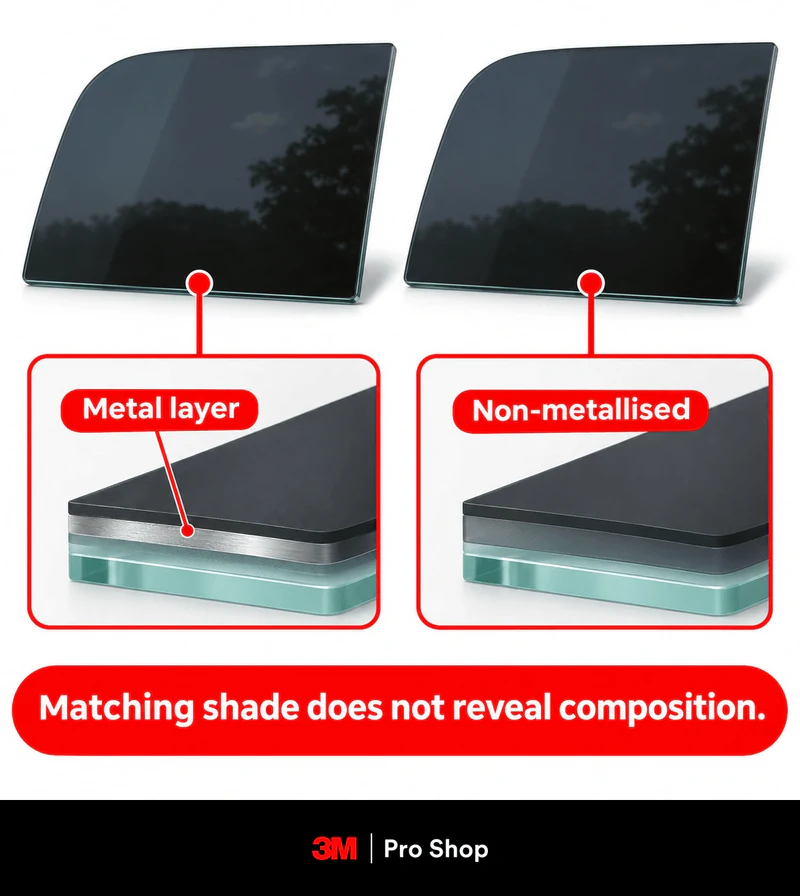
Ask for the actual product name rather than accept descriptions such as “premium black”, “HD” or “high heat rejection”. The manufacturer’s sheet should correspond to the series and shade being offered. If the paperwork names only a shop package, ask which film that package includes on each window.
This is especially useful on a previously owned car. The seller may remember the installer but not the product, or different panes may have been treated at different times. Do not assume every window carries the same film simply because the colour looks similar. Existing records are more useful than trying to identify a construction by eye.
What non-metallised means for current 3M films
3M Crystalline Black, identified as CR BLK, uses non-metallised multilayer optical film with ceramic nanotechnology. It is not a sputtered-metal range. Its layered construction is a different way of controlling sunlight, so high heat rejection should not be taken as evidence of a metal coating.
3M’s Crystalline Black product information states that the film does not interfere with mobile devices, GPS or satellite radio. That does not cover every remote, antenna or sensor a car might have. Those devices still need to be checked against their own requirements.
3M describes Ceramic IR as a metal-free nano-ceramic film. XP is also a current nano-ceramic offering. These names identify particular product ranges. They do not make every film carrying “ceramic” on a quotation equivalent to the same 3M product.
When comparing Crystalline Black with Ceramic IR, check the specifications for the shade you would fit. Their construction differs, but the replacement still needs to give you a suitable view through the glass and meet your car’s equipment requirements.
Signals, cameras and displays need different checks
Key-fob and autogate reception problems need their own checks. A remote that works only at close range is not the same complaint as a phone losing mobile data. A successful GPS check does not show that a separate remote system is working normally.
A camera used by an advanced driver-assistance system, or ADAS, needs a suitable view through the windscreen. It does not work like a radio receiver. A head-up display, or HUD, projects information into the driver’s view and has its own windscreen requirements. Neither is covered by a general statement about radio reception.
Driver-assistance cameras, head-up displays and window tint need to be assessed together against the vehicle manufacturer’s fitting requirements. A camera needs a suitable view, while a receiver needs a suitable radio signal. Do not cover or modify camera or sensor areas just because a film is described as signal-friendly.
Likewise, avoid making your own cut-outs in a fitted film to see whether reception improves. A device-specific installation requirement should be checked properly. Cutting, scraping or attaching equipment to the film can damage it and still fail to answer whether it caused the original problem.
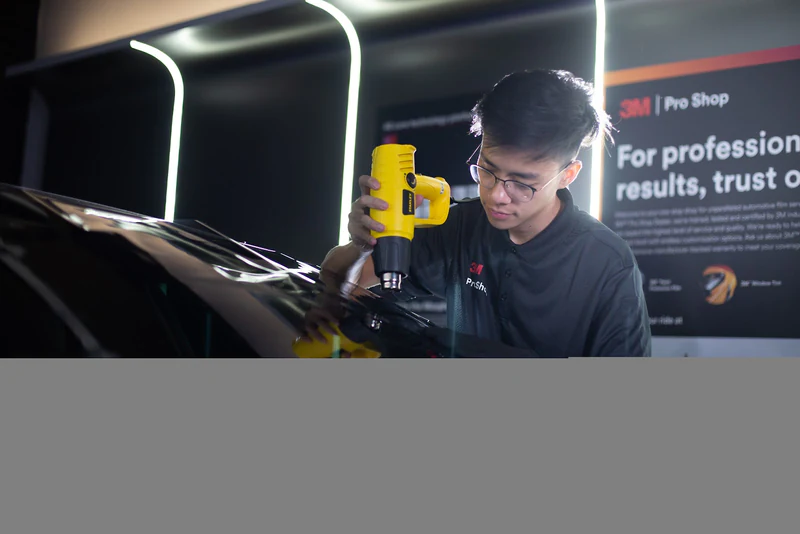
A non-metallised replacement still needs correct fitting and the right assessment for the car. It cannot repair a faulty antenna, a loose connection or an unrelated device problem. If an installer recommends a different film, ask which evidence points to the existing film and what the proposed replacement changes. That keeps the recommendation tied to the complaint instead of turning every reception concern into an automatic upgrade.
Keep a useful before-and-after record
If you are choosing new film and the equipment currently works normally, say so during the handover. Identify any existing reception complaint separately. A clear starting description helps both sides avoid arguing later about whether a symptom was present before the installation.
You do not need a signal score to describe the problem, and checks should never involve operating equipment while driving. Record the affected function in plain words and let the installer decide whether a device specialist is needed. Where a comparison is appropriate, the conditions need to be sufficiently similar for the observation to be useful.
For example, comparing a parked car in an open area with a later reading deep inside a covered carpark changes the surroundings as well as the installation. A different result in those circumstances does not isolate the film as the cause. Ask what has been held consistent before treating a demonstration as proof.
| Before-and-after detail | Why it matters |
| Same device and installation | A changed device would introduce another possible cause |
| Similar location and conditions | Open ground and a covered carpark are not equivalent |
| Same function being checked | A phone call and a GPS position are different observations |
Heat figures cannot answer the signal question
Brochures usually list visible light, UV and solar heat figures. Visible light transmittance, or VLT, tells you how much visible light passes through the tested glass and film. Total solar energy rejection, or TSER, tells you what percentage of the sun’s energy they reject under the stated test conditions. Neither figure measures radio reception.
Infrared rejection, or IRR, is another separate measurement. A high IRR figure does not tell you whether a film contains metal, and it does not prove that GPS or mobile reception will be affected. Non-metallised films can also reject infrared energy. Treating a large heat-related percentage as evidence of signal blocking mixes up two different questions.
This matters when comparing a shop demonstration with what happens in your car. Feeling less warmth behind a sample can help you understand the sample being shown. It does not establish how your navigation receiver will behave after installation. The lamp setup and the reception check answer different questions.
A film’s TSER and IRR figures describe heat-related properties, not radio reception. The manufacturer’s construction and compatibility information is needed for the signal question.
Check the cause before replacing tint
Removal makes sense when there is a supported reason to change the film, not just because somebody has used the word metallic. If the product is known, the manufacturer’s information identifies a relevant compatibility concern and the device check supports that concern, you can discuss a suitable replacement with much more confidence.
If the product is unknown, start with identification and a careful inspection. Ask the installer what can be established and what remains uncertain. You do not need a blanket promise that “everything will work”. You need an explanation tied to your film, your equipment and the problem you actually experience.
A replacement needs to suit your view at night as well as your equipment. Before approving it, you can ask the installer to assess the proposed shade and the equipment requirements together, rather than choose by the material label alone.
At 3M Pro Shop by P10X, the next step is to discuss the exact film and the affected equipment before choosing from the current 3M window-tint options. If another technician needs to inspect the device first, that is a better next step than guessing and replacing usable tint.
Find out the best protection for your car
Visit a 3M Pro Shop and discover the cost-effective 3M Protective Film and Window Tint
Frequently Asked Questions
Does every metallic tint cause signal problems?
No. Metallic film can affect some signals, but the outcome varies with the film, equipment, antenna position and conditions. Identify the affected system rather than assume the whole car will lose reception.
Can dark tint be non-metallic?
Yes. Darkness and metal content describe different things. Check the manufacturer’s construction information instead of using the shade to identify the film.
Can I identify metallic tint by looking?
Not reliably. Reflections and colour can be misleading. The manufacturer, series and supporting product information are better evidence than appearance alone.
Does non-metallised mean every device will work?
No. A supported claim for mobile, GPS or satellite-radio compatibility is not a guarantee for every device or installation. Check other equipment against its own requirements.
Is GPS interference an ADAS camera problem?
No. GPS involves receiving satellite radio signals. An advanced driver-assistance system (ADAS) camera needs a suitable view through the glass. Treat them as separate compatibility checks.
Should I replace tint when reception weakens?
Not automatically. Record the symptom, identify the film and arrange a proper check of the device and its installation. Replace the film when the evidence supports doing so.